

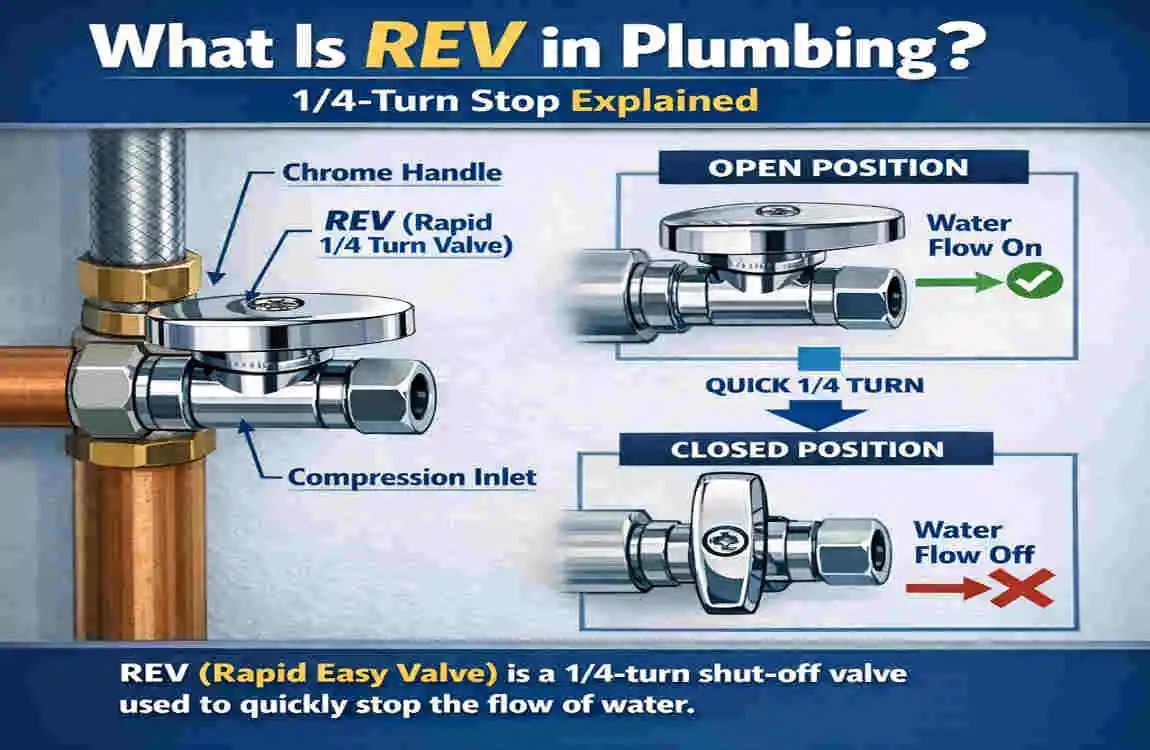
If you are looking at a valve label and wondering what REV means in plumbing terms, you are not alone. Plumbing labels can be confusing, especially when they use short codes or manufacturer-specific terms.
In many cases, REV points to a reverse or reversed configuration, but the exact meaning can vary by brand or product line. That is why it is always smart to check the product description, packaging, or valve documentation before buying or installing anything.
A 1/4-turn stop valve is a common fixture shutoff valve used to quickly control water. Instead of turning the handle several times like an older-style stop valve, you only turn it about 90 degrees to open or close the water flow.
What Is REV in Plumbing Terms?
Understanding the Term REV
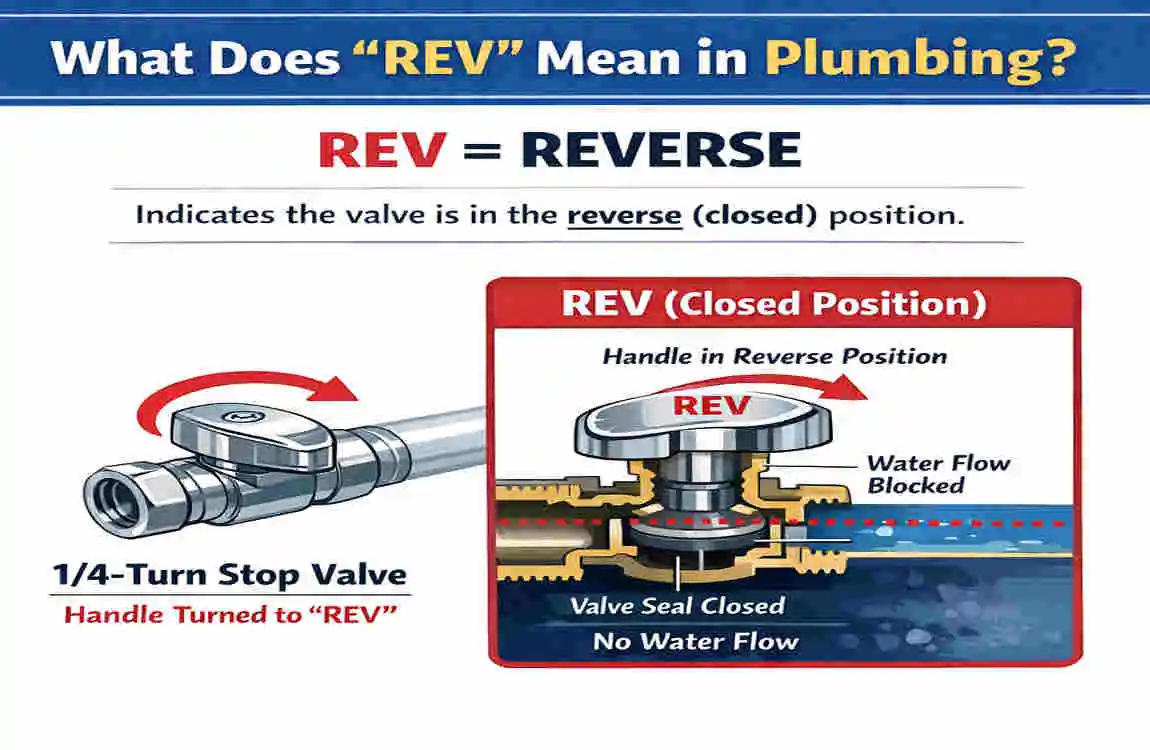
In plumbing, REV is not always a universal term with one fixed meaning. That is the first thing to understand.
Depending on the manufacturer, REV may refer to:
- A reverse configuration
- A reversed inlet or outlet arrangement
- A product variation or version code
So if you see REV on a valve or product listing, don’t assume it means the same thing every time. The exact meaning depends on the brand and how the product is made.
REV and the 1/4-Turn Stop
When people ask what a 1/4-turn stop is in plumbing terms, they are often looking at a stop valve used under a sink, toilet, or appliance.
A 1/4-turn stop valve is a shutoff valve that uses a simple lever handle. Turn it one way, and water flows. Turn it the other way, and the water stops.
The “1/4-turn” part means the handle usually moves about 90 degrees from open to closed.
Why This Valve Matters
This type of valve is important because it gives you quick control over water at one fixture.
If a faucet starts leaking or a toilet needs repair, you do not need to shut off water to the whole house. You can usually close just the valve for that fixture.
That saves time, reduces stress, and can help prevent water damage.
REV vs Standard Stop Valve Language
Sometimes older plumbing parts use different terms than newer ones. A label may use shorthand that only makes sense to a plumber or a product supplier.
That is why you should always check:
- The valve body
- The handle direction
- The connection type
- The product label or documentation
How Does a 1/4-Turn Stop Valve Work?
A 1/4-turn stop valve is simple to use, but its internal design makes it effective.
Ball Valve Mechanism
Most 1/4-turn stops use a ball-style mechanism.
Inside the valve is a small ball with a passage through it. When the passage lines up with the pipe, water flows. When the ball turns and the passage moves sideways, water stops.
This is why only a short turn is needed. The internal design does most of the work.
Open and Closed Positions
The handle position usually gives you a quick visual clue.
In many cases:
- Handle parallel to the pipe = open
- Handle perpendicular to the pipe = closed
This simple rule helps you tell at a glance whether water should be flowing.
But do keep in mind that installation can vary, so it is always wise to test carefully if you are unsure.
Why Quarter-Turn Valves Are Popular
These valves are widely used because they are easy to operate.
They are popular for a few reasons:
- Quick shutoff
- Easy to see
- Less turning than older valves
- Useful in emergencies
- Simple for homeowners to understand
If you have ever struggled with an old valve that took many turns to close, you can see why many homes prefer quarter-turn stops today.
Where Are 1/4-Turn Stops Used in a Home?
A 1/4-turn stop valve is usually placed near a single plumbing fixture. That makes it a local shutoff point.
Common Home Uses
You will often find them at:
- Bathroom sinks
- Kitchen sinks
- Toilets
- Laundry connections
- Dishwasher supply lines
- Other individual fixture supply lines
These are the places where a quick shutoff is most useful.
Why Fixture Shutoffs Matter
A fixture shutoff valve lets you isolate one area without turning off the water to the whole house.
That is helpful when:
- A faucet leaks
- A toilet is running
- A supply line needs replacement
- An appliance must be serviced
This small valve can make a big difference when you need repairs.
Real-World Example
Imagine your bathroom faucet starts dripping badly.
If the stop valve under the sink works properly, you can shut off only that faucet. The rest of the home still has water.
That is exactly why these valves are so useful.
REV vs Traditional Multi-Turn Stop Valves
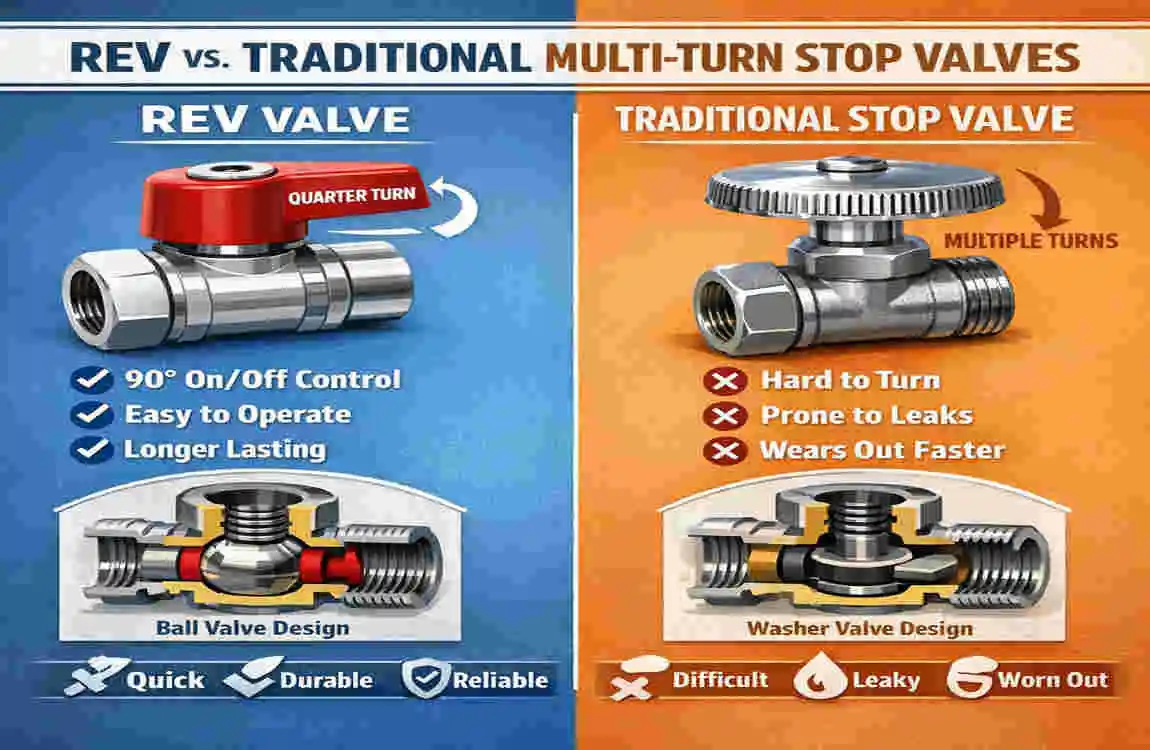
Many homeowners still have older multi-turn stop valves. These work differently from quarter-turn stops.
Main Differences
Feature1/4-Turn StopMulti-Turn Stop
Handle movement About 90° Several turns
Operation Quick Slower
Common mechanism Ball-style Compression-style
Ease of use Simple Requires more turning
Visual position Easy to identify Less obvious
Maintenance Usually straightforward May develop packing/stem issues
Why Homeowners Like 1/4-Turn Stops
Homeowners often prefer quarter-turn valves because they are easy to use, especially in a hurry.
They are also easier to see in the open or closed position. That matters when you are trying to stop a leak fast.
Traditional Multi-Turn Valves
Older multi-turn valves usually need several turns of the handle to open or close.
They can still work well, but they may be more annoying to operate. Over time, they can also develop issues around the stem or packing.
That is one reason many homeowners upgrade to quarter-turn stops during repairs or remodels.
Which Is Better?
For many modern homes, a 1/4-turn stop is more convenient. It is quick, simple, and easy to identify.
Still, the best valve depends on:
- The fixture
- The plumbing setup
- The connection type
- Available space
- What your plumber recommends
How to Identify, Operate, and Replace a 1/4-Turn Stop
If you want to work with one of these valves, it helps to recognise it first.
How to Identify One
Look for these signs:
- A small lever-style handle
- A valve mounted on the fixture supply line
- A handle that turns about 90 degrees
- A compact valve body near a sink, toilet, or appliance
If the handle only needs a quarter turn to shut off the water, you are likely looking at a quarter-turn stop valve.
How to Operate It Safely
Operating the valve is usually simple, but do it carefully.
A few good habits:
- Turn the handle gently
- Do not force a stuck valve
- Move it only as far as it is designed to go
- Check for leaks after turning it
If the valve feels stiff or does not move normally, stop and inspect it more closely.
Basic Replacement Considerations
If a stop valve is worn out, replacement may be the best option.
A basic replacement usually involves:
- Shutting off the water supply
- Relieving pressure in the line
- Removing the old valve
- Installing the new one correctly
- Turning water back on slowly
- Checking for leaks
The exact process depends on the connection type, such as compression, push-fit, or threaded fittings.
Safety Note
If the valve is corroded, seized, damaged, or hard to remove, it is often safer to call a licensed plumber.
That is especially true if the pipe or fitting looks old or fragile.
Common Problems With 1/4-Turn Stop Valves
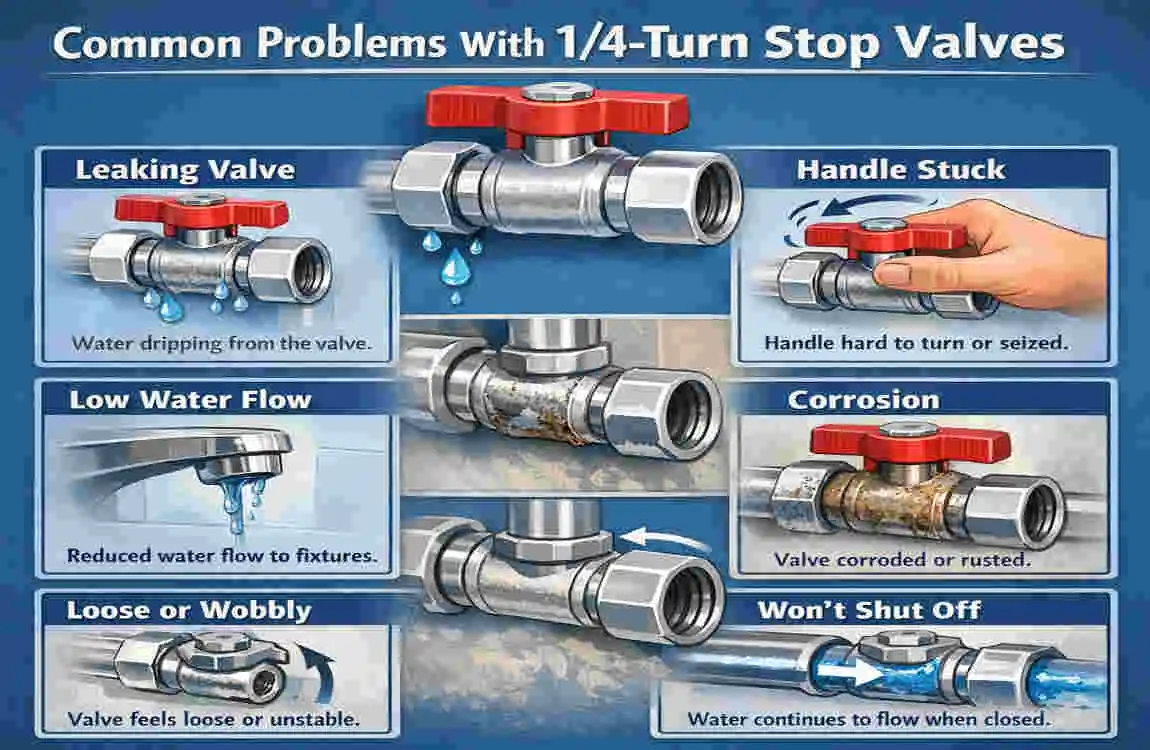
Even simple valves can have problems over time. The good news is that many of them are easy to spot.
Leaking Around the Handle
If you see moisture near the handle, the valve may have worn internal seals or a damaged stem area.
This can start as a small drip and get worse over time.
Dripping From the Connection
A leak where the valve attaches to the pipe may mean the fitting is loose, worn, or not installed correctly.
Don’t ignore this kind of leak.
Valve Not Fully Shutting Off Water
Sometimes the handle turns, but water still flows a little. That may mean the internal ball or seals are worn.
If the valve cannot fully stop the water, replacement is usually the best answer.
Stiff or Difficult Handle
A handle that is hard to move may be stuck from mineral buildup, corrosion, or age.
Never force it hard, because that can break the valve or damage the pipe.
Corrosion and Wear
Visible rust, green buildup, or mineral deposits are warning signs.
If a valve looks badly corroded, it may be time to replace it before it fails.
Incorrect Installation
If the valve was installed incorrectly or the wrong type was used, it may not work as expected.
That is another reason to check the exact product details before replacing it.
When Should You Replace a 1/4-Turn Stop?
Replacement is usually the better choice when:
- It leaks
- It does not shut off fully
- It feels stuck or unsafe
- It is badly corroded
- It has visible damage
- It is old and unreliable
If you keep repairing the same valve, replacing it is often more practical.
FAQ: What Is REV in Plumbing Terms 1/4-Turn Stop?
Is REV the same thing as a 1/4-turn stop?
Not always. REV can mean different things depending on the manufacturer or product context. The safest approach is to check the valve label or documentation.
What does 1/4-turn mean on a plumbing valve?
It means the handle usually turns about 90 degrees from open to closed.
Are 1/4-turn stops better than multi-turn valves?
Many homeowners prefer them because they are faster and easier to use. But the best choice depends on the fixture and plumbing setup.
How do I know if my 1/4-turn stop is open?
In many cases, the handle is parallel to the pipe when open and perpendicular when closed. Still, always confirm by observing water flow and the valve’s orientation.
Can I replace a multi-turn stop with a 1/4-turn stop?
Often yes, but it depends on the connection type, pipe size, and available space. A plumber can help if the setup is tricky.
How long do 1/4-turn stop valves last?
Their lifespan depends on quality, water conditions, installation, and usage. Some last many years, while others wear out sooner.
Should I repair or replace a leaking stop valve?
If the valve is old, corroded, or not sealing properly, replacement is often the better long-term solution.
Can I install a 1/4-turn stop myself?
Experienced DIYers may be able to handle a simple replacement, but damaged or corroded valves are best left to a professional.
| Term | Simple Explanation |
|---|---|
| REV | Often refers to a reversible or model-specific plumbing valve marking; check the manufacturer’s label for the exact meaning. |
| 1/4-Turn Stop | A shutoff valve that opens or closes with a 90-degree turn. |
| Main Purpose | Controls water flow to a faucet, toilet, or fixture. |
| Open Position | The handle is generally parallel with the water line. |
| Closed Position | The handle is generally perpendicular to the water line. |
| Key Benefit | Quick, easy operation and reliable water shutoff. |
| Common Locations | Under sinks, behind toilets, and near other plumbing fixtures. |
