

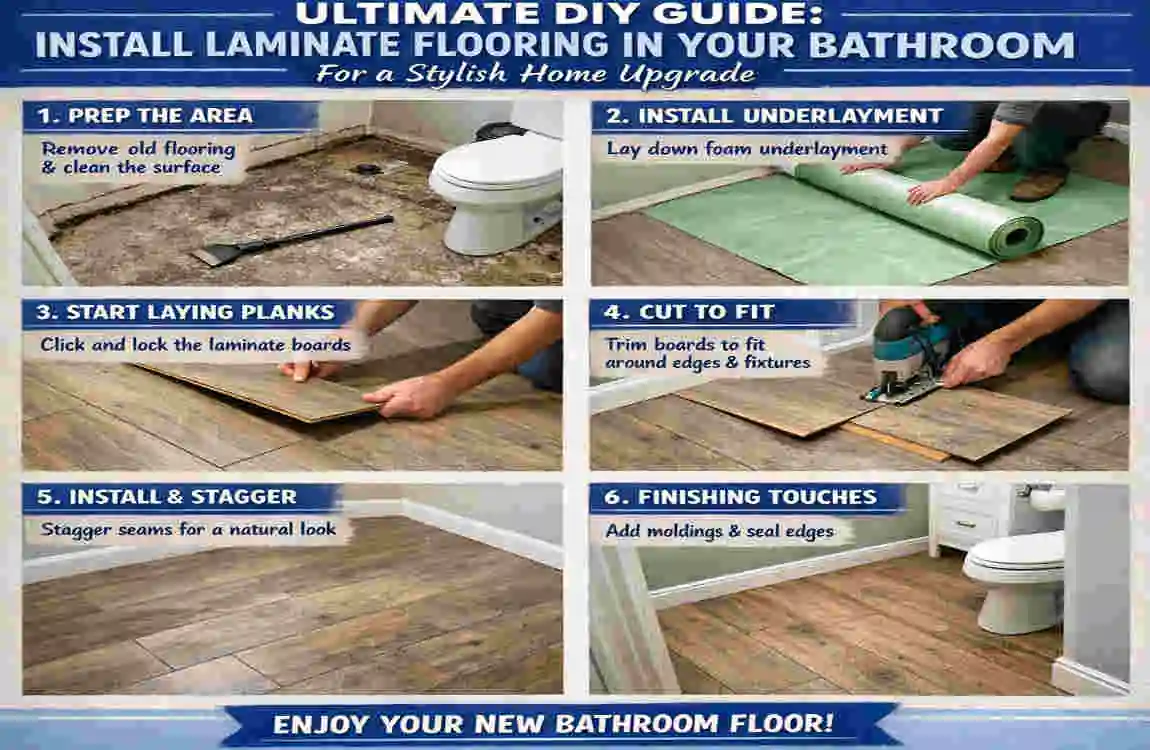
Did you know that 70% of homeowners prefer laminate over tile for its warmth and ease of installation? When it comes to bathroom renovations, laminate flooring has become an increasingly popular choice for homeowners looking to balance style, comfort, and affordability. The key to success lies in choosing a water-resistant laminate that can withstand the bathroom’s moisture-prone environment.
Modern waterproof laminate flooring can protect against moisture exposure for 24-72 hours, making it a viable option for bathroom spaces when installed correctly. Unlike traditional laminate, these specialized products are engineered with moisture-resistant cores that prevent warping and swelling.
| Step | Action | Key Tips |
|---|---|---|
| Prepare | Remove old flooring, clean/level subfloor (max 3/16″ variation/10ft), acclimate planks 48hrs. | Add 10% extra planks for waste; ensure room is dry. |
| Underlayment | Roll out moisture-barrier underlay, overlap seams 4″, tape down. | Trim around fixtures; vital for bathrooms. |
| First Row | Start opposite door; use 8-10mm spacers at walls, cut first plank to fit groove-out. | Check level; stagger seams 12″+ in next rows. |
| Main Rows | Angle/click planks, tap with block/hammer; cut around toilet/drain with jigsaw. | Dry-fit obstacles; maintain expansion gaps. |
| Final Row | Rip planks to fit, remove spacers; seal edges with silicone caulk + backer rod. | Caulk voids warranty; add transitions/baseboards. |
Why Choose Laminate for Bathroom Floors?

Laminate flooring has become a go-to choice for bathroom renovations, and for good reason. Let’s explore why it’s such a popular option and what you should consider before investing.
The Advantages of Laminate Flooring
Affordability is one of the biggest draws of laminate flooring. At just $3-7 per square foot, it’s significantly cheaper than tile, hardwood, or natural stone. This makes it an excellent option for homeowners working with a tight budget.
Beyond cost, laminate offers realistic aesthetics. Modern laminate planks come in designs that convincingly mimic wood, stone, and marble. You get the look of luxury materials without the luxury price tag.
Another major benefit is comfort underfoot. Unlike cold tile, laminate provides a warmer, softer surface that’s pleasant to walk on, especially in the morning. This makes it particularly appealing for bathrooms where you’re often barefoot.
Installation ease is another significant advantage. Laminate uses a floating installation method with click-lock systems, meaning no glue or nails are required. This makes it perfect for DIY projects and can typically be completed in 1-2 days.
Addressing Moisture Concerns
The primary concern with laminate in bathrooms is moisture exposure. Traditional laminate can swell and warp when exposed to excess water. However, modern waterproof laminate options have solved this problem.
When shopping for bathroom laminate, look for 100% waterproof cores, such as Aqua CLIC systems. These products have sealed edges and moisture-resistant layers that protect against water damage. The key is choosing a laminate with an AC4+ rating, which indicates superior water resistance.
Laminate vs. Other Bathroom Flooring Options
Flooring Type Cost/sq ft Warmth Installation Time Moisture Resistance
Laminate $3-7 Excellent 1-2 days High (waterproof)
Tile $5-15 Poor 3-5 days Excellent
Vinyl $2-6 Good 1-2 days Excellent
Hardwood $8-20 Excellent 2-3 days Poor
Home Value Impact
Installing laminate flooring in your bathroom can boost your home’s resale value by 5-10%. Potential buyers appreciate the modern aesthetics and the practical functionality that laminate provides. It signals that the home has been well-maintained and updated.
Tools and Materials Checklist
Before you begin your laminate flooring installation, gather all the necessary tools and materials. Having everything ready will make the process smoother and more efficient.
Essential Materials
- Waterproof Laminate Planks: Choose planks with an AC4+ rating for bathroom use.
- Underlayment: A moisture barrier is crucial for bathroom installations.
- Backer Rod: Foam rod for sealing gaps and preventing moisture infiltration.
- Silicone Caulk: 100% silicone for sealing edges and joints.
- Transition Strips: For doorways and transitions to other rooms.
Tools You’ll Need
- Circular Saw or Laminate Cutter: For cutting planks lengthwise.
- Jigsaw: For cutting around obstacles like toilets and drains.
- Tapping Block: A wooden block used with a hammer to tap planks into place.
- Spacers: To maintain consistent expansion gaps (typically 1/4-3/8 inch).
- Level: To ensure your floor is even.
- Measuring Tape: For accurate measurements.
- Hammer: For tapping and fastening.
- Safety Gear: Gloves, safety glasses, and a dust mask.
Budget Breakdown Table
ItemCost RangeNotes
Waterproof Laminate $2-5/sq ft AC4+ rating essential
Underlayment $0.50-1/sq ft Moisture barrier
Silicone Caulk $5-10 100% silicone recommended
Transition Strips $20-50 , depending on doorway width
Tools (if purchasing) $100-300. Many can be rented
Preparation Steps
Proper preparation is the foundation of a successful laminate installation. Rushing this phase can lead to problems down the road, so take your time to get it right.
Measuring and Planning
Start by measuring your bathroom carefully. Measure the length and width in multiple spots, as bathrooms are rarely perfectly square. Calculate the total square footage, then add 10% for waste from cuts and potential mistakes.
Removing Old Flooring
If your bathroom currently has flooring, you’ll need to remove it. For tile, use a grout saw or hammer and chisel to break up the grout, then carefully pry up the tiles. For sheet vinyl, cut it into manageable strips and peel it away.
Remove the toilet base by turning off the water supply, flushing, and unbolting the toilet from the flange. You’ll reinstall it after laying the laminate.
Subfloor Assessment
The subfloor must be level, clean, and dry. Use a level to check for high and low spots. The floor should not vary more than 3/16 inch over 10 feet.
If you find bumps, grind them down with a floor grinder. If there are low spots, use a self-leveling compound to fill them in. Allow the compound to dry completely before proceeding.
Clean the subfloor thoroughly, removing all dust, debris, and old adhesive. A clean surface ensures better adhesion of the underlayment.
Acclimating the Laminate
This step is often overlooked but is crucial for a successful installation. Leave your laminate planks in the bathroom for 48 hours before installation. This allows the planks to adjust to the room’s temperature and humidity, preventing expansion or contraction after installation.
Planning Doorways and Transitions
Before you start laying planks, plan how you’ll handle doorways and transitions to other rooms. Measure the doorway width and plan your plank layout so the last row doesn’t end up too narrow (less than 2 inches).
Step-by-Step Installation Guide
Now that you’re fully prepared, let’s walk through the installation process. Follow these steps carefully for professional results.
Lay the Underlayment
Roll out your moisture-proof underlayment across the entire bathroom floor. This barrier is essential for protecting your laminate from moisture damage.
Overlap seams by 4 inches and tape them securely with duct tape or underlayment tape. This overlap prevents moisture from seeping through gaps. Trim the underlayment around fixtures, such as the toilet flange and vanity base, with a utility knife.
Make sure the underlayment is smooth and wrinkle-free, as lumps can cause the laminate to flex and create noise underfoot.
Install the First Row
Start laying your first row of planks opposite the doorway. This ensures a straight line of sight when entering the bathroom.
Insert spacers (1/4-3/8 inch thick) between the planks and the wall. These spacers create an expansion gap that allows the laminate to expand and contract with changes in temperature and humidity. This gap is critical—without it, the planks may buckle.
Cut the first plank, if necessary, to fit snugly against the starting wall. The plank should be cut lengthwise using a circular saw or laminate cutter.
Stagger and Connect Planks
As you move to the second row, stagger the plank ends by at least 12 inches. This creates a more natural look and provides better structural stability.
Use the click-lock system to connect planks. Angle the new plank at 45 degrees and slide it into the groove of the previous plank, then press down firmly. Use a tapping block and hammer to ensure tight seams. Tap gently along the length of the plank to create a secure connection.
For planks that need to be cut lengthwise, use a circular saw or laminate cutter. For cuts around obstacles, use a jigsaw to carefully cut notches that fit around toilet flanges or drain pipes.
Handle Obstacles Like Toilets
Working around the toilet is one of the trickier parts of installing bathroom laminate. Dry-fit the planks around the toilet flange first to determine exactly where cuts are needed.
Use a jigsaw to cut a notch in the plank that fits around the toilet flange. The notch should be slightly larger than the flange to allow for easy installation. After the plank is installed, seal the gap with 100% silicone caulk to prevent water from seeping underneath.
Final Row and Finishing
As you reach the final row, measure the remaining space and rip the planks lengthwise to fit. Use a circular saw for this cut, ensuring the planks are the correct width.
Remove all spacers after installing the final row. The expansion gap is now complete around the perimeter of the room.
Seal all edges with 100% silicone caulk and backer rod. Apply the backer rod first into gaps wider than 1/4 inch, then caulk over it. This creates a waterproof seal that prevents moisture from seeping into the gaps. Note that many manufacturers require this sealing to maintain warranty coverage.
Add Baseboards and Transitions
Install quarter-round molding or baseboards around the perimeter of the room to cover the expansion gap and provide a finished look. Choose a style that matches your home’s existing trim.
At doorways, install transition strips to create a smooth transition between the bathroom laminate and flooring in adjacent rooms. These strips are typically glued or nailed in place.
Common Mistakes and How to Avoid Them
Even experienced DIYers can run into problems during laminate installation. Here are the most common mistakes and how to prevent them.
Poor Subfloor Preparation
One of the biggest mistakes is failing to prepare the subfloor properly. Bumps and uneven areas will cause the laminate to flex, creating noise and potentially damaging the planks.
Solution: Take time to assess and level your subfloor thoroughly. Use a floor grinder for bumps and self-leveling compound for low spots.
Loose Seams
If planks aren’t properly clicked together, seams can separate over time, allowing moisture to seep through.
Solution: Use a tapping block and a hammer to tap planks into place firmly. Take your time with this step—rushing leads to loose connections.
Inadequate Sealing
Failing to caulk edges and gaps is a common mistake that can lead to water damage and warping.
Solution: Seal all edges with 100% silicone caulk and backer rod. This is not optional if you want your floor to last.
Ignoring Expansion Gaps
Without proper expansion gaps, laminate planks can buckle as they expand and contract.
Solution: Always use spacers to maintain consistent 1/4-3/8 inch gaps around the perimeter. Remove spacers only after the final row is installed.
Poor Ventilation
Installing laminate without allowing the room to dry properly can trap moisture underneath.
Solution: After installation, ventilate the bathroom well for at least 24 hours. Open windows and run exhaust fans to allow moisture to escape.
Maintenance for Long-Term Durability
Proper maintenance will extend the life of your laminate flooring and keep it looking beautiful for years to come.
Regular Cleaning
Sweep or vacuum regularly to remove dirt and debris that can scratch the surface. Use a pH-neutral laminate cleaner with a damp mop (not wet). Avoid excess water, as standing water can damage the laminate.
Preventing Water Damage
While your laminate is waterproof, it’s not water-proof indefinitely. Wipe up spills immediately to prevent water from seeping into seams and gaps.
Re-caulk seams annually to maintain the waterproof seal. Over time, caulk can crack or shrink, compromising the moisture barrier.
Expected Lifespan
With proper care and maintenance, waterproof laminate flooring in bathrooms can last 15-25 years. This is comparable to other bathroom flooring options and represents excellent value for the money.
Cost Breakdown and ROI

Understanding the financial aspects of your project helps with budgeting and decision-making.
Installation Cost Table
Bathroom Size Material Cost Labor (DIY)Total Cost
50 sq ft $200-350 $0 $200-350
75 sq ft $300-525 $0 $300-525
100 sq ft $400-700 $0 $400-700
Return on Investment
Installing laminate flooring in your bathroom can recoup 70-90% of your investment when you sell your home. Potential buyers appreciate updated bathrooms with modern, durable flooring.
Beyond resale value, you’ll enjoy the benefits immediately—a beautiful, functional bathroom that’s easy to maintain and comfortable to use.
FAQ
Can all laminates be used in bathrooms?
No, only waterproof laminate with AC4+ ratings should be used in bathrooms. Standard laminate will warp and swell when exposed to moisture.
How long does it take to install laminate flooring in a bathroom?
For a typical bathroom (50-100 sq ft), installation takes 4-8 hours for a DIYer. Professional installers may complete it faster.
Can laminate be installed over concrete?
Yes, laminate can be installed over concrete. Still, you must use a vapor barrier to prevent moisture from rising from the concrete.
What should I do if the laminate gets wet?
If water spills on your laminate, wipe it up immediately. If water seeps under the planks, you may need to remove and replace affected planks.
Do I need to remove the toilet?
Yes, it’s best to remove the toilet to ensure proper installation around the flange. You can reinstall it after the flooring is complete.
