

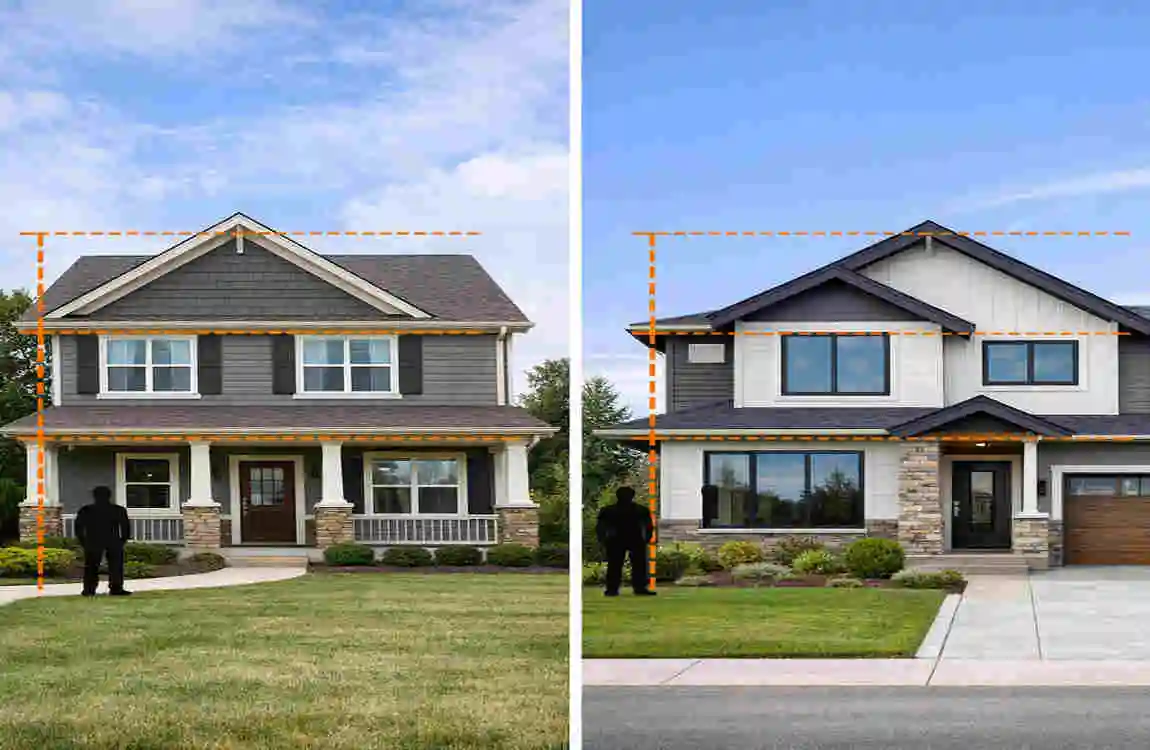
If you are planning to build, buy, or remodel, knowing the vertical scale of your property is essential. On average, two-story houses typically range from 20 to 30 feet in total exterior height. However, that simple number barely scratches the surface. The final height of a home depends on a wide range of design factors, including ceiling heights, roof pitch, and the type of foundation.
Understanding the average house height helps you navigate strict neighborhood zoning laws, plan your landscaping effectively, and even budget for heating and cooling. You do not need to be a master architect to grasp these concepts.
Standard Heights Explained: Breaking Down the Average House Height
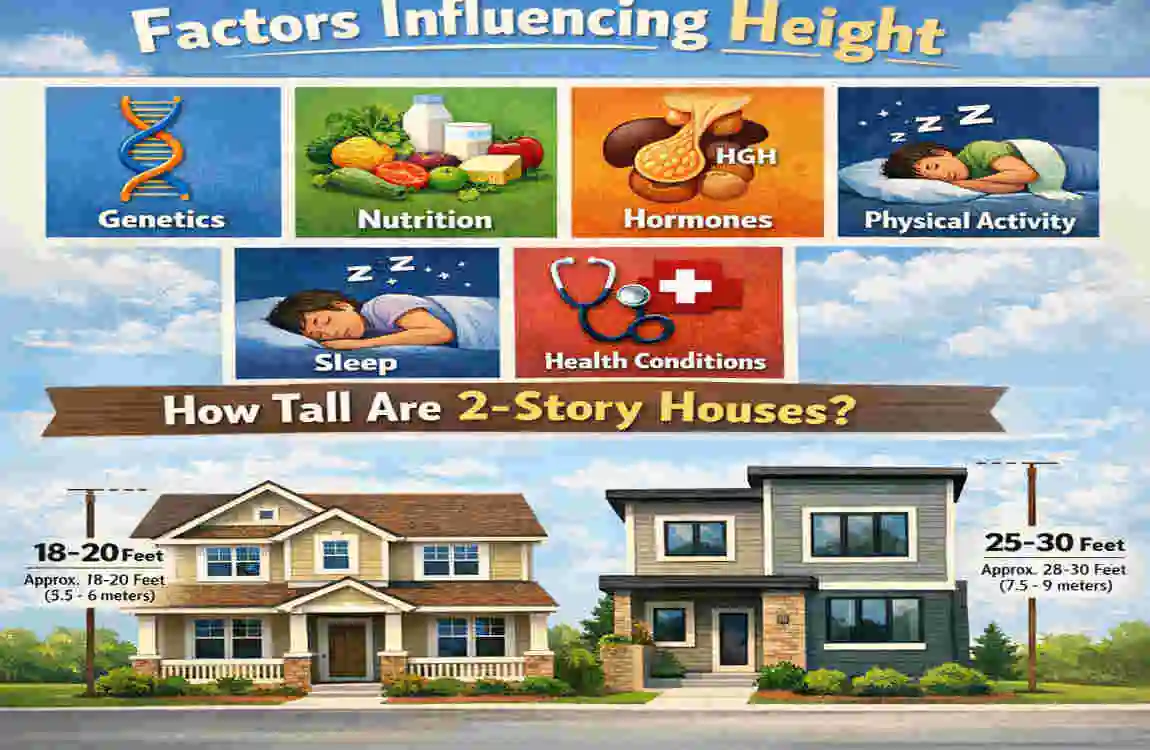
When you ask, “How tall are 2-story houses?” the answer requires us to look at the anatomy of a building. A house is basically a layered cake. To determine the total height, you have to account for the thickness of each layer.
Let’s start by defining some basic terms, so you know exactly what your builder or real estate agent is talking about.
What Exactly Is a “Story” in Home Building?
In the world of architecture and construction, a “story” refers to a single level of a building where people can live. But a story is not just the empty air between the floor and the ceiling.
When builders calculate story height standards, they include everything that makes that floor structurally sound. This means they count the ceiling joists (the wooden beams supporting the ceiling), the thickness of the flooring materials, and the space hidden between floors where plumbing and electrical wires live.
Because of these hidden structural elements, a standard single-story house usually takes up about 10 to 12 feet of vertical space on the exterior, even if the ceilings inside are only 8 feet high.
Interior vs. Exterior Measurements
It is very important to separate the space you live in from the space the house takes up outside.
If you walk into a standard single-story home, the interior ceiling height is usually around 8 to 9 feet. However, when you step outside and measure that same single-story house from the grass to the highest point of the roof, the baseline exterior height is usually between 10 and 15 feet.
Now, let’s double that for a two-story home.
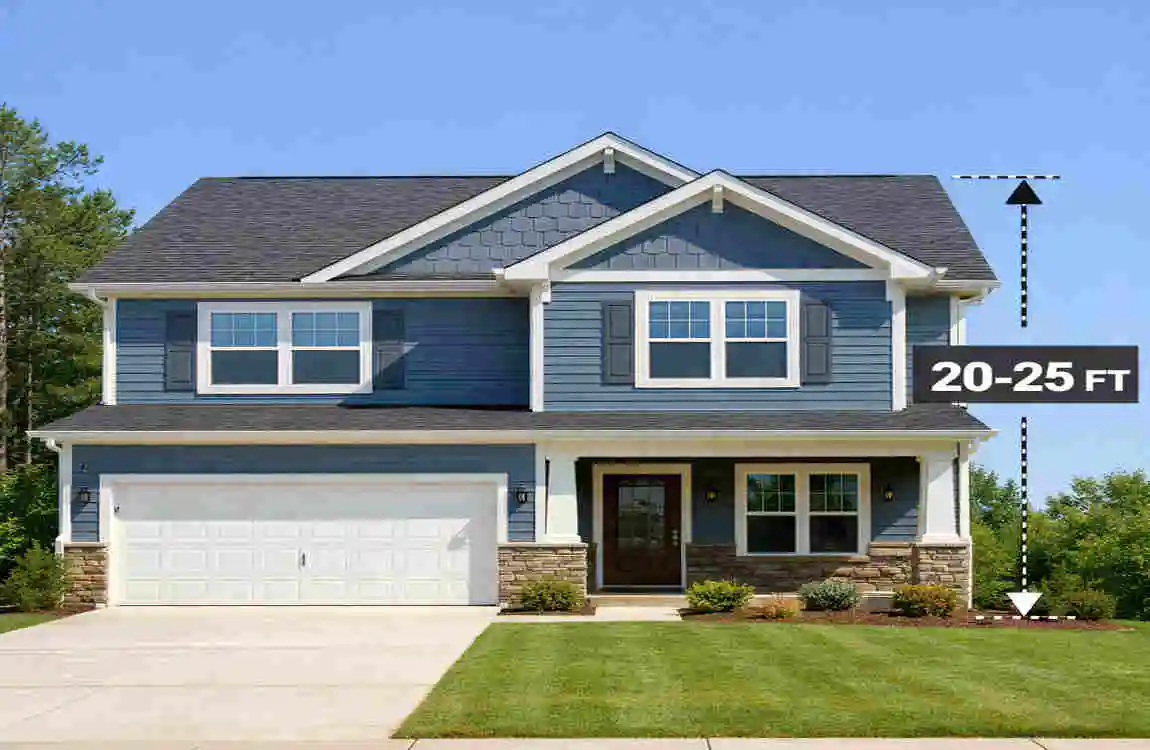
Inside a two-story home, you might have 9-foot ceilings on the first floor and 8-foot ceilings on the second floor. But outside, the two-story average measures roughly 20 to 25 feet to the eaves (the lower edges of the roof that hang over the walls) and about 25 to 30 feet to the very peak of the roof.
Visualizing the Dimensions
To make this easier to picture, let’s break down the layers of a standard two-story house. We will start from the dirt and work our way up to the clouds.
Component Average Height (Feet)Notes
Foundation 2-4 This includes a basic concrete slab or an elevated crawl space.
First Floor 8-10 This covers the ceiling height of your living room plus the thickness of the floor joists above it.
Second Floor 8-10 This covers the bedroom ceilings plus the attic floor framing.
Roof (Pitch) 4-8 The height of a standard Gable (peaked) or Hip (slanted on all sides) roof style.
Total Height 22-32: The final measurement from the ground level to the exterior roof peak.
Understanding Residential Building Dimensions and Codes
When you build a house in the United States, you cannot simply build as high as you want. You must follow the International Residential Code (IRC). These are the standard rules that keep buildings safe and uniform.
The IRC sets baseline story height standards to ensure stairs are safe, ceilings are not dangerously low, and homes can withstand strong winds. While custom-built homes can stretch these dimensions, they still must comply with the maximum height limits set by your specific city or county building codes.
Most local authorities cap residential home heights at about 35 feet. If your plans push past that, you will likely run into legal roadblocks!
Crucial Factors Influencing Two-Story Home Height
Now that we know the basic math, you might be wondering why some two-story houses look short and squat, while others look like towering mansions.
The truth is, calculating how tall 2-story houses are isn’t a one-size-fits-all equation. Several hidden design variables can drastically stretch or shrink the final profile of your home. Let’s explore the biggest factors that influence your home’s vertical footprint.
The Impact of Ceiling Heights
The most obvious factor changing your home’s height is the ceiling height. Gone are the days when every single house featured standard 8-foot ceilings.
Today, modern homeowners crave light, airy, and open spaces. It is incredibly common to see new builds featuring 9-foot or even 10-foot ceilings on the main floor. If you want a grand, dramatic entryway, you can opt for vaulted ceilings that soar 12 to 20 feet high.
Every extra foot you add to your interior ceiling automatically pushes the second floor—and the roof—higher into the sky. If you bump both the first and second-floor ceilings up by just two feet, you have just added four feet to the total exterior height of your house!
Roof Design and Pitch
The roof acts as the hat on top of your house, and just like hats, roofs come in all shapes and sizes. The “pitch” of your roof refers to how steeply it slants. Think of it like a skateboard ramp—some are almost flat, while others drop down drastically.
If you choose a low-pitch roof, it might only add 3 or 4 feet to your home’s total height. This is very common in modern or contemporary designs.
However, if you choose a steeply pitched roof—which is popular on Victorian, Craftsman, or Farmhouse styles—that roof alone can add 5 to 10 extra feet to the top of your house.
Foundation Types
What lies beneath your feet matters as much as what is above your head. The type of foundation you build sets the starting point for your height measurements.
- Slab Foundations: These sit directly flat on the ground. They add almost zero height to the overall structure.
- Crawl Spaces: These elevate the house a few feet off the dirt to protect against moisture and allow access to pipes. This immediately adds 2 to 3 feet to your exterior height.
- Basements: If you have a walk-out basement built on a sloped lot, an entire 8-foot floor might be visible from the back of the house, drastically changing the perceived height from the street!
Hidden Factors Affecting Your Home’s Height
Beyond ceilings, roofs, and foundations, here are five other critical elements that dictate the final scale of your home:
- Local Zoning Laws: Your city council usually dictates maximum height limits. They do this so giant houses do not block the sunlight or views of smaller, older neighboring houses.
- Energy Efficiency: Taller walls expose more square footage to the outside air. This requires thicker walls, more framing, and more insulation to keep your home warm in winter and cool in summer.
- Architectural Style: A classic American Colonial home might sit comfortably at 25 feet tall. Meanwhile, a super-modern, flat-roofed home might top out at 22 feet, and a steep-roofed Tudor style could push 32 feet.
- Material Choices: The materials you use to build your walls change the thickness of the floors between levels. Heavy materials like stone or brick require different framing techniques than lightweight vinyl siding, which can slightly alter the vertical math.
- HVAC and Ductwork: If you have thick heating and cooling ducts running between your first and second floors, builders must create a deeper “floor truss” system to hide them. This invisible layer can easily add another 12 to 18 inches to your home’s height.
(Visual Suggestion: Imagine a simple diagram showing a house split down the middle. One side shows an 8-foot ceiling, a flat roof, and a slab foundation. The other side shows a 10-foot ceiling, a steep roof, and a crawl space, visually demonstrating how the second house stands much taller.)
Regional and Global Variations in Story Height Standards
Building practices do not just change from neighborhood to neighborhood; they change drastically from state to state and country to country.
If you ask someone in sunny California, “How tall are 2-story houses?” you will get a very different answer than if you ask someone living in the snowy mountains of Vermont.
Let’s take a quick trip around the world to see how geography shapes the average house height.
How Geography Changes Height
The environment surrounding a house dictates how it must be built. Builders design homes to survive local weather conditions.
If you look at urban areas where land is very expensive, you will often find condo-style two-story homes. Because developers want to pack as many units as possible into a small space, these homes are often built shorter and tighter, sometimes ranging from just 18 to 22 feet tall.
Compare this to rural areas where land is cheap. Here, homeowners have the freedom to build sprawling, tall, majestic two-story homes with massive roofs that easily reach 30 feet.
The Snow Load Factor in the Northeast
If you live in the Northeast United States or anywhere that gets heavy winter weather, you must deal with something called “snow load.”
Imagine a thick, heavy, wet blanket of snow sitting on top of your house for three months straight. That snow is incredibly heavy. If your roof is flat, the weight could literally crush the house!
Because of this, homes in snowy regions are built with very steep roof pitches so that snow slides off easily. This steep pitch raises the house’s total height. While the US average is 25 feet, a two-story home in Maine or New York will commonly reach 28 to 32 feet tall simply because the roof design is needed to withstand winter conditions.
Global Perspectives: Europe and Beyond
When we step outside the United States, we see different building materials and different measurement systems taking the lead. Most of the world uses the metric system, so they measure the height of a two-story home in meters.
In Europe, land is scarce, and homes have been standing for centuries. The typical European two-story home is built primarily from brick and block rather than wood framing. This makes the homes incredibly sturdy but often slightly shorter.
Let’s look at a quick comparison table:
RegionAvg. Height (Feet)Key Influence on Height
US Average 25 Standard IRC codes and wood framing.
United Kingdom 26-30 Solid brick construction and older architectural traditions.
Australia 23-27 Warmer climates mean flatter roofs are more common.
Europe (Mainland) 23-29 (7-9 meters) Metric standardization and historic city zoning laws.
Why does this matter to you? Because if you find a beautiful home design online that originated in Australia, you cannot just hand those blueprints to a builder in snowy Colorado. Your builder will have to change the roof pitch to meet local weather codes, which will completely change the home’s total height and appearance! Always check your local regulations before falling in love with a foreign floor plan.
Practical Applications: Why Knowing How Tall 2 Story Houses Are Matters
At this point, you might be thinking, “This is all very interesting, but how does the height of a house actually affect my daily life?”
Understanding your home’s vertical dimensions is not just trivia for architects. Knowing the average house height has massive, real-world financial and practical applications for you as a homeowner.
Buying, Selling, and Curb Appeal
If you are putting your house on the market, height directly impacts “curb appeal”—that initial feeling a buyer gets when they pull into the driveway.
A taller home naturally commands attention. It feels grand, expensive, and imposing. Because buyers perceive taller homes as larger and more luxurious, they often appraise them for a higher value. Taller ceilings inside mean larger windows outside, which flood the home with natural light. If you are comparing two homes with the same square footage, the taller one will almost always feel like the Premium option.
Navigating Renovations and Additions
Are you feeling cramped in your current single-story home? Many growing families decide to “pop the top” and add a second story rather than moving.
This is where knowing story height standards becomes critical. If you plan to add a second story, you must ensure your existing first-floor walls and foundation are strong enough to support the extra weight.
Furthermore, you have to navigate the dreaded city permitting office. If your neighborhood limits homes to 28 feet, and your new addition pushes your home to 30 feet, the city will deny your permit. Knowing how to calculate height saves you from wasting thousands of dollars on architectural plans you cannot use.
Landscaping in Proportion
Have you ever seen a massive, beautiful two-story home hiding awkwardly behind overgrown, giant trees? Or conversely, a huge house with tiny, pathetic-looking shrubs that make the property look barren?
When you know the height of your home, you can choose plants and trees that scale perfectly with your exterior. If your house is 25 feet tall, planting an oak tree right next to the foundation is a terrible idea—it will eventually grow to 60 feet and dwarf your home, while its roots destroy your foundation.
Instead, use your luxury home‘s height to plan a tiered landscape. Plant low shrubs near the 2-foot foundation, medium ornamental trees that reach 10 feet to frame the first story, and place larger shade trees further back in the yard to complement the full 25-foot structure.
Steps to Measure Your Two-Story House
Do you want to figure out the height of your current home? You don’t need to climb a dangerous ladder with a floppy tape measure. Here are three simple steps you can take today:
- Use a Laser Rangefinder: Stand on your lawn, point a laser measuring tool at the highest eaves of your house, and let the technology do the math.
- Calculate the Roof Pitch: You can estimate the extra height of your roof by finding its slope. If your roof rises 6 inches for every 12 inches it goes back (a 6/12 pitch), you can do some basic geometry to estimate the peak. (Formula: Rise / Run x Length to the center).
- Consult Your Blueprints: The easiest and safest method! Dig out your original house plans or request them from your local city records office. The exterior elevations will show the exact height down to the inch.
Business Tip: Calculating roof pitch and dealing with zoning boards can give anyone a headache. If you are planning an addition or a custom build, contact our team of design experts! We provide comprehensive, custom height assessments to ensure your dream home is beautiful, safe, and perfectly legal.
Common Myths Debunked About Residential Building Dimensions
When people start researching home construction, they often stumble upon a lot of bad advice online. Let’s clear the air and bust some of the most common myths regarding residential building dimensions.
Every Two-Story House is Exactly 20 Feet Tall
Wrong. As we learned earlier, this completely ignores the roof! Even a home with perfectly standard 8-foot interior ceilings will have foundation blocks, floor joists, attic space, and a roof. When you factor in the “hat” of the house, practically no two-story home stops right at the 20-foot mark. Expect it to vary widely based on the architectural style.
Building Taller Doesn’t Change the Budget Much
The Reality: Many homeowners think that since the foundation and roof stay the same size, simply stretching the walls up a few feet won’t cost much.
This is a very expensive misconception. Increasing your home’s height drastically increases your budget. Adding 10% to your wall height can easily result in a 15% to 20% increase in material costs. You are paying for more lumber, more drywall, more exterior siding, longer plumbing pipes, longer electrical wires, and more insulation. Furthermore, taller walls require special scaffolding and heavy machinery, which increases labor costs.
Basements Automatically Count as a Full Story
According to the International Residential Code (IRC), a basement is not usually considered a “story” above grade if the majority of it is buried underground. Even if you have a finished basement with a family room and a bedroom, the city evaluates exterior height from the main ground level (grade). So, your two-story house with a basement is still legally and visually considered a two-story house from the street.
Frequently Asked Questions (FAQs)
We know that navigating story height standards can be confusing. To make things easier, we have compiled the most common questions homeowners ask when determining the vertical footprint of their property.
How tall are 2-story houses in meters? If you are working with international plans or the metric system, an average two-story house sits between 6 and 9 meters tall. A standard 25-foot American home translates to roughly 7.6 meters.
What is the standard height per story? When estimating, builders generally assign 10 feet of exterior height per story. This allows enough room for standard 8- to 9-foot ceilings inside, plus the necessary thickness of the flooring, ceiling joists, and plumbing gaps between the levels.
Do building codes dictate two-story heights? Absolutely. Your local municipality enforces strict zoning laws that dictate exactly how high you can build. While the rules vary by location, most residential neighborhoods cap total home height at 35 feet.
Does a steeper roof make my house technically taller? Yes. When the city measures the official height of your house, they measure from the ground level all the way to the highest peak of your roof. A steeply pitched roof can add up to 10 feet of height compared to a flat roof, which could easily push you over the legal height limits if you aren’t careful!
Can I increase the height of my interior ceilings without raising the roof? Sometimes! If you have a one-story home with a large, unused attic space, a contractor might be able to remove the flat ceiling and create “vaulted” ceilings by finishing the underside of the roof framing. This gives you extra interior height without altering the house’s exterior dimensions.
