

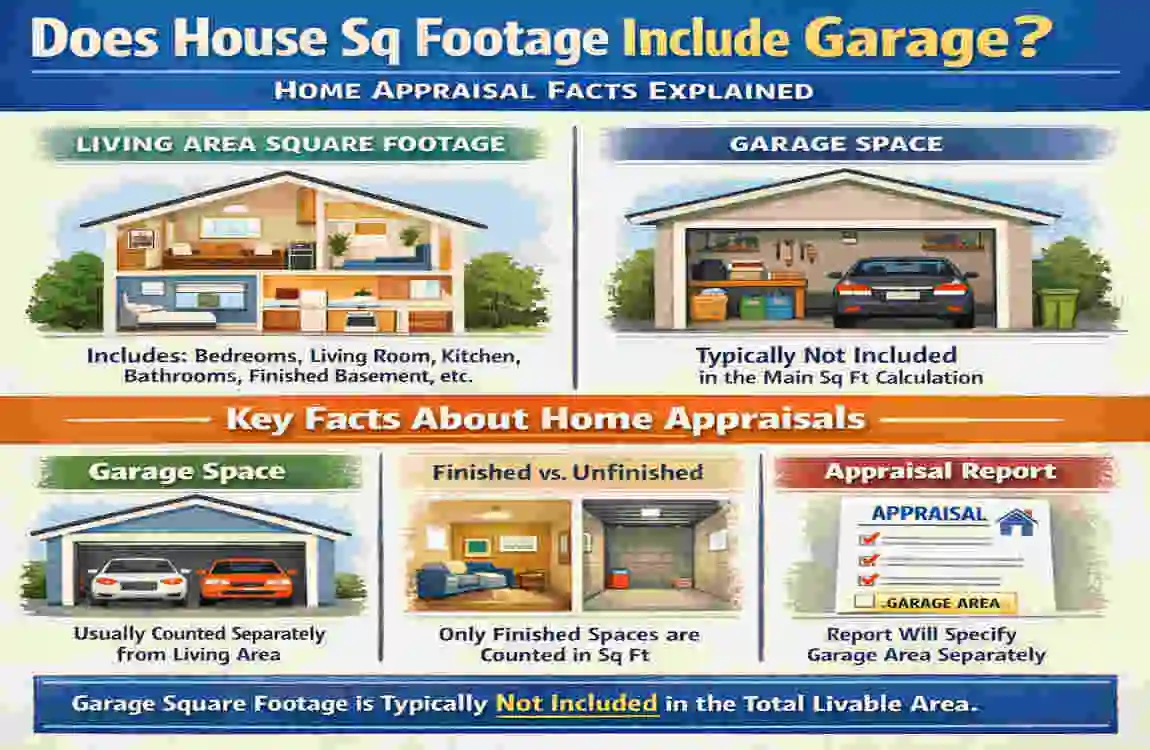
Picture this: You are walking through a beautiful open house. The listing says the home is 2,500 square feet. It feels spacious, the layout is great, and there is a massive three-car garage attached to the side. But when you start doing the mental math of the bedrooms and the living room, the numbers don’t add up. You pause and ask yourself, “Does house square footage include garage space?”
It is one of the most common questions in real estate, and the answer can make a huge difference in how you value a home. Whether you are a seller trying to get the best price, a buyer trying to avoid overpaying, or a homeowner planning a renovation, understanding the rules of square footage is critical.
The short answer is typically no. In the vast majority of cases, garages are classified as unfinished or non-heatable utility spaces, which excludes them from the home’s official “livable” square footage. However, like everything in real estate, there are nuances, exceptions, and specific appraisal rules that you need to know.
What Counts as Livable Square Footage?
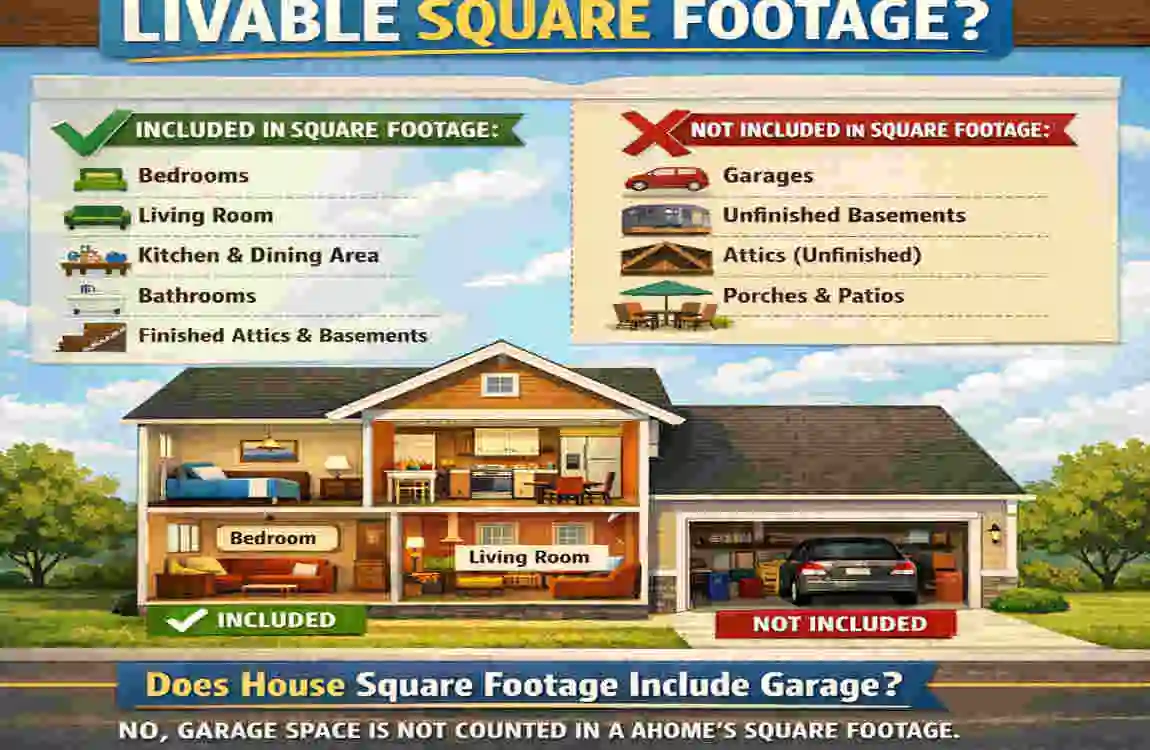
To understand why the garage is usually left out, we first need to define what actually counts. In the world of real estate appraisals and lending, we use a metric called Gross Living Area (GLA). This isn’t just a fancy term; it is the gold standard for determining a house’s size.
The Core Definition of Livable Space
For an area to be considered “livable square footage” and included in the main number you see on a listing, it generally must meet three specific criteria:
- It must be finished: The space needs finished walls (usually drywall), finished floors (carpet, tile, or hardwood), and a finished ceiling. Exposed studs or concrete floors usually disqualify a space.
- It must be conditioned: This is the big one. The space must be heated and cooled by the home’s main HVAC system. Space heaters or window units often don’t count in the official GLA.
- It must be above grade: This means the space is above the ground level. This is why basements, even beautiful finished ones, are often listed separately from the main square footage.
The Problem with Garages
Based on these criteria, you can see why a standard garage fails the test. Even if your garage has drywall, it usually has a concrete floor. More importantly, it is rarely hooked up to the central heating and air conditioning. It is considered “utility space”—a place for cars and storage, not for living.
The ANSI Z765 Standards
Real estate professionals often rely on a set of rules known as the ANSI Z765 Standards (American National Standards Institute). These are the guidelines that standardized how we measure houses. Under ANSI rules, any area that is not suitable for year-round living is excluded. Since a garage is designed to store vehicles and often contains fumes or uninsulated walls, it is considered strictly non-living space.
Why It Matters: Accuracy is everything. If a seller includes the garage in the square footage, they are effectively inflating the home’s size. This distorts the “price per square foot” calculation, making the home seem like a better deal than it actually is. By adhering to strict definitions, appraisers ensure that buyers are comparing apples to apples.
Space Type: Included in Sq Ft? Why or Why Not?
Living Room Yes Finished, heated, above grade.
Standard Garage No Unfinished, unheated utility space.
Finished Basement Partially is often listed separately because it is below grade.
Enclosed Porch, Maybe only if it is fully finished and heated like the main house.
Does House Square Footage Include Garage? The Rules
Now that we know the basics, let’s dive deeper into the specific rules that answer the question: Does house sq footage include garage?
The Standard Answer: No
If you are applying for a mortgage, the bank will send an appraiser to evaluate the property. Most lenders in the United States, including giants like Fannie Mae and the Federal Housing Administration (FHA), have strict guidelines. They explicitly state that the garage cannot be included in the Gross Living Area.
This rule applies even if the garage is pristine. You could have an epoxy floor, custom cabinets, and a flat-screen TV on the wall. Unless that space has been legally converted into a living room (more on that later), the appraiser will measure it, note it, and then exclude it from the final square footage count.
Attached vs. Detached Garages
Does it matter if the garage is attached to the house? Surprisingly, no.
- Attached Garages: Even though you can walk from your kitchen directly into the garage without going outside, it is still considered a separate utility zone. The shared wall is the dividing line for the square footage measurement.
- Detached Garages: These are treated as “accessory structures.” They add value to the property, but they are never confused with the main living area.
Regional Variations
While ANSI is the dominant standard in the United States, real estate is local, and you might see variations depending on where you live.
- United States: Most MLS (Multiple Listing Services) follow ANSI or Fannie Mae rules to ensure loans can be sold on the secondary market.
- Canada: The rules are very similar. The “Residential Measurement Standard” (RMS) used in places like Alberta strictly excludes garages.
- Europe: In some European countries, measurements might include “gross internal area,” which technically captures everything within the external walls, including the garage. However, “habitable space” is still separated.
Fannie Mae : No ; must be finished and heated to count.
ANSI Z765 No Distinctly separates finished vs. unfinished areas.
Local MLS : Sometimes agents list “Total Area,” but must clarify.
Exceptions: When Garages Count
You know the rule is “no,” but are there times when the answer to does house sq footage include garage changes to “yes”? Absolutely. This usually happens when the garage stops being a garage.
The Fully Converted Garage
If a homeowner decides they don’t need indoor parking and transforms the garage into a living space, it can count toward the square footage. However, it’s not as simple as throwing down a rug. To be officially counted, the conversion must meet several hurdles:
- The Garage Door is Gone: The large rolling door must be removed and replaced with a permanent, insulated wall and standard windows.
- Climate Control: The HVAC system must be extended into the room. A portable space heater doesn’t count.
- Flooring and Finishes: The concrete floor typically needs to be raised or insulated and covered with finished flooring. Walls and ceilings must be finished to the same quality as the rest of the house.
- Access: There must be natural access from the main house (not just walking outside and coming in a side door).
If these criteria are met and the city permits the renovation, the appraiser will reclassify the space as a “family room” or “bedroom” (if it has a closet and an egress window). Suddenly, those 400 square feet are added to the GLA!
Heated and Insulated Garages
What if you have a “man cave” garage? It has a garage door, a heater, insulation, and a billiards table. In this case, the answer remains no. As long as that garage door exists and a car can park there, it is a garage. The appraiser will assign it a higher value than a basic unfinished garage, but it will not count toward the square footage.
Multi-Level Garages
Here is a rare but interesting scenario. Some hillside homes have a garage on the ground level with a finished room above it.
- Lower Level: The area where the cars park is excluded.
- Upper Level: If the room above the garage is finished, connected to the house, and heated, it is included in the square footage.
How Appraisers Measure Sq Footage
Understanding the “how” can help you spot errors. Appraisers don’t just guess; they use a systematic process to determine a home’s size.
The Step-by-Step Measurement Process
- The Exterior Tape: Appraisers typically start on the exterior. They measure the home’s exterior dimensions—the footprint. They take a tape measure or a laser device and walk the perimeter.
- Identify Non-Living Areas: As they sketch the outline, they identify the “pop-outs” that don’t count. They will measure the garage box separately and mark it as “Garage.” They also subtract porches, patios, and decks.
- The Deduction: They take the total exterior area and subtract the garage area. For example, if a house is a 60×50 rectangle (3,000 sq ft) with a 20×20 garage built into it (400 sq ft), the livable square footage is 2,600.
- Verification: They may check interior measurements to account for stairwells or two-story foyers (which only count once, not for both floors).
Tools and Tech
Gone are the days of graph paper and pencils alone. Modern appraisers use high-tech tools to ensure accuracy.
- Laser Distance Meters: These provide measurements accurate to the millimeter.
- Software Sketching: Programs like SketchUp or specialized appraisal software automatically calculate the area once the lines are drawn.
- Drones: For complex rooflines or hard-to-access areas, drones can help verify the footprint.
Garage-Specific Measurement Rules
When an appraiser measures the garage, they are thorough. They measure the interior and exterior to ensure they aren’t accidentally subtracting living space. For example, if a laundry room is carved out of the back of the garage, they will measure it carefully to ensure it counts as living space, while the parking area remains excluded.
Measurement Method, Accuracy Level, Best Use Case
Exterior Tape 95% Standard rectangular homes.
Laser + Software 99% Complex layouts with angles.
Interior Only Lower Condos where exterior walls are shared.
Impact on Home Value and Sales
So, if the garage doesn’t count towards the square footage, does it mean it’s worthless? Absolutely not. In fact, the garage is one of the most valuable “non-living” assets a home can have.
Valuation Effects
When an appraiser determines the value of your home, they use a “comparable sales” approach. They start with the square footage value, but then they make “line-item adjustments.”
- The Adjustment: If your home has a 2-car garage and the comparable home down the street has no garage, the appraiser will add a lump sum value to your home. Depending on the market, a standard garage can add anywhere from $20,000 to $50,000 to the appraisal value.
- Oversized Appeal: An oversized garage (say, a 3-car or one with a workshop) can boost the home’s appeal by 5-10%, even if that extra space isn’t in the GLA.
Listing Strategies
Smart real estate agents know how to handle the “does house square footage include garage” question. They won’t lie about the square footage, but they will market the home’s utility.
- “Total Under Roof”: You might see a listing that says “2,000 sq ft Living Area (2,500 sq ft Total Under Roof).” This signals to buyers that there is ample extra space.
- Highlighting the Perk: Marketing the garage as “finished workspace,” “gym-ready,” or “heated storage” tells buyers that while it’s not a bedroom, it is usable, valuable space.
Buyer Perceptions
Psychologically, buyers love garages. In many suburban markets, a garage is a non-negotiable requirement. A buyer might choose a 1,800 sq ft home with a garage over a 2,000 sq ft home without one. The utility of having a place to park, store holiday decorations, or set up a workbench often outweighs the slight loss of space in a living room.
Garage Size, Estimated Value, Add Impact on Sq Ft Number
Standard 2-Car (400 sq ft) $25,000 – $40,000 Excluded from GLA
Converted Garage (Living) varies based on finish , included in GLA
Oversized / Workshop $35,000 – $60,000 Excluded from GLA
Tax and Insurance Implications
The rules for taxes and insurance can be confusing because they often differ from appraisal rules.
Property Taxes
Your local tax assessor wants to know the value of the entire structure. While they separate the living area from the non-living area, they usually assess the garage as a taxable improvement. So, does the house’s square footage include the garage for tax purposes? Usually, the tax record shows a “Base Area” (living space) and an “Adjusted Area” or “Total Building Area” (including the garage). You are taxed on the total value of all these parts.
Homeowners Insurance
Insurance companies care about “Replacement Cost.” If your house burns to the ground, they have to rebuild the garage, too. Therefore, your insurance policy covers the garage’s square footage. However, the premiums are heavily influenced by the livable square footage because that is where the expensive finishes (kitchens, bathrooms, flooring) are located. A 400 sq ft garage is cheaper to rebuild than a 400 sq ft kitchen, so it impacts your Premium differently.
DIY Measurement Guide
Are you questioning the square footage listed on your tax record or a Zillow listing? You can check it yourself.
How to Calculate Your Own Sq Ft
- Sketch the Floor plan: Draw a rough outline of your house on a piece of paper.
- Measure the Exterior: Go outside with a 100-foot tape measure. Measure the length of every exterior wall. Write these numbers on your sketch.
- Identify the Garage: Measure the exterior walls of the garage specifically.
- Do the Math: Calculate the total area of the entire rectangle (or shape) of the house. Then, subtract the area of the garage.
- Formula: (Total Exterior Area) – (Garage Area) – (Porch Area) = Estimated Livable Square Footage.
Common Myths and Mistakes
There is a lot of misinformation out there regarding whether house sq footage includes the garage. Let’s bust a few myths.
- Myth: “My garage is attached, so it counts.”
- Fact: Proximity doesn’t matter. It is still a utility space.
- Myth: “I painted the floor and put up drywall, so now it’s a room.”
- Fact: Unless you removed the garage door and added HVAC, it is just a really nice garage.
- Mistake: Inflating the Listing.
- Sellers sometimes add the garage footage to the listing to make the price per square foot look lower. This usually backfires. When the appraiser comes, they will slash the square footage, potentially causing the financing to fall through because the house doesn’t appraise for the offer price.
- Mistake: Over-finishing without Permits.
- If you convert your garage into a bedroom illegally (without permits), you cannot count it in the square footage for resale. In fact, you might be forced to tear it out.
Renovation Considerations
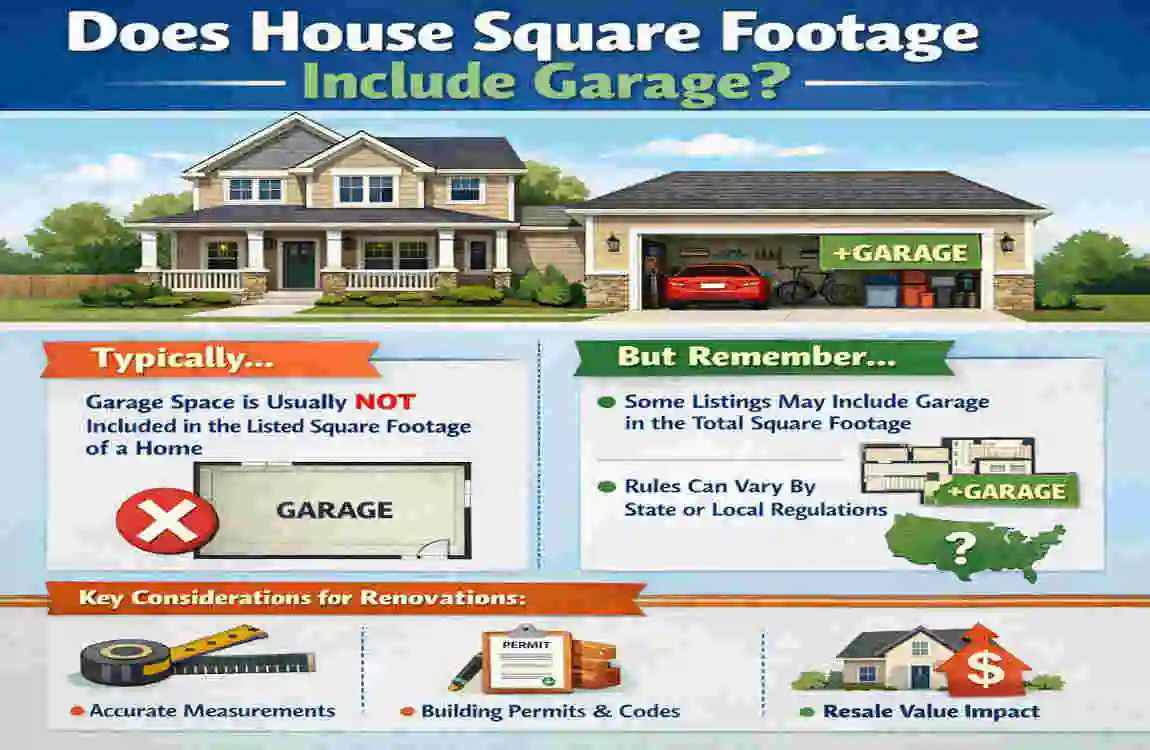
If you are tight on space, consider converting your garage to add square footage. This is a popular trend, but is it worth it?
The Garage Conversion
Converting a garage is one of the cheapest ways to add square footage, since the roof and foundation are already in place.
- Cost: Expect to pay between $50,000 and $150,000 for a high-quality conversion of a 400 sq ft garage. This is significantly cheaper than building a new addition.
- Value: You gain livable square footage, which boosts your appraisal value.
- The Trade-off: You lose covered parking and storage. In some neighborhoods, not having a garage can make the house harder to sell.
Permits are Non-Negotiable: You must check with your local zoning office. Some cities require homes to have covered parking. If you convert your garage, you might be legally required to build a carport elsewhere on the property.
FAQs
Does house square footage include the garage in specific states like Texas or Florida? Generally, no. While real estate is local, practically all states follow the ANSI/Fannie Mae appraisal guidelines to ensure mortgages are federally backed.
Can I include a finished garage in my square footage? Only if it has been legally converted. This means the garage door is removed, the floor is leveled with the house, and it has permanent heat/AC.
How do I verify the home’s square footage before buying? Do not rely on the seller’s word. Hire a certified appraiser to measure the home, or ask your home inspector if they offer a verification service.
Does a basement count in square footage? Usually, no, if it is below grade (underground). It is valuable, but it is listed separately from the “Gross Living Area” on most appraisal forms.
