

Let us take a moment to think about your typical morning routine. You wake up, switch on your bedroom lights, ask your smart speaker to read the daily news, start the coffee maker, and maybe check the charging status of your electric vehicle (EV). We do all of these things without a second thought. But none of this modern convenience would be possible without one invisible powerhouse: your home’s electrical system.
When we talk about your home’s electrical system, we mean the entire network that brings power from the street into your living room. This includes your main breaker panel, the complex web of house wiring hidden behind your drywall, and every single outlet and switch you touch daily.
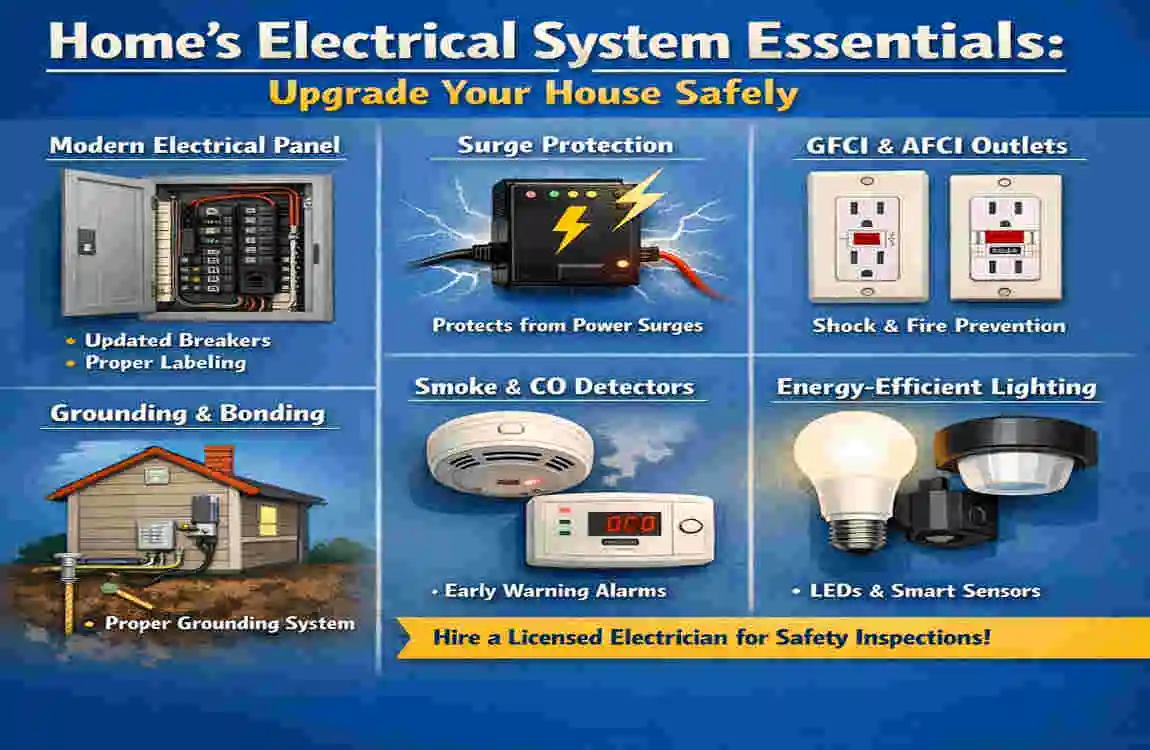
Upgrading this vital network is not just about keeping the lights on. Safe electrical upgrades actively prevent devastating house fires, significantly reduce your monthly energy bills, and completely future-proof your home for the next decade of technological advancements.
| Component | Description | Function | Common Capacity/Notes |
|---|---|---|---|
| Service Entrance & Meter | Entry point from utility lines (overhead/underground) with energy meter. | Measures usage; connects power to home. Smart meters track real-time data. | 100-200A service; check for corrosion. |
| Main Breaker Panel | Central “control hub” (breaker box/distribution board). | Distributes power to circuits; main breaker shuts off all power. | 100A, 150A, or 200A rating; upgrade for EVs. |
| Branch Circuits & Wiring | Wires running from panel to outlets, lights, appliances. | Delivers electricity; includes hot, neutral, ground wires. | 15-20A circuits; copper preferred over aluminum. |
| Outlets & Switches | Receptacles and controls for devices/lights. | Safe connection points; GFCI/AFCI for protection. | 120V standard; tamper-resistant in 2026 codes. |
| Grounding System | Ground wire/rod connected to earth. | Prevents shocks by diverting faults. | Essential for safety; test annually. |
Understanding Your Home’s Electrical System Basics
Before we can discuss improvements, we need to understand the basic building blocks of your setup. Many homeowners feel intimidated by the thought of electricity. It seems like magic. But once you break it down into simple terms, your home’s electrical system is actually quite easy to understand.
Core Components of a Home’s Electrical System
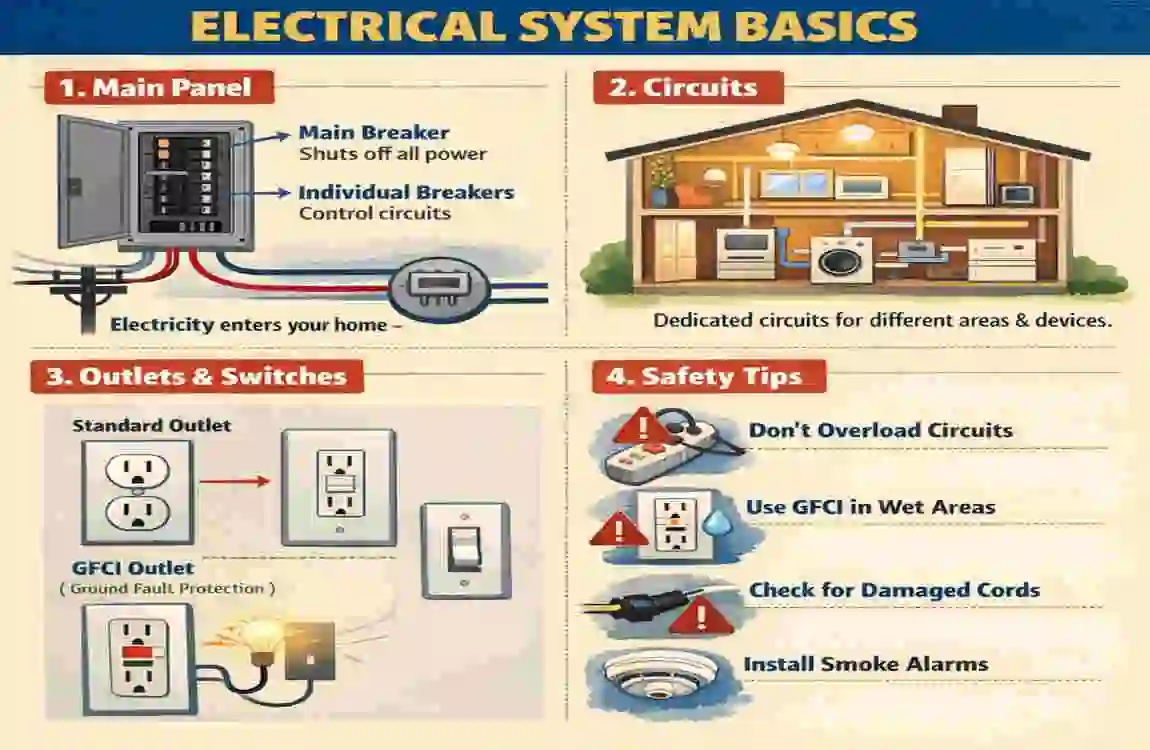
Your home’s power network consists of three main checkpoints. Think of these as the gateway, the brain, and the nervous system of your house.
The Service Entrance and Meter. This is where the magic enters your property. The local utility company runs power lines either underground or overhead to your house. The very first thing this power hits is your electrical meter. This spinning glass or digital box sits on the outside of your house and carefully tracks exactly how much power you consume. Hence, the utility company knows what to charge you.
The Main Breaker Panel. Once the electricity passes through the meter, it flows directly into your main breaker panel. You probably know this as the “breaker box.” This gray metal box is the command center of your home’s electrical system. It takes the massive, raw power coming from the street. It divides it up into smaller, safer, and more manageable pathways (called circuits) for different rooms in your house.
If you live in an older home, you might only have a 100-amp panel. Today, upgrading from a 100-amp to a 200-amp panel is almost mandatory to handle the sheer volume of modern appliances we use.
The House Wiring Finally, we have the wiring. This is the nervous system that carries the power from the breaker panel to your outlets and light fixtures. Modern homes use safe, insulated copper wiring. However, if your home was built decades ago, you might have outdated aluminum wiring or, even worse, ancient “knob-and-tube” wiring. These older setups pose a massive fire risk because they cannot withstand the heat generated by modern electronics.
How Electricity Flows in Your House
To truly grasp how this all works, let us use a very simple, everyday analogy: plumbing.
Imagine that electricity is water flowing through a series of pipes.
- Volts are the water pressure. It is the force pushing the electricity forward.
- Amps represent the volume of water flowing through the pipe.
- Watts are the total amount of power you get when you combine pressure and volume.
When you plug your phone charger into an outlet, you are opening a “faucet.” Electricity (water) flows from the breaker panel through the circuits (pipes) to your device.
To keep this flow safe, modern systems include grounding. A ground wire acts like an emergency drain. If something goes wrong and electricity leaks out of its normal path, the ground wire gives that dangerous stray voltage a safe path straight down into the earth, preventing it from shocking you.
Busting a Common Myth: You might hear people say, “Old houses are fine if the lights still turn on.” This is a dangerous myth! Just because a light turns on does not mean the wires inside the wall aren’t overheating and slowly melting their insulation. Writing like you are talking to a friend makes these complex topics easier to understand, so take it from a friend: don’t ignore the hidden health of your home.
Signs Your Home’s Electrical System Needs Attention
Now that you know how the system is supposed to work, how do you know when it is failing? Your house will usually try to warn you before a complete disaster strikes. You need to know what to listen to and what to look for.
Warning Signals to Watch For
Grab a notepad and take a walk around your house. If you notice any of the following warning signs, it is time to consider serious electrical upgrades.
- Frequent Breaker Trips: Does your breaker trip whenever you run the microwave and toaster at the same time? Breakers are designed to shut off the power when a circuit gets overloaded to prevent a fire. If they are tripping constantly, your system is crying out for more capacity.
- Flickering or Dimming Lights: If your living room lights dim significantly when the air conditioner or refrigerator kicks on, it means those large appliances are siphoning power from the rest of your house.
- Warm Outlets and Switches: Walk up to a few outlets you use often and place the back of your hand against the plastic cover. It should feel completely cool to the touch. If an outlet feels warm, or if you see brown scorch marks around the plug, you have a dangerous heat buildup.
- Strange Buzzing or Burning Smells: Electricity should be silent and odorless. If you hear a faint buzzing sound from a wall or catch a whiff of burning plastic or ozone, turn off your main power immediately and call a professional.
- A Web of Extension Cords: Extension cords are meant for temporary use, like plugging in holiday lights. If you have permanent extension cords running under rugs or across rooms to power your home office, you do not have enough dedicated outlets.
The Risks: Modern Demands on Old Systems
Our power consumption habits have changed drastically over the last few years. The shift to remote work means we have multiple laptops, monitors, and networking gear running 24/7.
Furthermore, the rise of electric vehicles and fully integrated smart appliances places an enormous, continuous draw on your home’s electrical system. Older systems were not built to push that much “water” through their “pipes” for hours on end. Overloading is the number one cause of electrical fires today.
Do you want to make sure your house is fully protected? You can download our free 2026 Home Electrical Safety Checklist directly from our website to perform your own basic visual audit today!
Safe Upgrade Strategies for Your Home’s Electrical System
So, you have spotted a few warning signs, or you know your house is aging. What are the next steps? Upgrading your home’s electrical system might sound daunting. Still, when you break it down into manageable projects, it is an incredibly smooth process.
Here are the most important, high-impact strategies for modernizing your home.
Panel and Breaker Upgrades
The most common and most impactful upgrade you can make is replacing your main electrical panel. If you still have an old-fashioned fuse box (where you have to unscrew and replace a blown glass fuse physically), you are living in the past. You need to upgrade to a modern circuit breaker panel immediately.
Even if you have breakers, you likely need a capacity bump. Upgrading from a 100-amp service to a 200-amp service gives your house the “larger pipes” it needs to handle modern life smoothly.
Additionally, a modern panel upgrade allows you to install AFCI and GFCI breakers.
- GFCI (Ground Fault Circuit Interrupter): These protect you from fatal electric shocks, particularly in wet areas like kitchens and bathrooms.
- AFCI (Arc Fault Circuit Interrupter): These monitor the circuit for dangerous electrical sparking (arcing) behind your walls and shut the power down before a fire can ignite.
The Cost Breakdown: How much does a panel upgrade cost? In local markets and across, taking local material costs and professional labor into account, a full panel upgrade generally ranges from $1,500 to $4,000. It is a one-time investment that completely transforms your property’s safety.
Rewiring Essentials
Sometimes, replacing the panel is not enough. If the “nervous system” of your house is failing, you need a rewiring project.
If your home is more than 40 years old, the insulation around your wires is likely crumbling and turning to dust. This leaves bare, energized metal exposed behind your drywall—a massive hazard. Rewiring involves a professional electrician carefully installing brand-new, highly insulated copper wiring throughout your walls.
This is also the perfect time to think about smart wiring. If you are opening up your walls, you should run data cables (like Cat6) and neutral wires to every switch box to easily support the Internet of Things (IoT) devices you will undoubtedly buy in the future.
Adding Capacity for Modern Needs
We are moving toward a greener, more electrified future. Two major trends are driving electrical upgrades in 2026:
Electric Vehicle (EV) Chargers: You cannot effectively charge an EV on a standard wall outlet; it will take days. You need a dedicated 240-volt circuit installed in your garage or driveway. This requires specialized breakers and heavy-duty wiring.
Solar Energy Integration: With the intense push for green energy and independence from the struggling national grid, more homeowners are installing solar panels. To safely connect those solar panels to your house, you need an upgraded, solar-ready main panel that can handle power flowing in two directions.
Top Home Electrical Safety Tips
While major upgrades require a professional, maintaining home electrical safety is something you can practice every single day. By making a few small changes to your daily routine, you can drastically reduce the risk of accidents and extend the life of your appliances.
Daily Habits for a Safer Home
Start by looking at how you plug things in.
First, invest in high-quality surge protectors. A surge protector is different from a basic power strip. A surge protector actively absorbs sudden spikes in electricity (like from a lightning strike or a grid fluctuation) before they can fry your expensive television or computer.
Second, ban the practice of “daisy-chaining” in your house. Daisy-chaining is when you plug one power strip directly into another power strip to reach across a room. This is incredibly dangerous! It forces a massive amount of electrical resistance onto a single wall outlet, which will quickly overheat and melt the plastic.
Protecting Your Family
If you have young children, you must childproof your outlets. However, skip those annoying, cheap plastic plug inserts that kids can easily pry out with their fingernails. Instead, upgrade your wall outlets to Tamper-Resistant (TR) receptacles. These have built-in, spring-loaded shutters that block the slots. The shutters only open when the two equal prongs of a real plug are pushed in at the same time, completely preventing a child from shoving a hairpin into the socket.
Furthermore, ensure your home’s smoke and carbon monoxide (CO) detectors are hardwired directly into your home’s electrical system. Battery-operated detectors are okay, but hardwired detectors communicate with each other. If a fire starts in the basement, the alarm in your second-story bedroom will go off instantly.
Emergency Prep and Load-Shedding Solutions
We cannot ignore the reality of grid instability. In regions with heavy load shedding, sudden power losses and surges wreak havoc on sensitive electronics.
To protect your home, consider integrating a robust Uninterruptible Power Supply (UPS) or a standby backup generator directly into your main electrical panel via a transfer switch. A transfer switch safely isolates your house from the main grid during an outage, allowing your generator to power your fridge and lights without back-feeding dangerous electricity onto the street lines and harming utility workers.
Quick Safety Checklist:
- Test all GFCI buttons in your kitchen and bathrooms monthly.
- Replace any frayed or damaged appliance cords immediately.
- Keep all heat-producing appliances (toasters, space heaters) unplugged when not in active use.
- Ensure all lightbulbs match the recommended wattage of their fixtures.
Cost-Effective Ways to Upgrade Your House Electrical Setup
We understand that jumping straight into a massive rewiring project or a full panel replacement can be tough on the wallet. The good news is that you do not have to do everything all at once. There are plenty of cost-effective, incremental ways to improve your house wiring and overall system efficiency.
Budget-Friendly Options
One of the absolute easiest ways to upgrade your system and save money is to replace all your old incandescent light bulbs with modern LED lighting. Traditional bulbs turn 90% of their electricity into wasted heat, which also stresses your wiring. LEDs run incredibly cool, use a fraction of the power, and last for years.
Next, start upgrading your major appliances to highly energy-efficient models. Look for the Energy Star rating or equivalent local efficiency labels. A modern, efficient refrigerator draws significantly less power than a fridge built fifteen years ago, instantly taking pressure off your electrical panel.
DIY vs. Pro: Know Your Limits. When looking to save money, it is tempting to try some Do-It-Yourself electrical work.
- What you CAN do: You can safely swap out a lightbulb, install basic smart plugs, and replace the decorative plastic faceplates on your wall switches.
- What you CANNOT do: You should never attempt to replace a breaker, wire a new outlet, open the main panel, or run new cables through your walls. A single mistake here can result in a fatal shock or a house fire. Always hire a pro for the real work.
The ROI of Electrical Upgrades
Upgrading your electrical system is one of the few home improvement projects that actually pays you back over time. Check out our simple Return on Investment (ROI) breakdown below:
Type of Electrical Upgrade, Upfront Cost Level, Monthly Energy Savings, Home Value Boost
Complete LED Conversion Low Up to 15% Minor
Smart Thermostat & Plugs Low to Medium 10% – 20% Moderate
200-Amp Panel Upgrade Medium to High Prevents appliance burnout Very High (Major selling point)
Solar Panel Integration High Up to 80% (Depends on array) Extremely High
These upgrades not only save you money on your monthly utility bills but also massively increase your property’s resale value. Buyers love seeing a modernized, safe power system. Use our free ROI calculator tool on our website to see exactly how much you could save, and easily book a consultation with our team!
Smart Home Integration with Your Home’s Electrical System
We are firmly in the age of the smart home. But true home automation goes far beyond just buying a smart speaker. The ultimate smart home connects directly to your home’s electrical system at its foundation.
Voice-Controlled Systems and Smart Wiring
Imagine walking into your home with your hands full of groceries and simply saying, “Turn on the kitchen lights.” By upgrading your standard wall switches to smart switches compatible with ecosystems like Google Nest or Amazon Alexa, you gain total control over your home’s lighting environment.
To do this right, your electrician needs to ensure your switch boxes contain a “neutral wire.” Many older homes only ran the active hot wire to the switch. Smart switches require a tiny, constant trickle of electricity to stay connected to your Wi-Fi router, which makes the neutral wire an absolute necessity for modern low-voltage smart wiring.
Energy Monitoring and Future-Proofing
One of the most exciting trends in 2026 is the rise of smart electrical panels and dedicated energy monitoring apps.
Instead of just waiting for your utility bill at the end of the month, a smart panel lets you open an app on your phone to see exactly how much power your house is using in real time. You can see exactly how much electricity the air conditioner uses compared to the water heater. You can even remotely turn off specific breakers if you realize you left the stove on while driving to work!
This level of monitoring is becoming essential for sustainability. It helps you identify energy hogs and adjust your habits to save money. Furthermore, as we look to the future, installing 5G-ready, connected electrical panels ensures your home will be perfectly compatible with the advanced, AI-driven grid management systems utilities will roll out in the coming years.
Hiring Pros: What to Look for in Electrical Upgrades
By now, you understand the immense value of keeping your electrical system in top shape. But when it is time to do the heavy lifting, who do you call?
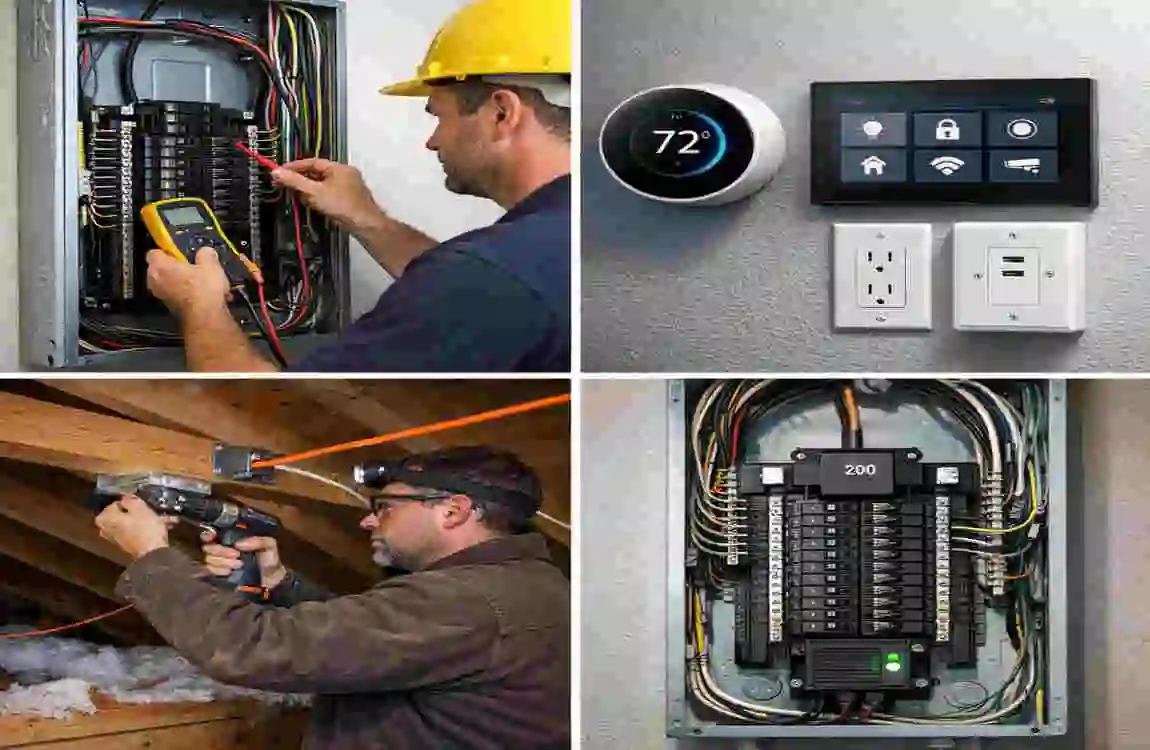
Your home’s electrical system is not the place to cut corners. Hiring an unqualified handyperson to do your house wiring is like asking a mechanic to perform open-heart surgery. You need a dedicated, licensed professional.
Watch out for these red flags:
- Contractors who refuse to provide a written estimate.
- Electricians who suggest doing the work without pulling the required local building permits.
- Anyone who tells you a massive rewiring job can be done in a few hours is lying.
We pride ourselves on total transparency, rigorous safety standards, and unmatched expertise. Contact us today for a completely free, no-obligation audit of your home’s electrical system. We will walk you through everything, step by step.
FAQs: Home’s Electrical System Queries
How often should I have my home’s electrical system professionally inspected? If you live in a house that is over 25 years old, you should have a professional inspection every 3 to 5 years. For newer homes, an inspection every 10 years is usually sufficient, unless you notice warning signs, such as tripping breakers.
How much does it cost to upgrade an electrical panel ? While prices fluctuate with material costs, a professional panel upgrade (moving from an old system to a modern 200-amp breaker panel) generally ranges from $1,500 to $4,000, depending on the complexity of the installation.
Why do my lights flicker when my air conditioner turns on? This happens because your air conditioner requires a significant surge of power to start its compressor. If your panel lacks capacity, the AC temporarily pulls power away from your lighting circuits. A panel upgrade or a dedicated AC circuit usually solves this.
Are smart electrical panels worth the investment? Yes! While they cost more upfront, smart panels provide real-time energy monitoring via smartphone apps. This helps you identify wasted electricity and can save you up to 20% on your monthly utility bills over time.
What is the difference between a GFCI and an AFCI breaker? A GFCI (Ground Fault Circuit Interrupter) protects you from getting electrocuted, especially near water (kitchens/bathrooms). An AFCI (Arc Fault Circuit Interrupter) protects your house from catching fire by detecting dangerous sparking behind your drywall. Modern codes require both!
