

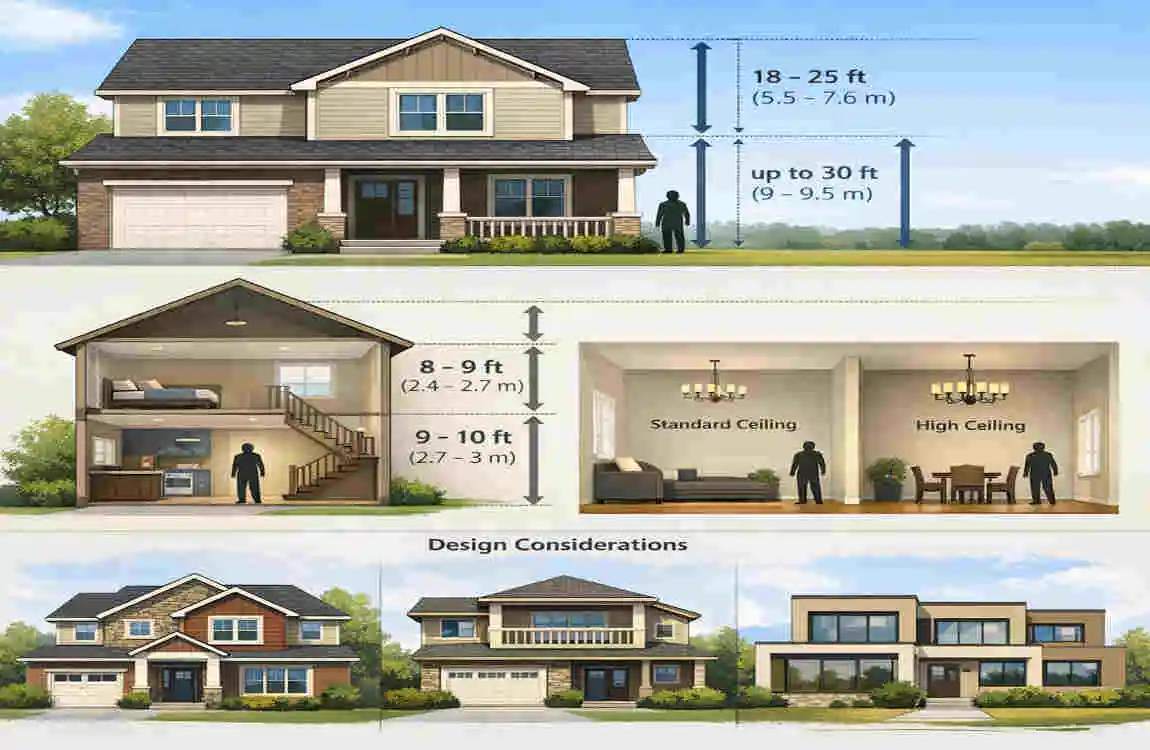
It sounds like it should have a straightforward answer, like “20 feet.” But if you have ever walked through a neighborhood, you know that two houses with the same number of floors can look vastly different in stature. One might loom over the street with a grand, steep roof, while the distinct modern home next door sits low and sleek.
Understanding a house’s total height matters for many reasons. It is not just about aesthetics, though curb appeal is huge. It is about navigating planning permissions, ensuring your neighbors don’t complain about blocked sunlight, and figuring out if you can fit that majestic chandelier in the entryway.
What Counts Toward Total Height?
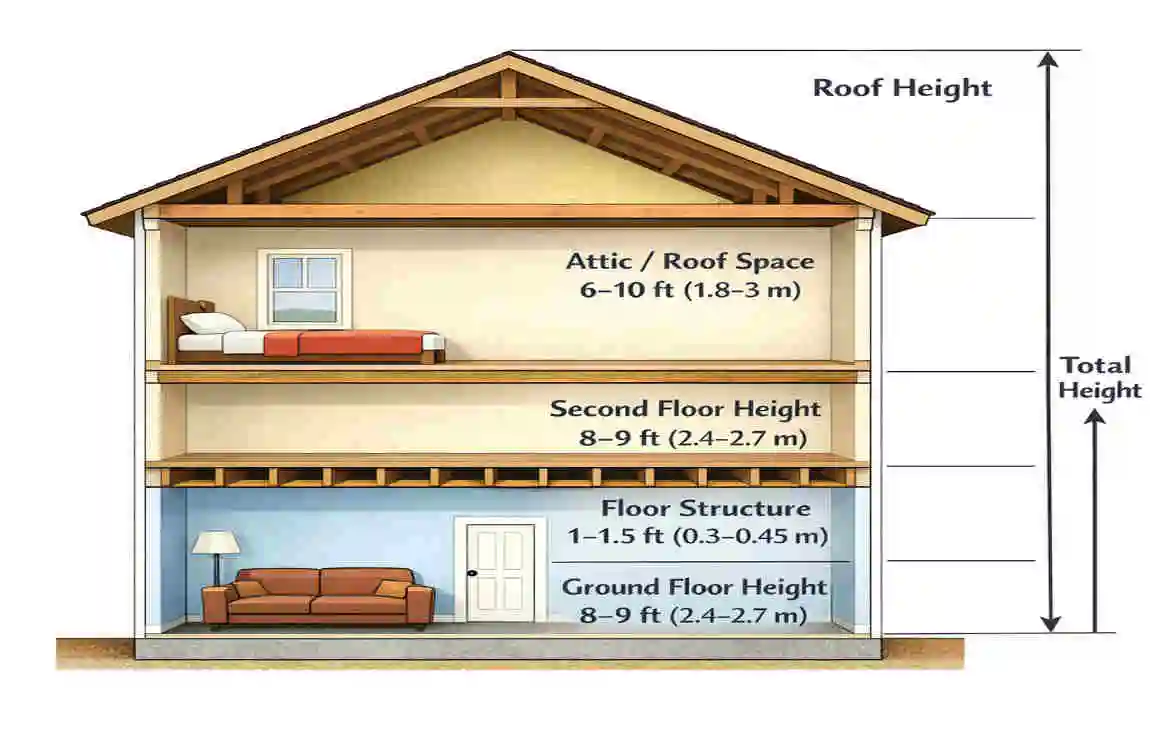
Before we start throwing around numbers, we need to agree on what we are actually measuring. When a builder or an architect talks about the height of a house, they aren’t just measuring the walls. They are looking at the complete vertical footprint.
To get an accurate figure, you have to stack up several components. Think of your luxury house like a layer cake. You have the bottom crust, the filling, the cake layers, and the icing on top.
The Key Components
Here is what creates the total vertical rise:
- The Foundation/Toe: This is where it all begins. Your house rarely sits flush with the dirt. There is usually a foundation slab or a raised floor system. Depending on your flood zone or terrain, this could add anywhere from 6 inches to several feet before you even hit the first floor.
- Ground Floor Ceiling Height: This is the distance from your floorboards to the drywall above your head.
- The Intermediate Floor Structure: This is the “filling” of the sandwich. Between the ceiling of the first floor and the walking surface of the second floor, there is a web of joists, plumbing pipes, HVAC ducts, and subflooring. This usually takes up about 10 to 14 inches (roughly 25–35 cm).
- Second Floor Ceiling Height: Just like the ground floor, this adds another large block of vertical space.
- The Roof Structure: This is the biggest variable. The “pitch” (steepness) of your roof determines how high the ridge (the very top point) sits above the top plate of the wall.
Defining the Measurement
When we ask how tall a 2-storey house is, we are usually looking for the external wall-to-wall height from the finished ground level to the highest point of the roof.
In some regions or architectural styles (such as modern homes with parapet walls that hide a flat roof), the measurement might stop at the top of the parapet. However, for the vast majority of traditional homes, we are measuring right up to the roof ridge.
It is crucial to note that, if you are looking at this from a legal perspective—such as for a zoning permit—some local councils measure from “natural ground level,” while others measure from “finished floor level.” Always check your local definitions, as that small distinction can make a big difference in approval.
Typical Height Ranges by Region
So, let’s get down to the brass tacks. If you were to take a tape measure to the average suburban home, what would you find?
Global Framing: The Standard Numbers
Broadly speaking, if you are looking for a quick answer, the total height of a standard two-storey home usually falls between 18 and 25 feet (approximately 5.5 to 7.6 meters).
However, that is a wide range. Let’s narrow it down based on the “vibe” of the house:
- The Compact/Modern Build: For homes with flat roofs or lower ceiling heights (standard 8-foot ceilings), you are looking at the lower end—around 20 to 22 feet (6.0 to 6.7 meters).
- The Traditional/Suburban Build: For a house with a standard pitched roof and maybe a slightly higher ground floor ceiling (9 feet), the average is often around 22 to 24 feet.
- The Estate/Premium Build: If you have high ceilings (10 feet+), a steep, dramatic roof, and a raised foundation, your home could easily soar to 30 feet or more.
Regional Nuances
Geography plays a fascinating role in construction. If you are asking how tall a 2-storey house is in the UK or Europe versus North America, the answers shift slightly.
- North America: In the US and Canada, “bigger is better” has been a trend for decades. It is very common to see 9-foot or even 10-foot ceilings on the ground floor. Combined with the popularity of complex, steep rooflines to handle snow or rain, North American homes often trend toward the taller end of the spectrum (25+ feet).
- UK and Europe: Here, efficiency and strict planning permissions often keep heights lower. Ceiling heights of 2.4 meters (approx. 8 feet) are standard. Roofs might be pitched, but ridge-height restrictions in historic towns can strictly cap total height, often keeping homes closer to the 8-meter mark to fit in with neighbors.
- Australia/New Zealand: There is a mix here. While land sizes are shrinking, the desire for modern, airy homes is increasing. You will often see 2.7-meter ceilings on the ground floor, raising the total height, even if the roof pitch is kept moderate for a modern “box” aesthetic.
A Visual Breakdown
To help you visualize this, here is a simple breakdown of a “Standard” vs. “Premium” height stack:
ComponentStandard House HeightPremium House Height
Foundation Rise 1 ft (0.3m) 2 ft (0.6m)
Ground Floor 8 ft (2.4m) 10 ft (3.0m)
Floor System 1 ft (0.3m) 1.5 ft (0.45m)
Second Floor 8 ft (2.4m) 9 ft (2.7m)
Roof Structure 4-6 ft (1.2-1.8m) 8-12 ft (2.4-3.6m)
TOTAL HEIGHT ~22 ft (6.7m) ~30+ ft (9.1m+)
Ceiling Heights by Floor
The distance between the floor and the ceiling is the most “human” element of house height. It dictates how the space feels. When asking how tall a 2-storey house is, the ceiling height is the variable you have the most control over during the design phase.
The Ground Floor: The Social Zone
The ground floor is where life happens. It’s the kitchen, the living room, the dining area. Because these are social, public spaces, we generally crave volume here.
- Standard (8 Feet / 2.4m): This was the industry standard for decades. It is cost-effective and efficient at heating and cooling. However, in large open-plan rooms, 8-foot ceilings can sometimes feel oppressive or “squat.
- The New Standard (9 Feet / 2.7m): In modern construction, 9 feet is rapidly becoming the baseline. That extra 12 inches allows for taller windows, which let in more light, making the whole floor footprint feel larger than it actually is.
- Grand (10 Feet+ / 3.0m+): Luxury homes often push this to 10 or 12 feet. This allows for dramatic lighting fixtures, elaborate crown molding, and a sense of grandeur. However, it significantly increases the cost of materials and the building’s total height.
The Second Floor: The Private Zone
Moving upstairs, the priorities shift. Bedrooms and bathrooms are for resting. We want them to feel cozy and secure.
- Standard (8 Feet / 2.4m): Even in homes with tall ground floors, it is very common to keep the second floor at 8 feet. It creates a cozier sleeping atmosphere and keeps the total roof ridge height lower (which helps with planning permission).
- Vaulted Ceilings: A great design trick to make a second floor feel taller without raising the exterior walls is to vault the ceiling. By following the roofline rather than installing a flat ceiling, you can add volume to the main bedroom without increasing the building’s exterior height by a single inch.
The “Sandwich” Layer
Do not forget the space between the floors! This is often the shocker for new home builders. You cannot just stack an 8-foot room on top of an 8-foot room and get 16 feet.
You need space for floor joists. Standard lumber joists might be 10 inches deep. Engineered I-joists could be 12 to 14 inches. Plus, you need space for subflooring (plywood) and the finished floor (hardwood/tile) above, and the drywall ceiling below.
Pro Tip: If you are running central air conditioning (HVAC) ducts between floors, you might need “bulkheads” or open-web trusses, which can increase this inter-floor thickness, adding to the overall height of the house.
Roof Design and Its Impact on Height
If the ceiling height is the variable you feel, the roof is the variable you see from the street. It is the single biggest factor in answering how tall a 2-storey house is. Two houses with identical floor plans and ceiling heights can differ in total height by 10 feet solely due to the roof choice.
Roof Styles and Shapes
- Gable and Hip Roofs: These are the classics. They slope upwards to a central ridge. They shed water and snow efficiently and provide attic space. However, they add significant height.
- Mansard Roofs: Think French architecture. These have very steep sides and a flat top. They are excellent for maximizing internal space on the top floor (essentially turning an attic into a third floor), but are visually heavy and tall.
- Flat Roofs: Common in modern architecture. A flat roof (which technically has a tiny slope for drainage) adds almost zero height above the ceiling joists. If you are building in an area with strict height restrictions, a flat roof is your cheat code.
Understanding “Pitch”
Builders talk about roof steepness in terms of “pitch.” In the US, this is measured as rise-over-run (e.g., a 6/12 pitch means the roof rises 6 inches for every 12 inches of horizontal distance).
- Low Pitch (3/12 to 4/12): This adds minimal height. It’s functional but can look “commercial.
- Medium Pitch (6/12 to 8/12): This is the residential “sweet spot.” It looks balanced and adds roughly 5 to 7 feet to the peak of an average-width house.
- Steep Pitch (10/12 to 12/12): This is dramatic and traditional. A 12/12 pitch rises at a 45-degree angle. On a house that is 30 feet wide, a 12/12 pitch roof adds 15 feet of height just on its own!
Structural Considerations
Nature also dictates your height. If you live in an area with heavy snowfall, you generally need a steeper roof to prevent snow load collapse. This forces your house to be taller. Conversely, in high-wind hurricane zones, lower-profile hip roofs are often preferred because they are more aerodynamic.
Regional Code Considerations and Planning
You might have a dream of a 35-foot-tall Victorian mansion, but your local government might have other plans. The local planning department often answers the question of how tall a 2-storey house is before you even hire an architect.
Height Limits and Zoning
Almost every residential zone has a “Maximum Building Height.”
- The Cap: In many suburban neighborhoods, this cap is often around 30 to 35 feet (approximately 9 to 11 meters).
- The Measurement Point: Be careful here. Some zones measure to the midpoint of the roof slope, while others measure to the highest point of the roof. If you have a steep roof, that difference matters.
“Right to Light” and Setbacks
In the UK and parts of Europe, the “Right to Light” is a major issue. You cannot build a house so tall that it casts a permanent shadow over your neighbor’s garden or blocks their windows.
Even in the US, “Solar Access” laws are becoming common. If your two-storey house is too tall and blocks a neighbor’s solar panels, you could face legal trouble.
Setbacks
Often, the taller your house is, the further back it must be from the property line. This is called a “setback ratio.” For example, for every foot of height over 20 feet, you should push the house back another foot from the fence. This ensures that tall houses don’t feel like they are looming over the sidewalk or the neighbors.
Practical Tip: Before falling in love with a design, request a “Zoning Envelope” study. This shows you the invisible box you are allowed to build inside.
Design Considerations for Optimizing Height
Designing a home is about balance. You want height for luxury, but you don’t want to look like a tower. Here is how to manage the aesthetics and functionality of your two-storey height.
Proportion and Scale
There is a concept in architecture related to the Golden Ratio. A house that is too tall and narrow looks unstable and awkward. A house that is too wide and short looks squat.
If you are building on a narrow lot (common in cities), you need to be careful. A standard 2-storey height on a narrow facade can look imposing. Designers often break this up by using different materials on the top and bottom floors (e.g., brick on the bottom and siding on the top) to visually “lower” the house.
Light and Ventilation
If strict height limits force you to have lower ceilings (say, 8 feet), you can compensate with tall windows. Taking a window header almost to the ceiling makes the room feel significantly taller.
Another trick? Skylights. If you are capped on wall height, skylights in the second-floor rooms draw the eye upward, giving the illusion of infinite height without breaking the zoning laws.
Structural Efficiency and Trusses
If you are trying to squeeze as much living space as possible into a height-restricted area, look into Attic Trusses. These are special roof supports that leave a hollow space in the middle. They allow you to put a room inside the roof space. You essentially get a 2.5-storey house for the height of a 2-storey house.
Accessibility and “Future-Proofing”
While we are discussing verticality, don’t forget about getting up and down. A taller house means more stairs.
- Stair Design: Higher ceilings mean longer staircases. A 10-foot ceiling requires more steps than an 8-foot ceiling, which eats up more floor space.
- Elevators: In Premium two-storey homes, stacking closets on the first and second floors creates a shaft for a future elevator, a smart move for aging-in-place.
Case Studies: Typical Layouts
To truly understand the answer to how tall a 2-storey house is, let’s look at three specific scenarios. These “real-world” examples show how design choices change the numbers.
Case Study A: The “Everyday Suburban”
- Style: Traditional Gable layout.
- Specs: 8-foot ceilings on both floors. Standard 12-inch floor joist system. 6/12 pitch roof.
- The Math:
- Foundation: 1 ft
- 1st Floor Walls: 8 ft
- Floor System: 1 ft
- 2nd Floor Walls: 8 ft
- Roof Height: 5 ft
- Total Height: 23 Feet.
- Verdict: This fits easily into almost any zoning code. It feels comfortable but not grand.
Case Study B: The “Modern Luxury”
- Style: Contemporary custom build.
- Specs: 10-foot ceilings on the ground floor, 9-foot on the second. Open web truss floor system (16 inches) for HVAC. Steep 10/12 pitch roof for drama.
- The Math:
- Foundation: 2 ft (raised for presence)
- 1st Floor Walls: 10 ft
- Floor System: 1.3 ft
- 2nd Floor Walls: 9 ft
- Roof Height: 10 ft (due to steep pitch and wide footprint)
- Total Height: 32.3 Feet.
- Verdict: This is a statistically imposing house. It likely requires careful check against height restrictions (often capped at 30 or 35 feet). The interior feels incredibly spacious.
Case Study C: The “Urban Infill”
- Style: Modern box / Flat roof.
- Specs: 9-foot ceilings on both floors (to compensate for small footprint). Flat roof with parapet.
- The Math:
- Foundation: 0.5 ft (Slab on grade)
- 1st Floor Walls: 9 ft
- Floor System: 1 ft
- 2nd Floor Walls: 9 ft
- Parapet/Roof Structure: 1.5 ft
- Total Height: 21 Feet.
- Verdict: Despite having high ceilings, this house is shorter than the “Everyday Suburban” because it lacks the pitched roof. This is the ultimate design for height-restricted city lots.
Practical Planning Tools
Ready to calculate your own height? You don’t need to be an architect to get a rough estimate. Here are some tools and checklists to help you plan.
Quick Reference Height Table
Use this for a fast estimation of your project.
VariableAdds to HeightNotes
Foundation 0.5 – 3 ft. Depends on the flood zone and slope.
Ceiling (per floor): 8-12 ft; 9 ft is the current “sweet spot.”
Floor Thickness 10 – 16 inches. Deeper joists are needed for wider room spans.
Roof Pitch (Low) 3 – 5 ft Good for budget and height limits.
Roof Pitch (Steep) 8 – 15 ft. Adds curb appeal and attic space.
Chimneys +2 ft over the ridge. Must extend above the roof for safety.
The “Napkin Math” Checklist
If you are sketching a design on a napkin, ask yourself these four questions to answer “how tall is my 2-storey house?”:
- What is my ceiling height wish list? (e.g., “I want 9 feet down and 8 feet up”).
- How do I want the roof to look? (Pointy and traditional? Or flat and modern?
- Is my land flat or sloped? (A sloped lot can make one side of the house 10 feet taller than the other!)
- What does the council say? (Look up “Max Building Height” for your zip code.
FAQ Section
Here are some of the most frequently asked questions we hear from homeowners regarding house heights.
Q: Does the type of roof always affect the total height? A: Yes, significantly. As shown in the case studies, a pitched roof can add anywhere from 5 to 15 feet to your total height, whereas a flat roof adds almost nothing. If you are struggling with height restrictions, changing the roof design is the first place to look.
Q: What is the minimum practical ceiling height for a 2-storey house? A: The legal minimum in many places is 7 feet 6 inches or roughly 2.3 meters. However, for a modern home, 8 feet (2.4m) is considered the functional minimum. Anything lower will feel cramped and may hurt resale value.
Q: How do skylights or loft spaces affect height? A: Generally, skylights do not add to the external height of the house (unless they are large lantern-style lights). Loft conversions utilize the space inside the existing roof triangle, so they are a great way to add livable space without increasing the building’s ridge height.
Q: How tall is a 2-storey house in meters compared to feet? A: A typical 2-storey house is roughly 6.0 to 7.5 meters tall. In feet, this translates to roughly 20 to 25 feet.
