

If you are trying to buy or rent a home in the UK right now, you know the struggle is very real. We are currently living through one of the most intense housing shortages in modern history. Record-high buyer demand is clashing aggressively with a painfully slow supply chain.
In the construction world of 2026, a short-term project is a home that goes from design to move-in-ready in under 6 months. Instead of building a house block by block in the mud and rain, construction companies are shifting the work indoors. They are focusing heavily on modular homes that UK residents can actually afford.
These projects include prefabricated (prefab) sections built in climate-controlled factories and even homes printed entirely by giant 3D printers. These fast builds are not just a quick fix; they are high-quality, durable, and highly energy-efficient homes that are completely revolutionizing affordable housing.
Why Short-Term Housing Construction Projects Are Trending
You might be wondering why this shift is happening right now. Why are developers suddenly obsessed with building homes in factories instead of fields? The answer comes down to three massive factors: incredible efficiency, significant cost savings, and strong government backing.
Benefits of Fast Builds in UK Housing Construction Projects
When you compare these modern methods to old-school construction, the benefits are absolutely impossible to ignore. Let us break down the biggest advantages.
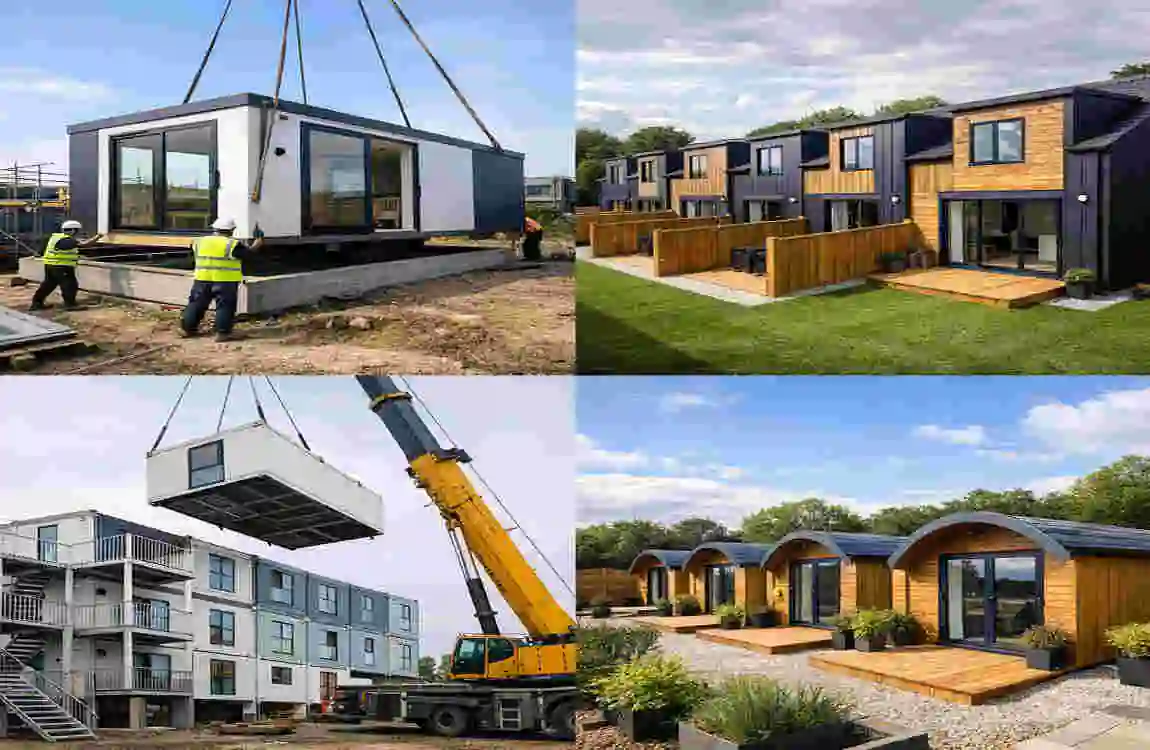
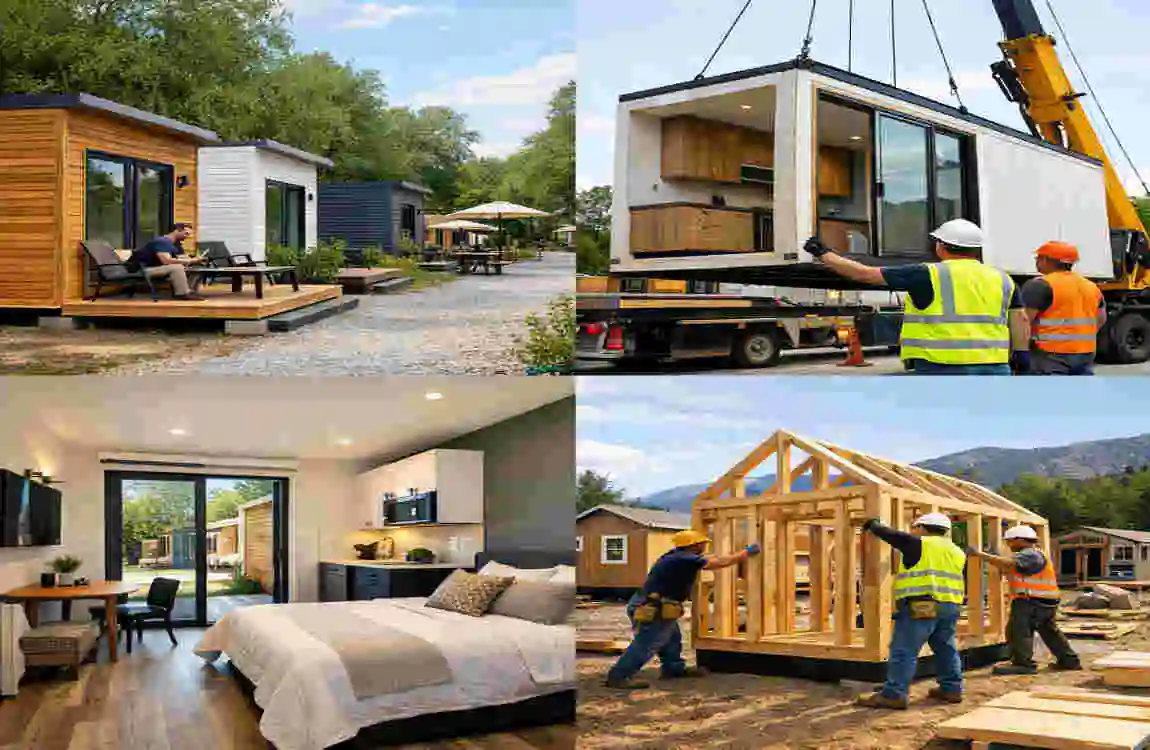
Lightning-Fast Speed Time is money, especially in real estate. According to data from the Home Builders Federation, fast-track housing builds are completed 50% to 70% faster than traditional brick builds. Because workers build the walls, floors, and roofs inside a factory, they do not have to stop working when it rains or snows. Once the pieces are finished, trucks deliver them to the site, and cranes assemble them like giant Lego pieces in just a few days.
Serious Cost Savings: Building faster means spending less on labor and site management. Developers are currently seeing construction costs drop by 20% to 30% when using modular techniques. Factories buy materials in massive bulk, which lowers the cost of lumber, steel, and insulation. Furthermore, factory machines cut materials with laser precision, drastically reducing expensive waste. These savings ultimately trickle down, creating more affordable purchase prices and lower rents for everyday families.
Greener, Cleaner Sustainability. We all need to do our part to protect the environment, and the construction industry is no exception. Short-term housing construction projects boast a much lower carbon footprint. Transporting finished house parts requires fewer delivery trucks than hauling raw materials every single day for a year. Plus, these homes are designed with the latest green tech, meaning they require far less energy to heat and cool.
Government Incentives Driving UK Housing Projects
The government clearly sees the potential here and is actively investing in the sector. Without this official support, the boom would not be happening nearly as fast.
The £10 billion Affordable Homes Program. With the crucial 2026 updates to the Affordable Homes Program, the government has allocated £10 billion to accelerate home building. A large chunk of this funding is reserved exclusively for developers who use modern, off-site construction methods. If a builder promises to use modular tech to build affordable housing, they get pushed to the front of the line for grants and financial support.
Relaxed Planning Rules and Reforms: Getting planning permission in the UK used to be a notoriously slow and painful process. However, recent planning reforms have specifically smoothed the path for fast-track housing builds. Local councils are now encouraged to approve modular housing projects quickly, provided they meet safety and green energy standards. This red-tape reduction allows developers to break ground faster than ever before.
Short-Term Housing Construction Projects UK Spotlight
Now that you understand why this is happening, let us look at where it is happening. Across England, Scotland, and Wales, incredible developments are springing to life.
Here is our exclusive spotlight on the top 10 UK housing construction projects leading the fast-build revolution in 2026.
Legal & General Modular Housing Village, Yorkshire
Up in Yorkshire, Legal & General is completely redefining the village concept. They have successfully launched a massive project featuring 300 fully prefab homes. The most shocking part? The build time from factory floor to final site assembly took just 12 weeks per unit.
They designed these homes specifically to combat the local cost-of-living crisis. By securing affordable rents, they offer a lifeline to young families. Furthermore, every single home features a net-zero carbon design, utilizing advanced solar panels and ground-source heat pumps to keep energy bills virtually non-existent.
Urban Splash’s 3D-Printed Homes, Manchester
Manchester is known for its industrial history, but Urban Splash is bringing it straight into the future. They are currently managing the world’s largest 3D-printed residential housing project right in the city center.
Instead of human bricklayers, massive robotic arms extrude special eco-friendly concrete layer by layer to form the walls. This incredibly innovative technique allows for curved, unique architectural designs that would be far too expensive to build traditionally. It is fast, it produces zero waste, and it is drawing global attention to the Northern Powerhouse.
Peabody’s Factory-Built Flats, London
Finding affordable space in London feels nearly impossible, but Peabody is tackling the challenge head-on. They are focusing heavily on social housing in high-demand urban boroughs by utilizing factory-built apartment modules.
Workers build entire flat units—complete with fitted kitchens, painted walls, and installed bathrooms—in a facility outside the city. Trucks then drive these finished pods into London at night to avoid traffic. Cranes stack them up to create mid-rise apartment blocks in a fraction of the usual time, rapidly easing the city’s housing density issues.
Ilke Homes Revival Project, Derby
If you want to understand the true scale of modern manufacturing, look at Ilke Homes in Derby. Their massive, state-of-the-art factory operates just like a car manufacturing plant. They have achieved an astounding output capacity of 4,000 housing units per year.
Their Revival Project focuses on replacing old, run-down local authority housing with bright, spacious, and hyper-insulated modular homes. Because they use a standardized assembly line, the quality control is absolute perfection. Every home leaves the factory completely defect-free.
TopHat’s Precision Homes, Midlands
TopHat is bringing serious technological firepower to the Midlands. They rely heavily on advanced robotics to complete up to 90% of the construction process off-site.
Their robots cut, nail, and glue timber frames with millimeter precision that human hands cannot match. This extreme precision means their homes are incredibly airtight. When a house is airtight, no heat escapes during the freezing UK winters, making these homes incredibly cheap to heat. They are a brilliant example of technology serving everyday human needs.
Vision Homes Scotland Prefabs
The housing crisis is not just a city problem; rural areas suffer too. Vision Homes Scotland is stepping up to provide high-quality prefab homes for remote northern communities.
Building in the Scottish Highlands is notoriously difficult due to harsh, unpredictable weather. By using fast-track housing builds, Vision Homes bypasses the weather problem entirely. They build the sturdy, weather-resistant modules indoors and lock them together on-site during a brief window of clear weather. This project is bringing vital new life to rural villages.
Willmott Dixon’s Rapid Response Homes, South East
Sometimes, housing needs are sudden and desperate. In the South East, Willmott Dixon is pioneering a rapid response housing project designed specifically for emergencies, such as families displaced by severe winter floods.
These homes are specifically engineered to be deployed and assembled in a matter of days, not weeks. While they serve as emergency relief, they are not flimsy temporary shelters. They are robust, fully functional homes that provide immediate comfort and dignity to people who have lost everything, serving as a critical safety net for the region.
Sigma Homes’ Net-Zero Pods, Bristol
Bristol has always been a famously green and eco-conscious city, and Sigma Homes is perfectly in step with that energy. They are rolling out a series of “Net-Zero Pods” aimed at eco-conscious first-time buyers.
These modular pods arrive on-site with solar roofing tiles already seamlessly integrated into the structure. They also feature built-in rainwater harvesting systems. For young buyers who care deeply about the climate crisis, these fast-build pods offer the perfect blend of modern aesthetics, rapid availability, and total environmental responsibility.
Mount Anvil’s Docklands Micro-Flats
Urban density requires creative solutions. In London’s Docklands, Mount Anvil is using short-term construction projects to build highly efficient micro-flats.
These units have a very small physical footprint, but smart, built-in factory furniture maximizes every single inch of living space. They are targeting young professionals who want to live near the financial district without paying astronomical rents. By stacking these factory-built units high, Mount Anvil is maximizing the use of incredibly expensive London land.
Future Projects:Pipeline
The innovation does not stop with the projects currently on the ground. The 2026 pipeline is absolutely bursting with futuristic ideas.
A prime example is Laing O’Rourke’s upcoming initiative. They are using “digital twins,” which means they build a perfect, fully functioning 3D virtual model of a housing estate before laying a single real brick. This AI-driven software predicts logistical delays and tests energy efficiency in the virtual world, ensuring the actual physical build happens faster and cheaper than ever before.
Quick Stats on Top Housing Construction Projects
To help you digest all this incredible activity, here is a quick reference table comparing some of the leading fast-track projects:
Project Developer Location Focus Avg. Build TimeScope/Units Estimated Cost Savings
Legal & General Yorkshire 12 weeks 300 homes 25% lower than traditional
Urban Splash Manchester 8 weeks 150 (3D Printed) 20% lower materials cost
Peabody London 16 weeks High-density flats 15% overall reduction
Ilke Homes Derby 10 weeks 4,000/year output 30% reduction in labor
Sigma Homes Bristol 14 weeks Eco-Pods Massive lifetime energy savings
How These Housing Construction Projects Are Transforming UK Homes
The UK landscape is changing rapidly. But how exactly are these short-term housing construction projects altering the fundamental way we think about housing? It all comes down to the brilliant intersection of technology, problem-solving, and economics.
Technological Innovations in Fast-Track Builds
To truly appreciate these homes, you need to understand the tech. The industry generally splits these fast builds into three main categories: modular, prefab, and 3D printing.
Modular homes are built in complete, 3D box sections. Imagine a fully finished living room, complete with carpets and light fixtures, being driven down the motorway on a wide-load truck. Prefabricated (prefab) homes are slightly different: factories build flat panels (like a finished wall with windows already installed) that workers then assemble on-site. Finally, 3D printing uses massive automated machines to print the structural shell on-site using quick-drying composite materials.
Let us look at a quick case study. When a developer in Birmingham recently switched from traditional builds to a modular system, they calculated their Return on Investment (ROI). Because they finished the project six months early, they started collecting rental income half a year sooner than projected. That early income easily offset the initial costs of setting up the modular transport logistics, proving the tech is highly profitable.
Challenges and Solutions in Short-Term UK Projects
Of course, no massive industry shift happens without a few growing pains. Fast-track housing builds face unique challenges.
One major hurdle is the supply chain. Because factories churn out homes so quickly, they need a massive, uninterrupted supply of timber, steel, and glass. When global shipping delays happen, the factory line can grind to a halt. To solve this, UK developers are aggressively sourcing materials locally. They are investing heavily in British timber forests and local steel recyclers to ensure they are not reliant on vulnerable international shipping routes.
Another challenge is transport logistics. Moving a fully built, 14-foot-wide bedroom module down narrow, winding British country roads is a logistical nightmare. Companies overcome this by using advanced route-mapping software and working closely with local police to schedule late-night transport convoys, minimizing disruption to everyday traffic.
The Massive Economic Impact on the UK Housing Market
The ripple effects of these UK housing construction projects are transforming the broader economy. First and foremost, they are a massive engine for job creation.
While you might think factory-built homes take jobs away from traditional bricklayers, the reality is quite different. The off-site construction sector has created over 50,000 new, high-skilled jobs in the UK. We now need thousands of factory technicians, robotics engineers, quality control inspectors, and logistics experts. Furthermore, these factory jobs offer safe, indoor, year-round employment, unlike the seasonal and physically grueling nature of traditional site work.
More importantly, these projects are finally helping to stabilize runaway property prices. By rapidly increasing the supply of available homes in high-demand areas, we are starting to see the aggressive bidding wars cool down. When a local council can drop 200 new modular homes into a community in just three months, it immediately relieves the intense pressure on the local rental market.
The Future of Housing Construction Projects in the UK

If 2026 is the year modular housing truly went mainstream, what does the next decade look like? The future of housing construction projects in the UK is incredibly bright, incredibly fast, and driven heavily by artificial intelligence.
AI-Driven Designs and Mass Customization
By 2030, industry experts predict that Artificial Intelligence will completely dominate home design. Currently, modular homes rely on somewhat standardized templates. However, AI software will soon allow buyers to engage in “mass customization.”
Imagine sitting at your computer, dragging and dropping rooms to design your perfect home. The AI will instantly calculate the structural safety, generate the factory blueprints, and send the order straight to the robotic assembly line. You will get a completely bespoke, custom-designed home built with the speed and cost-efficiency of a standardized factory line.
Political Pledges and Policy Outlook
The political landscape is also firmly behind this movement. The current government, which is leaning heavily into Labor’s ambitious pledge to build 1.5 million new homes over the next parliamentary term, knows that traditional methods alone will fail.
Expect to see even more aggressive policy shifts. We anticipate new tax breaks for developers who use zero-carbon modular techniques, and stricter penalties for companies sitting on unused land. The government will likely force local councils to set aside specific land quotas for fast-track housing builds. The political mandate is clear: build faster, or step aside.
Top Tips for Savvy Investors
If you are reading this from a business or investment perspective, this is your wake-up call. The smart money is moving away from slow, traditional developments and pouring into off-site manufacturing.
If you want to capitalize on this boom, look into funding the supply chain. Invest in companies that manufacture robotic arms, eco-friendly insulation panels, or specialized transport vehicles used for modular logistics. Alternatively, look for property funds that specifically target brownfield land (abandoned urban sites). These sites are often ideal for installing pre-built modular flats, enabling a remarkably fast turnaround on your investment capital.
Frequently Asked Questions on Housing Construction Projects UK
To wrap things up, we have compiled a quick FAQ section to answer the most common questions we hear from our readers about these innovative new homes.
What exactly are short-term housing construction projects?
In the context of the 2026 property market, short-term housing construction projects are homes built and ready for move-in in under six months. Instead of building the house brick by brick, developers use modern methods such as factory-built modular components, prefabricated panels, or 3D printing. The bulk of the construction is done off-site, which dramatically speeds up the timeline and avoids weather-related delays.
Which UK city is currently leading in fast-build homes?
While London is utilizing fast builds to solve its high-density flat shortage, cities in the North and Midlands are truly leading the manufacturing charge. Manchester is globally recognized for its massive investments in 3D-printed neighborhoods, while Derby and areas of Yorkshire host some of the largest and most productive modular housing factories in Europe. These areas are becoming the “Silicon Valley” of modern home manufacturing.
What is the average cost of modular housing projects in the UK?
One of the best things about modular housing is the cost reduction. On average, developers and buyers can expect a modular home to cost about 20% to 30% less to construct than a traditional brick-and-mortar home. Because the factories buy materials in massive bulk and use machines that eliminate waste, they pass those substantial savings down the line. This makes these projects highly attractive for affordable housing programs.
Are these fast-track construction projects actually sustainable?
Yes, they are exceptionally sustainable. In fact, they are much greener than traditional builds. Factory construction creates significantly less material waste. Furthermore, because these modular homes are precision-engineered by machines, they are highly airtight. This means they trap heat well, requiring very little energy to stay warm in winter. Many of these projects also come with solar panels and smart-energy systems pre-installed straight from the factory.
