

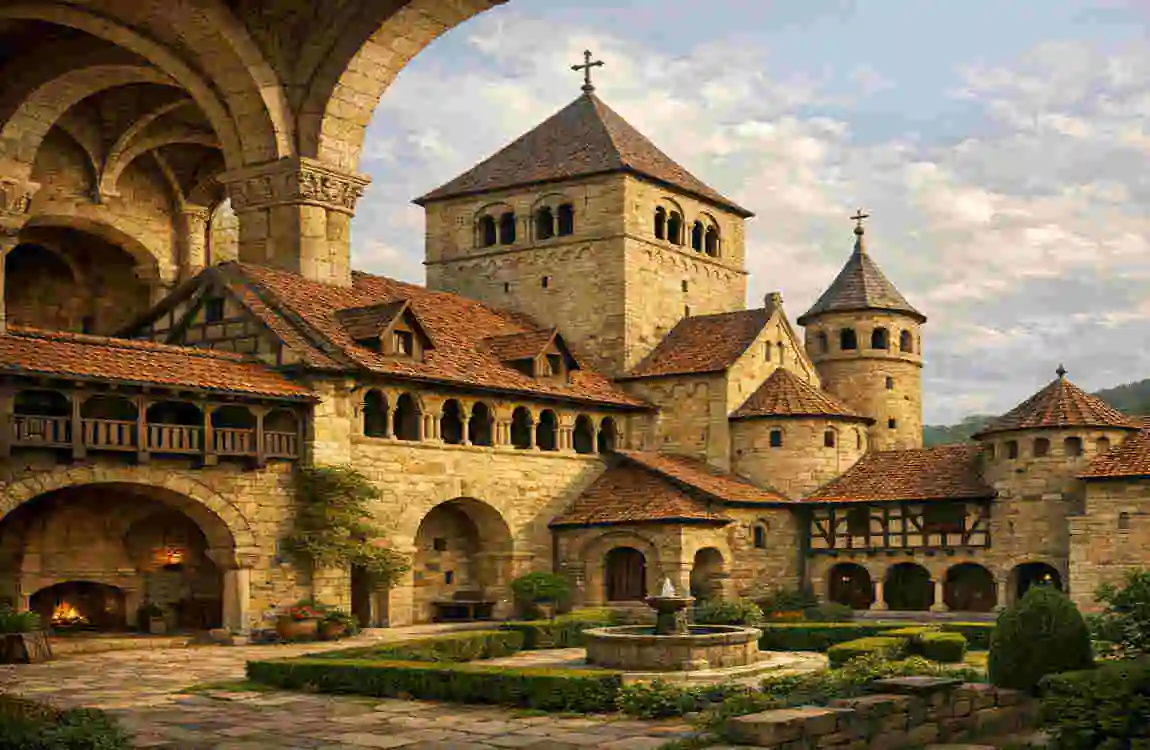
Have you ever walked into a historic building, looked up at a soaring ceiling or a sturdy stone tower, and felt an immediate sense of awe? There is something undeniably magnetic about the architecture of the early Middle Ages. It speaks of power, permanence, and a touch of mystery. While many of us associate these heavy stone designs with grand cathedrals, the Ottonian architectural features found in historic houses and imperial residences are just as captivating—and they are making a surprising comeback in the world of modern luxury design.
If you are a history buff, an architecture enthusiast, or a homeowner looking for inspiration for your next renovation, you have stumbled upon a goldmine of design concepts. We are going to take a deep dive into the 10th and 11th centuries, a time known as the Ottonian Renaissance. This era, under the rule of Emperors Otto I, II, and III, bridged the gap between the older Carolingian styles and the upcoming Romanesque period.
Historical Context of Ottonian Architecture
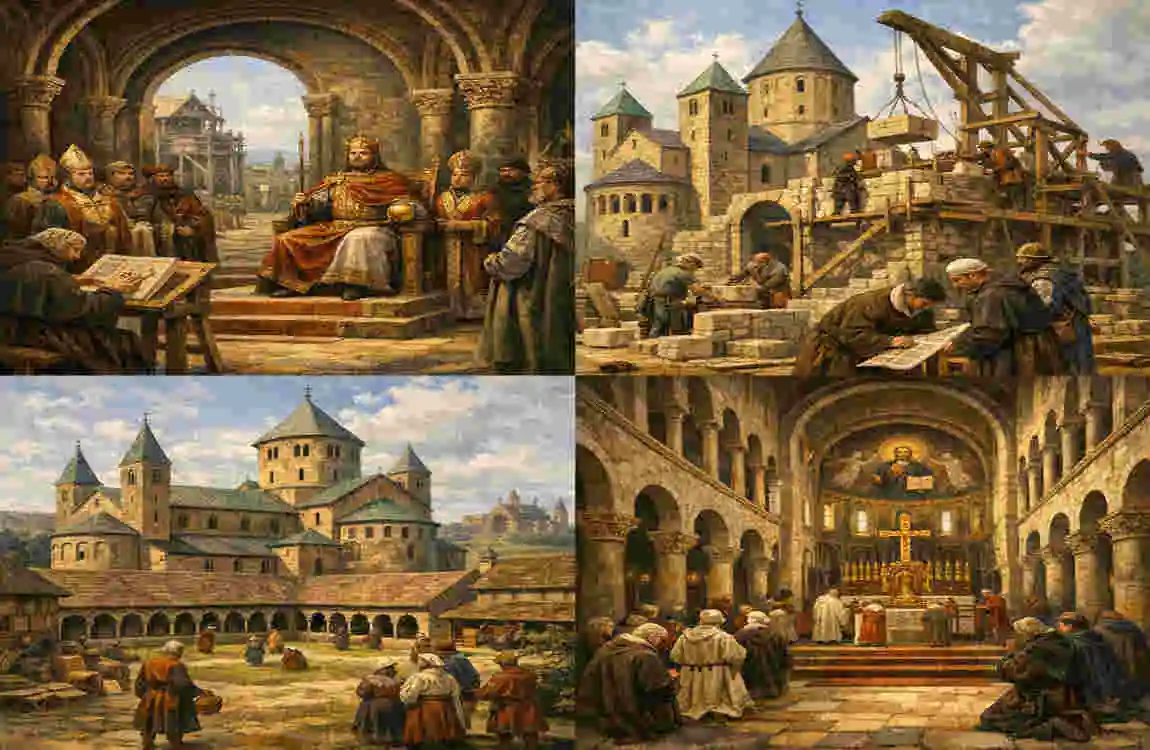
To truly appreciate Ottonian architectural features, we first need to understand the world that created them. Imagine Europe in the mid-10th century. It was a time of rebuilding and consolidation. After the fragmentation of Charlemagne’s empire, a new dynasty emerged from Saxony. This was the Ottonian dynasty, beginning with the coronation of Otto I in 962 AD.
The Ottonian Renaissance 936–1056 AD
The period spanning roughly from 936 to 1056 AD is often called the Ottonian Renaissance. It wasn’t just a political movement; it was a cultural and artistic revival. The Ottonian emperors viewed themselves as the successors to the Roman Caesars. Consequently, they wanted their buildings to reflect the glory of ancient Rome, but with a distinct Germanic twist and Byzantine influences (thanks to the marriage of Otto II to the Byzantine princess Theophanu).
This unique blend of cultures resulted in a style that was monumental yet simplified. Unlike the intricate, lace-like stone carving of later Gothic architecture, Ottonian architecture was about mass, solidity, and geometric clarity. It was designed to impress and to intimidate.
More Than Just Churches
When we look at textbooks, Ottonian architectural features are almost always discussed in the context of great abbeys like St. Michael’s in Hildesheim. However, these features were also integral to secular architecture—specifically, the Pfalzen (imperial palaces) and elite historic houses.
These weren’t just homes; they were power centers. The emperor and his court were itinerant, meaning they traveled from palace to palace. Therefore, each residence had to be a fortress, a church, and a luxury home rolled into one. The architecture had to legitimize their rule. The use of stone in an era of wood, the height of the towers, and the complexity of the vaults were all physical manifestations of the emperor’s divine right to rule.
A Fun Fact About Ottonian Homes
Did you know that these imperial homes were designed for a complete lack of privacy by modern standards? Ottonian homes housed the entire court. The architecture blended extreme functionality with heavy symbolism. The great halls were designed for public feasting and judgment, meaning the Ottonian architectural features we admire today were originally backdrops for high-stakes medieval politics.
Core Ottonian Architectural Features: Vaults
If there is one element that defines the interior atmosphere of this era, it is the vault. Ottonian architectural features in ceilings marked a significant departure from flat timber roofs, moving toward more durable, fire-resistant stone structures. Let’s break down the evolution of the vault in this period.
The Evolution of the Vault
In the earlier Carolingian era, most large spans in secular buildings were covered by flat wooden ceilings. While easy to build, they were fire hazards. The Ottonians began to revive Roman techniques, specifically the barrel vault and the groin vault.
- Barrel Vaults: Imagine a continuous arch, like a tunnel. This was sturdy but heavy. It required thick, continuous walls to support it, which meant fewer windows and darker interiors.
- Groin Vaults: This was the game-changer. A groin vault is formed by the intersection of two barrel vaults at right angles. This creates a stronger structure that directs the weight (or thrust) to the four corners (piers) rather than the entire wall.
Why Ottonian Vaults Matter in Homes
In historic houses and imperial residences, the shift to groin vaults was revolutionary. Because the weight was concentrated on pillars rather than the walls, architects could punch openings into the walls for windows. This allowed light to flood into the great halls and private chapels of the elite.
Ottonian vaulted architectural features were often experimental. You can see this in places like Hildesheim’s residences. The builders were figuring out how to span wider spaces without the roof collapsing. They used stone voussoirs (wedge-shaped stones) and early forms of ribbing—a technique that would eventually evolve into the soaring Gothic-era ceilings.
Visualizing the Structure
To understand the impact of these vaults, compare them to a modern loft conversion. In a modern industrial loft, you might see exposed concrete beams that define the space. Ottonian vaults did the same thing with stone. They created a rhythm in the ceiling.
When walking through a hall with these Ottonian architectural features, you feel a sense of rhythm: arch, space, arch, space. It breaks up the monotony of a long room.
Pros and Cons in the Ottonian Era
Of course, it wasn’t all perfect.
- The Pros: Stone vaults offered excellent thermal mass (keeping homes cool in summer and retaining heat in winter) and protection against fire—a constant threat in the Middle Ages.
- The Cons: They were incredibly expensive and difficult to build. Only the wealthiest imperial families could afford the skilled masons required to construct a groin vault.
Iconic Ottonian Architectural Features: Towers
When you approach a historic building from the Ottonian era, the first thing you notice is the verticality. Towers are perhaps the most visually striking of the Ottonian architectural features. They weren’t just stuck on as an afterthought; they were integral to the design, serving purposes of defense, status, and aesthetics.
Types of Ottonian Towers
Ottonian builders were creative with their tower placement. We generally see a few specific types integrated into house and palace facades:
- Stair Turrets: These were often slender, round, or polygonal towers attached to the main building. They housed spiral staircases—an engineering marvel of the time—allowing access to upper residential floors without taking up interior space.
- Westworks (Westwerk): While primarily a church feature, the concept of a monumental, multi-story entrance with flanking towers was adapted for imperial palaces to create an imposing facade.
- Crossing Towers: In larger complexes, a square tower might sit at the intersection of wings, anchoring the building visually.
Design Specifics and Aesthetics
The beauty of these towers lies in their rugged simplicity. They often featured stepped profiles, where the tower gets slightly narrower as it rises. You will also see corner pilasters (flat, rectangular columns projecting slightly from the wall), which added texture to the stone facade.
Another key detail is the arched window. Near the top of the towers, you would often find bifora windows (double arched windows divided by a small column). This is a classic Ottonian architectural feature that lightens the visual weight of the stone tower.
Function: Defense Meets Luxury
In historic houses of the nobility, towers were a necessity. The 10th century was not a peaceful time. A tower served as a watchpost for imperial security. However, we cannot ignore the “curb appeal” factor. A tall tower signaled to everyone for miles around that a person of significance lived there.
For example, in the imperial residences at Magdeburg and Quedlinburg, towers were status symbols. They elevated the living quarters above the noise and smell of the ground level, offering the nobility fresh air and a view of their domain.
Comparison of Tower Features
Here is a quick breakdown of how different towers functioned within Ottonian architecture:
Tower TypePrimary ShapeKey FunctionTypical Location
Stair Turret , Round or Octagonal , Vertical circulation (Spiral stairs) , Corners of the main hall
Flanking Tower Square or Round Defense and Structural Support , sandwiching the main entrance
Crossing Tower Square Visual Anchor and Light Source Center of the building complex
Watchtower Tall, Square Surveillance and Signaling Detached or semi-detached
Modern Inspiration
Today, we see echoes of these Ottonian architectural features in luxury estates. The “tower room” or the “turret” is a beloved feature in custom home design, offering a cozy reading nook or a dramatic entryway. It’s a direct nod to the grandeur of the Ottonian era.
Imperial Home Designs: Synthesis of Ottonian Features
So, how do vaults and towers come together to make a home? This brings us to the broader topic of imperial home designs. The genius of Ottonian architectural features lies in their synthesis. It wasn’t just about having a tower or a vault; it was about the symmetrical planning and the creation of a “sacred space” for the ruler.
The Layout: Order and Symmetry
Ottonian palaces were distinct from the chaotic, organic growth of earlier medieval villages. They were planned. The layouts usually featured a Great Hall (Aula Regia) as the centerpiece. This was a rectangular building, often two stories high.
The lower floor might be vaulted (using those sturdy groin vaults we discussed) and used for storage or heating. The upper floor, reached by a stair tower, was the main living and reception area. This vertical separation is a hallmark of Ottonian architectural features in residential design.
Decorative Elements
While the structure was heavy stone, the interiors were far from drab. The Ottonians loved color.
- Frescoes: Walls were often covered in plaster and painted with scenes from the Bible or imperial victories.
- Stucco: Elaborate stucco work was used to create reliefs on the walls.
- Column Statues: Columns weren’t just structural; they were decorative. The capitals (the top part of the column) were carved with stylized leaves (a simplified Corinthian style) or geometric patterns.
Case Study: The Pöhlde Abbey Complex
Archaeological excavations at sites like Pöhlde have given us a glimpse into these proto-imperial houses. The residential wings show a clear integration of the church and the home. The emperor could walk from his bedroom to the chapel without stepping outside. This physical connection between the “State” and the “Church” is a defining characteristic of imperial Ottonian designs.
Symbolism of the Home
Every element had a meaning. The verticality of the towers represented aspirations toward heaven and dominance over the earth. The enclosure of the vaults represented safety and divine protection. When you stood in an Ottonian hall, the architecture was designed to make you feel small in the emperor’s presence, yet safe within his walls.
The scale of these homes was massive for the time. Multi-story stone buildings were rare. By building up, the Ottonians were asserting their technological and economic superiority.
Notable Examples of Historic Houses Showcasing Ottonian Architectural Features
Reading about architecture is one thing, but seeing it brings the concepts to life. While many secular buildings from the 10th century have been lost or heavily modified, several key sites still showcase these Ottonian architectural features brilliantly.
Quedlinburg Abbey and Castle Complex
Located in the Harz mountains of Germany, Quedlinburg is a UNESCO World Heritage site and a prime example of the Ottonian legacy. It was a favorite residence of the Ottonian emperors.
- What to look for: Explore the vaulted crypts and the residential quarters. The masonry here is classic Ottonian—sturdy, serious, and beautifully preserved. The towers guarding the castle hill offer a silhouette that has barely changed in a thousand years.
The Imperial Palace of Goslar (Kaiserpfalz Goslar)
Although much of what stands today was expanded in the later Romanesque period, the core layout and foundations are Ottonian.
- What to look for: This is the largest, best-preserved secular building of the 11th century in Germany. Look at the integration of the Great Hall with the chapel. The use of arched windows and the sheer scale of the stone facade perfectly illustrate the “Imperial” style.
St. Michael’s in Hildesheim
While primarily a church, the architectural language here served as the blueprint for Ottonian palaces.
- What to look for: The famous “Bernward Column” and the bronze doors are masterpieces of the era. Architecturally, pay attention to the alternating support system (pillar-column-column-pillar), a rhythmic feature that was likely mirrored in the great halls of the palace.
Lesser-Known Gems in Alsace
In the region of Alsace (bordering France and Germany), you can find older stone houses that, while modified, retain the Ottonian influence. Look for thick walls, small arched windows on the ground floor, and heavy timber framing on upper stories that mimic the structural logic of earlier stone designs.
Modern Interpretations and Legacy of Ottonian Architectural Features
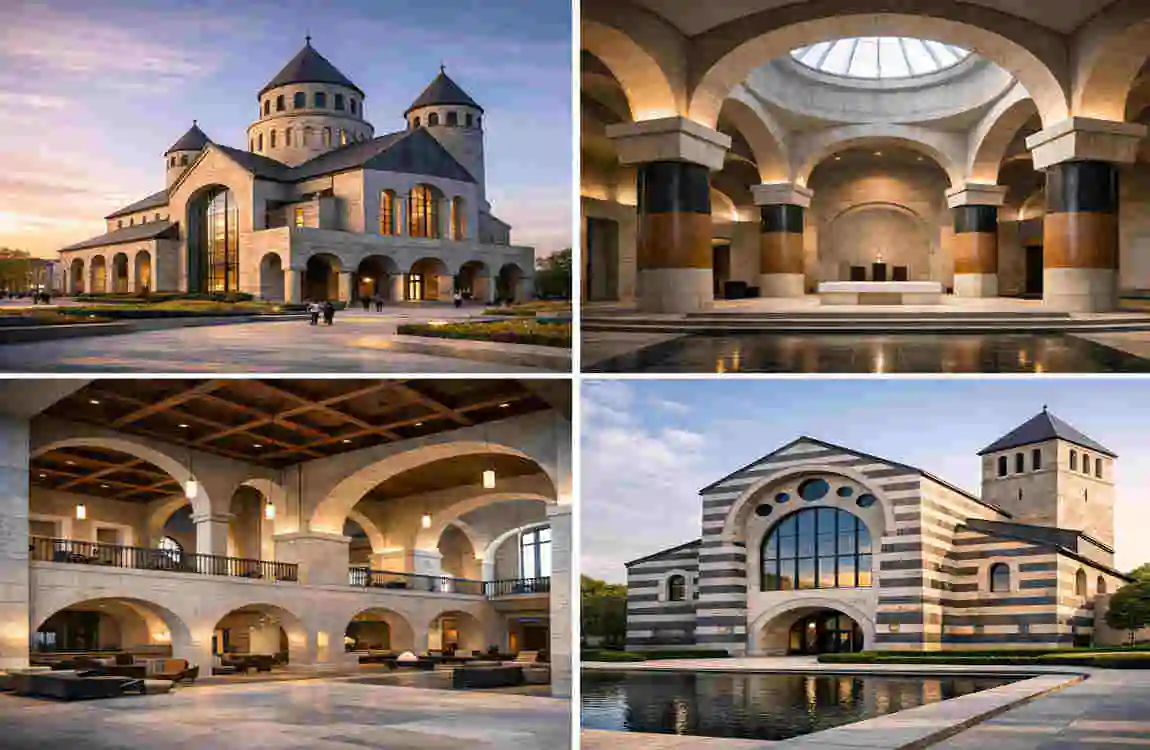
You might be thinking, “This is great history, but how does it apply to my life?” The truth is, Ottonian architectural features are incredibly relevant to modern design. We are currently seeing a revival of “Neo-Romanesque” elements in boutique hotels, wineries, and bespoke luxury homes.
The “Castle Chic” Revival
In the 19th century, there was a massive revival of Romanesque architecture (the direct successor to Ottonian). Today, architects are stripping that back to its minimalist roots.
- Vaulted Ceilings: Modern architects are using brick and stone barrel vaults in kitchens and living rooms to create warmth and acoustic dampening. It adds a “wine cellar” vibe that is cozy and sophisticated.
- Stone Towers: Privacy is a major luxury today. Modern estates are incorporating tower-like structures to house private offices or libraries, separating homeowners from household noise—just as the Ottonian emperors did.
Sustainability and Thermal Efficiency
We mentioned this earlier, but it bears repeating. The thick stone walls and vaults characteristic of Ottonian architectural features are champions of passive temperature control. As we look for greener ways to build, looking back at these heavy thermal mass techniques offers a solution that reduces the need for air conditioning.
The Celebrity Connection
It is worth noting that many celebrities and tech moguls are buying historic estates in Europe or building “modern castles” in the US. They are drawn to the style’s permanence. When you see a celebrity home tour featuring a “grotto” pool or a stone-clad wine room, you are looking at a direct descendant of the Ottonian vault.
Here is a concise, easy-to-read FAQ section that complements the main article. It addresses the most common questions about Ottonian architectural features while maintaining that professional, conversational tone.
Frequently Asked Questions About Ottonian Architectural Features
What are the main distinct Ottonian architectural features?
The most distinct Ottonian architectural features are massive walls, round arches, and a focus on simple, geometric shapes. Unlike the intricate Gothic style that came later, Ottonian architecture is all about solidity and rhythm.
Key elements include the Westwork (a monumental, multi-story entrance with towers), the alternating support system (swapping between columns and piers to hold up arches), and the early use of stone vaults instead of wooden ceilings.
Did Ottonian houses actually have vaults?
Yes, but mostly in the homes of the elite! While common houses had simple timber roofs, imperial residences and palaces (Pfalzen) utilized Ottonian vaults.
Specifically, they used groin vaults (where two barrel vaults intersect) in lower levels, crypts, and sometimes in the side aisles of great halls. These stone vaults were crucial for fire protection and for supporting the heavy floors above, allowing for multi-story living spaces.
Why are towers such a prominent feature?
Towers in Ottonian architecture served a dual purpose: defense and status. In a time of political instability, a tall tower provided a lookout point for security.
However, in historic houses and palaces, towers were also a “billboard” for power. Stair turrets and crossing towers added a vertical emphasis that pointed toward heaven, symbolizing the divine right of the emperor. They transformed a simple residence into a commanding fortress.
How is Ottonian architecture different from Romanesque?
Think of Ottonian architecture as the “prequel” to Romanesque. It is often called Pre-Romanesque.
The main difference is in the decoration and structure. Ottonian walls are often flatter and less decorated than the deeply carved facades of the later Romanesque period. Ottonian architectural features rely more on the sheer mass of the wall and the rhythm of the arches, whereas Romanesque architecture began to articulate the wall more with depth, sculpture, and more complex vaulting systems.
Where is the best place to see Ottonian architectural features today?
The heartland of the Ottonian dynasty was in Saxony, Germany. To see the best preserved Ottonian architectural features, you should visit:
