


Have you ever walked into a dark, cozy room in a basement or an attic and wondered, “Could I just put a bed in here and call it a day?” It sounds tempting to create a snug, cave-like retreat where the morning sun never bothers you. But before you start moving your furniture, you need to ask a critical question: do bedrooms need windows, or can you skip them for a cozy, windowless nook?
When you are designing a home, finishing a basement, or just trying to maximize your living space, the rules around what officially counts as a “bedroom” can seem confusing. A bedroom needs a bed and maybe a closet. However, the law sees things very differently.
Building a home is not just about making things look good. It is mostly about keeping people safe. Emergency egress—which is a fancy term for a safe escape route during emergencies—is one of the biggest factors in home design. If a fire breaks out in the hallway, you need a safe, secondary way to get out of the house. That is where windows come in.
Beyond safety, there are incredible benefits to natural light and proper ventilation. Breathing fresh air and waking up to the sun genuinely impacts your daily mood and health.
Why Windows Matter in Bedrooms
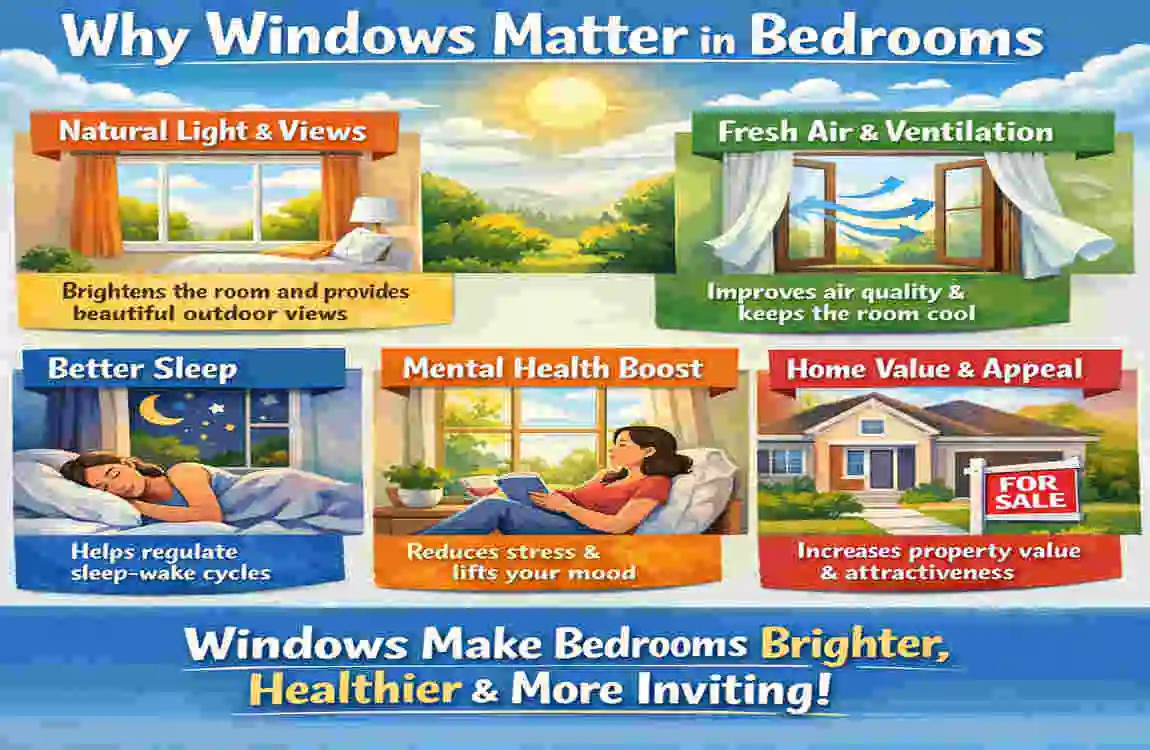
We often take our windows for granted. You pull the curtains back in the morning, peek at the weather, and go about your day. But windows play a massive, multi-faceted role in our homes. They are not just glass panes; they are lifelines, health boosters, and major financial assets.
The Hidden Health Impacts
Let’s talk about your health first. When you sleep in a room, you breathe the same air for 6 to 8 hours. Without a window to crack open, indoor air quality can plummet. Dust mites, pet dander, and stagnant air build up quickly.
A well-placed window lets you flush out stale air and bring in a fresh breeze. This simple act of cross-ventilation can dramatically reduce indoor allergens and keep your respiratory system happy.
Furthermore, your body relies on natural light to regulate its internal clock, known as your circadian rhythm. When you expose yourself to morning sunlight, your brain knows it is time to wake up and be alert. As the sun sets, the fading light signals your body to produce melatonin, helping you sleep. Without a window, your body loses these crucial environmental cues, which can lead to sleep disorders and negatively affect your overall mental well-being.
The Life-Saving Safety Angle
Now, let’s discuss the most critical reason windows matter: your safety.
Imagine waking up to the terrifying sound of a smoke alarm. The hallway outside your bedroom door is filled with thick, black smoke. You cannot safely exit through the rest of the house. What do you do?
If your bedroom has a properly sized window, you have a secondary escape route. According to the National Fire Protection Association, roughly 1 in 4 home fires start in or involve bedrooms. When a fire blocks your primary exit, a window becomes your only lifeline. First responders also use these windows to enter your home and rescue anyone trapped inside. A windowless bedroom in a fire scenario is a deadly trap, plain and simple.
Real Estate Value and Marketability
From a financial perspective, windows are just as vital. If you plan to sell your home eventually, you want to list it with as many bedrooms as possible. More bedrooms equal a higher asking price.
However, real estate laws are very strict. If a room does not have a legally compliant window, you cannot legally market it as a bedroom. Appraisers and real estate agents will firmly label it as a “bonus room,” “office,” or “den.” This simple classification change can knock thousands of dollars off your home’s overall market value.
Legal Requirements: Do Bedrooms Have to Have Windows?
So, let’s answer the big question directly: do bedrooms have to have windows?
Yes, they absolutely do.
Under almost every modern building code in the United States, a bedroom must have at least one operable window (or an exterior door) to legally and safely function as a sleeping space. You cannot simply throw a mattress in a dark storage room and call it a bedroom.
To understand exactly why and how this works, we need to look at the rulebook that most builders and inspectors use: the International Residential Code (IRC).
Breaking Down the International Residential Code (IRC)
The IRC is a comprehensive set of building standards created to ensure homes are safe to live in. While it is an “international” code, local governments adopt and tweak it to fit their specific needs.
When it comes to bedroom windows, the IRC is incredibly specific. It mandates that every sleeping room must have at least one Emergency Escape and Rescue Opening (EERO). This is usually a window, though an exterior door also counts.
Here are the strict minimums set by the IRC for an egress window:
- Minimum net clear opening area: 5.7 square feet (or 5.0 square feet if it is on the ground floor).
- Minimum opening height: 24 inches.
- Minimum opening width: 20 inches.
- Maximum sill height: 44 inches from the finished floor.
You might look at those numbers and think, “Wait, a 24-inch height and a 20-inch width doesn’t equal 5.7 square feet!” You are completely right. Those are just the minimums for each dimension. To hit the required 5.7 square feet of clear, open space, one of those dimensions must be significantly larger.
The IRC offers no full exemption for this rule. If a room is designed for sleeping, it needs an exit. However, there are sometimes very specific, rare variances granted for historic homes or specialized additions, which we will cover later.
Local Codes: How States Tweak the Rules
While the IRC provides the baseline, your local state or city government gets the final say. They can adopt the IRC as is, or add their own stricter rules.
Let’s look at two completely different states to see how this plays out in the real world:
California: The Golden State is famous for its strict environmental and energy laws. Under California Title 24, they focus heavily on energy efficiency and natural lighting. California requires that the glass area of the window must equal at least 10% of the room’s total floor area. If you have a 120-square-foot bedroom, you need at least 12 square feet of glass. This ensures adequate natural light and reduces the need for artificial, electricity-draining lighting during the day.
Texas: In Texas, the climate dictates different priorities. The Texas building codes often emphasize ventilation to address the sweltering heat. While they adhere strictly to the IRC’s 5.7-square-foot egress rule for safety, local Texas municipalities may also have specific requirements for how far the window must open to allow maximum airflow, usually requiring an openable area of at least 4.5 square feet for ventilation.
Comparing Building Codes at a Glance
To make this easier to digest, here is a quick table comparing the standard IRC rules with some common state-level variations:
Code Type Window Size Req.Primary PurposeCommon Exceptions
IRC R310 (Standard) 5.7 sq ft clear opening Emergency Egress None for new builds
California Title 24 10% of total floor area Energy Efficiency / Light Registered Historic Homes
Texas Local Codes 4.5 sq ft operable area Ventilation / Airflow Certain detached ADUs
New York State 5.7 sq ft + strict sill limits Fire Safety in dense housing High-rise sprinklered buildings
Egress Windows: The Non-Negotiable Rule
We have mentioned the word “egress” a few times now, but what does it actually mean for you as a homeowner?
Egress means a path out. In the context of building codes, an egress window is a window large enough and low enough to the floor for a fully grown adult to climb out of during an emergency easily. It also has to be large enough for a firefighter, wearing bulky protective gear and an oxygen tank, to climb into your house.
The 44-Inch Sill Height Rule
One of the most important aspects of an egress window is the sill height. The IRC requires that the bottom of the clear opening (the sill) be no more than 44 inches above the finished floor.
Why 44 inches? Because in a panic, or if the room is filled with blinding smoke, a person needs to be able to easily swing their leg over the window ledge without needing a ladder or a step stool. Children, older people, and people with mobility issues especially need windows that are accessible in a crisis.
A Quick History: Why This Became Mandatory
You might be wondering why building codes are so incredibly strict about this. To understand, we have to look back at the history of the Uniform Building Code (UBC).
Before the 1970s, home building was much more like the Wild West. People built homes with tiny, high-up windows in bedrooms to save money or maximize wall space for furniture. Tragically, a series of devastating residential house fires in the 1970s resulted in high fatalities, specifically because people became trapped in their bedrooms. The windows were either too small to squeeze through or too high to reach.
In response to these tragedies, the UBC (which eventually evolved into today’s IRC) aggressively updated its fire safety mandates. Egress windows transitioned from being a “good idea” to an absolute, non-negotiable legal requirement.
The Cost of Adding an Egress Window
If you are renovating a basement or converting a windowless room into a legal bedroom, you will likely need to install a new egress window.
This is not a simple DIY afternoon project. It involves cutting through your home’s foundation, excavating dirt from the exterior, installing a corrugated window well, and ensuring proper drainage so water doesn’t flood your new bedroom.
Because of the labor-intensive nature of this work, costs typically range from $1,000 to $5,000 per window, depending on your foundation type and the depth of the window well.
Does this sound overwhelming? You don’t have to tackle it alone. Our team specializes in code-compliant window installations. Explore our egress window installation services to get a seamless, safe, and beautiful result.
Ventilation and Natural Light Rules
Safety is the primary reason bedrooms need windows, but it is not the only reason. Building codes also prioritize ensuring your home is a healthy place to live. That is why the IRC includes specific rules about natural light and fresh air.
The 8% and 4% Rules
Beyond the egress requirements, building inspectors look at two specific percentages when evaluating a bedroom window:
- The Light Rule (8%): The total glazed area (which is a builder’s term for the actual glass part of the window) must equal at least 8% of the bedroom’s floor area. This ensures the room gets enough natural daylight, so you aren’t forced to use artificial lighting constantly.
- The Ventilation Rule (4%): The openable area of the window (the part that actually slides, cranks, or swings open) must equal at least 4% of the bedroom’s floor area. This ensures you can pull enough fresh air into the room to maintain healthy indoor air quality.
Can You Use Mechanical Alternatives?
“But wait,” you might ask. “What if I install a really powerful exhaust fan and a massive skylight? Do I still need a traditional window?”
The answer is generally yes. While the IRC allows mechanical ventilation (such as HVAC systems or exhaust fans) and artificial lighting to supplement natural sources, they are considered supplements, not replacements, for egress.
If you have a massive mechanical fan, you might satisfy the ventilation requirement of the code, but you will still fail the egress requirement. You cannot escape a house fire through a bathroom exhaust fan.
Modern Trends: Energy Star Windows
As we navigate through 2026, building codes are becoming increasingly focused on energy efficiency. The days of installing cheap, single-pane glass are long gone.
Today, inspectors and homeowners alike are prioritizing Energy Star-certified windows. These windows feature advanced low-E (low-emissivity) coatings and argon gas fills between the panes. They reflect heat into your room in winter and block the sun’s scorching rays in summer. Upgrading to these modern windows not only satisfies code requirements but also drastically lowers your monthly utility bills.
Exceptions and Special Cases
In the world of construction and real estate, there is almost always an exception to the rule. While you generally cannot build a standard house with a windowless bedroom, certain unique situations require a slightly different approach.
Let’s look at a few special cases where the rules bend, shift, or double down.
Basement Bedrooms: Double the Requirements
Basements are the most common place homeowners try to add a bedroom without adding a window. It makes sense—digging a hole in the ground to install a window is expensive.
However, basement bedrooms are subject to the strictest scrutiny from building inspectors. If your basement has a bedroom, it must have an egress window that exits directly to the outside. Even if the rest of your basement has a walk-out door, the specific room you designate as the bedroom needs its own direct escape route.
Furthermore, if your egress window is below ground level, you must install a window well. This well must provide a minimum clear area of 9 square feet, and if the well is deeper than 44 inches, it must have a permanently affixed ladder or steps so you can climb out.
Tiny Homes and ADUs: Modular Code Loopholes
The rise of Tiny Homes and Accessory Dwelling Units (ADUs) has challenged traditional building codes. Because these structures are so small, traditional egress windows can sometimes take up an entire wall.
Depending on your local jurisdiction, some tiny homes fall under RV (Recreational Vehicle) codes rather than standard residential codes. RV codes often have much smaller egress requirements.
However, if your ADU is built on a permanent foundation, it must comply with the IRC. Always check with your local zoning office before assuming your tiny home is exempt from standard window sizing.
Historic Renovations: The Waiver Process
What if you buy a beautiful, 150-year-old Victorian home, and the original bedroom windows are just an inch too small to meet the modern 5.7 square foot requirement? Do you have to rip out the historic, handcrafted wood frames?
Not necessarily. Local building departments often have a waiver process for officially registered historic homes. Because removing the original architecture would compromise the building’s historical integrity, inspectors may allow you to keep the slightly undersized windows, provided you implement alternative safety measures. This often means installing hardwired, interconnected smoke detectors and, in some cases, a residential fire sprinkler system.
The Appraisal Pitfall: The “Bonus Room”
If you try to sell a home with a room with a closet and a bed but no window, you will run headfirst into a brick wall during the appraisal process.
Appraisers are strictly bound by guidelines set by Fannie Mae, Freddie Mac, and the FHA. If a room does not meet local egress code requirements, the appraiser will not count it as a bedroom.
This means your “4-bedroom house” is legally appraised as a “3-bedroom house with a bonus room.” This seemingly minor difference in terminology can drastically reduce the amount a bank is willing to lend a buyer, potentially tanking your home sale.
Windowless Bedrooms: Workarounds and Risks
Despite all the rules, some homeowners still try to find sneaky ways to create windowless bedrooms. They want to maximize their space and are willing to cut corners to do it. Let’s talk about these “hacks,” why they fail, and the serious risks involved.
The Closet Conversion Myth
A very common trend is converting a large walk-in closet or an interior storage room into a tiny nursery or a guest bedroom. Homeowners think, “If I just add a door and a light fixture, it’s a bedroom!”
As we’ve established, this is entirely false. Not only is it illegal, but a realtor will flat-out refuse to list it as a bedroom on the Multiple Listing Service (MLS). You cannot hack the real estate market by putting a mattress in a closet.
DIY Fixes: Mirrors and LED Sky Ceilings
Some people try to combat the psychological dread of a windowless room by getting creative with interior design.
They might hang large, fake window frames with mirrors inside them to bounce light around the room. Others install high-tech “LED Sky Ceilings”—massive light panels that simulate moving clouds and daylight.
While these DIY fixes are fantastic for making an interior office or a media room feel less claustrophobic, they do not make the room a legal bedroom. They are aesthetic band-aids that completely ignore the physical safety requirement of emergency egress.
The Severe Risks: Failed Inspections and Insurance Hikes
If you decide to ignore the rules and build a windowless bedroom anyway, you are taking on massive liability.
First, if you ever try to pull permits for other work on your house, the building inspector will see the illegal bedroom and force you to tear it out or retrofit it at your own expense.
Second, and far more terrifying, is the insurance risk. Let’s say a fire unfortunately breaks out, and someone is injured because they were sleeping in an illegal, windowless bedroom. Your homeowners’ insurance company will investigate. When they discover that you intentionally bypassed safety codes, they will likely deny your claim entirely. You could be left paying hundreds of thousands of dollars out of pocket and face potential legal negligence charges.
It is never, ever worth the risk to cut corners on safety.
Updates and Future-Proofing Your Home
Building codes are not static; they evolve constantly as technology improves and we learn more about safety and environmental impact. Now that we are solidly in 2026, there are some exciting new updates and trends in the world of windows and home building that you need to be aware of.
New Trends: Smart Glass and Climate-Adaptive Codes
One of the biggest shifts we are seeing right now is the integration of “Smart Glass” (also known as electrochromic glass). These windows can tint automatically based on the sun’s intensity, reducing glare and heat without the need for physical blinds.
While smart glass does not change the physical size requirements for egress, climate-adaptive codes are increasingly dictating where windows should be placed. Some progressive cities are updating their codes to require windows on specific sides of the house to maximize passive solar heating in the winter and minimize solar heat gain in the summer.
The Push for Sustainability: Triple-Pane Mandates
As the fight against climate change accelerates, local governments are getting aggressive about energy conservation. In many northern states and green-certified zones, standard double-pane windows are no longer enough.
We are seeing a massive push toward triple-pane window mandates in new constructions. These windows offer incredible insulation, virtually eliminating drafts and keeping interior temperatures perfectly stable. If you are renovating a bedroom in 2026, investing in triple-pane egress windows is the best way to future-proof your home against upcoming, stricter energy codes.
Predicting the Code Cycle:
The International Residential Code is updated every 3 years. The most recent major revision was the 2024 IRC. Historically, it takes states and local municipalities about two years to fully adopt and enforce the new codes.
This means that right now, in 2026, the 2024 IRC rules are becoming the strict law of the land in most regions. These updates include tighter restrictions on window fall protection (safety grates for second-story windows) and more rigorous testing of window flashing and waterproofing. Staying ahead of these trends ensures your home passes inspection on the first try.
How to Check Your Home’s Compliance
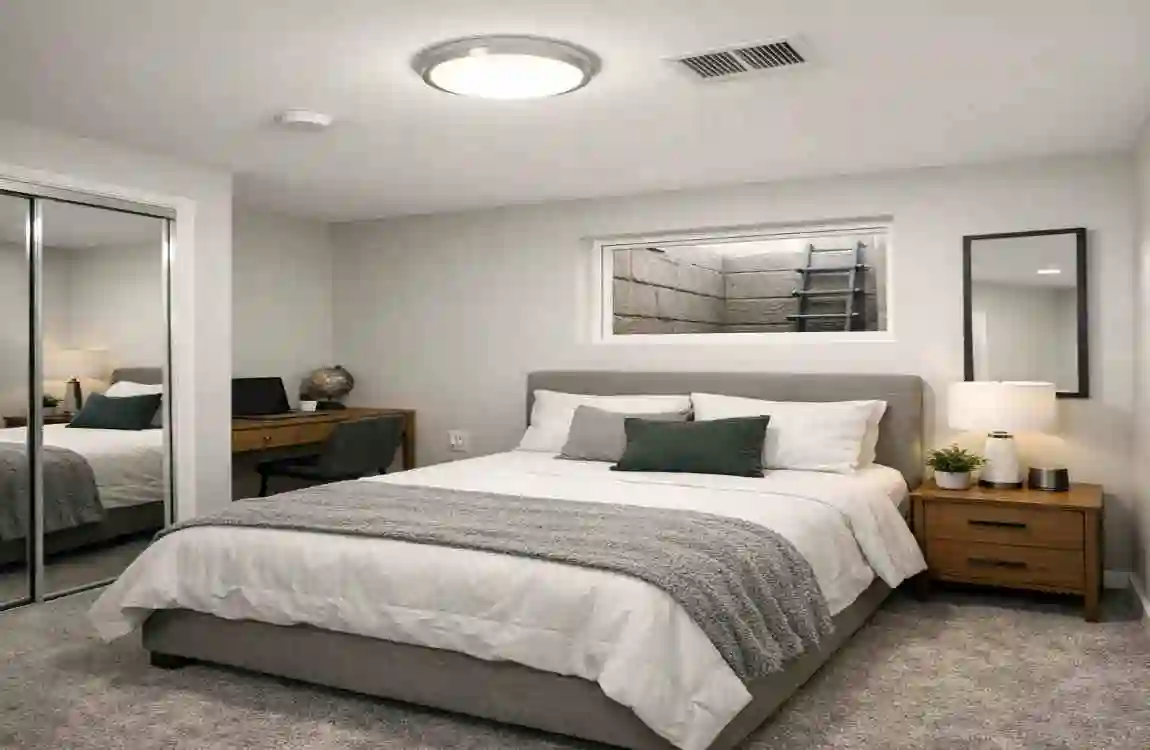
Are you feeling unsure about the bedrooms in your current home? Don’t panic. You can easily check whether your windows are up to code with just a few simple tools and a little time.
Follow this step-by-step guide to audit your own home:
Grab Your Tape Measure
Open your bedroom window as wide as it can go. You need to measure the clear, open space, not the glass itself.
- Measure the width of the open space. Is it at least 20 inches?
- Measure the height of the open space. Is it at least 24 inches?
- Multiply the width by the height (in inches), and divide by 144 to get your square footage. Is it at least 5.7 square feet?
Measure the Sill Height
Drop your tape measure from the bottom lip of the open window straight down to the finished floor. If the number is greater than 44 inches, your window is too high and is non-compliant.
Review Your Home’s Permits
If you recently bought a home with a finished basement, head down to your local city planning or building department. Ask to pull the public permit records for your address. Make sure the basement bedroom was officially permitted and inspected by the city. If it wasn’t, you might have inherited an illegal space.
Test the Operation
Egress windows must be operational from the inside without the use of keys, tools, or special knowledge. Try to open your window. Does it stick? Do you need to wiggle it forcefully? Are there security bars bolted over the outside? If you can’t open it easily in a panic, it is not a safe egress window.
Frequently Asked Questions (FAQ)
To wrap up all this technical information, let’s address some of the most common questions homeowners ask us about bedroom window requirements.
Do bedrooms have to have windows in every state?
Yes, practically speaking. While local codes vary slightly, all 50 states base their building regulations on the International Residential Code (IRC) or similar standards. These codes universally require an emergency escape and rescue opening (usually a window) in any room classified as a bedroom.
What is the absolute minimum window size for a bedroom?
Under the standard IRC, the minimum clear opening must be 5.7 square feet (or 5.0 square feet for ground-floor rooms). The opening must be at least 20 inches wide and at least 24 inches high. Keep in mind that a 20×24-inch opening is only 3.3 square feet, so one of those dimensions must be much larger to meet the 5.7-square-foot rule.
Can a bedroom have no windows in an apartment?
No. Apartment buildings are subject to commercial and multi-family building codes (such as the International Building Code, or IBC), which are often stricter than residential codes. A bedroom in an apartment must have an operable window for fire safety. The only exception is if the building has a highly specialized, engineered, and approved alternative egress system, which is incredibly rare in standard residential units.
Does a skylight count as a bedroom window?
It can, but only under very specific conditions. For a skylight to count as an egress window, it must meet the minimum clear opening size (5.7 square feet), and the bottom edge of the skylight must be no more than 44 inches from the floor. Since skylights are typically installed high up on the ceiling, they rarely qualify as legal egress.
I want to add a bedroom to my basement. Do I have to dig a window well?
Yes. If your basement is completely underground and you want to add a legal bedroom, you must excavate the earth outside and install an egress window well. The well must be large enough to allow the window to open fully and must provide enough space for a person to climb out.
If my room has a door leading to the outside, does it still need a window?
Not necessarily! The building code requires an “Emergency Escape and Rescue Opening.” While we usually assume this is a window. This exterior door, which leads directly outside, perfectly satisfies this requirement, as long as it meets the size requirements and can be opened easily from the inside.
