

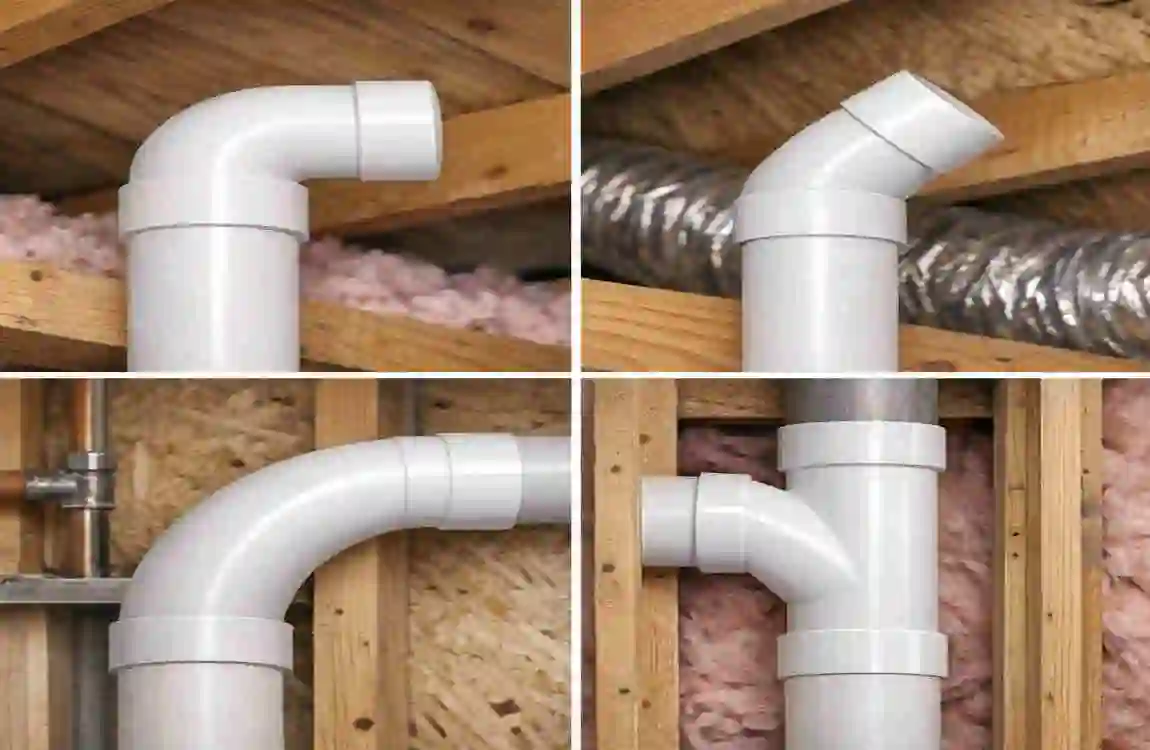
Have you ever walked into your beautiful bathroom only to be greeted by a strange, swampy smell? Or maybe you have noticed your kitchen sink draining at a snail’s pace, accompanied by an annoying gurgling sound. These common household annoyances usually point to one hidden culprit: your plumbing vent system.
While we often think about the pipes that carry water into our homes and the drains that whisk waste away, we rarely think about the air pipes that make it all work. Plumbing vents matter in every single house. They are the unsung heroes that stop foul smells, prevent slow drains, and keep bubbles from popping up in your sinks. Without a proper airway, your plumbing system would literally choke.
Today, we are going to dive deep into a very specific, yet incredibly crucial, part of this system: the vent elbows hidden inside your walls and ceilings.
What Are Plumbing Vent Elbows?
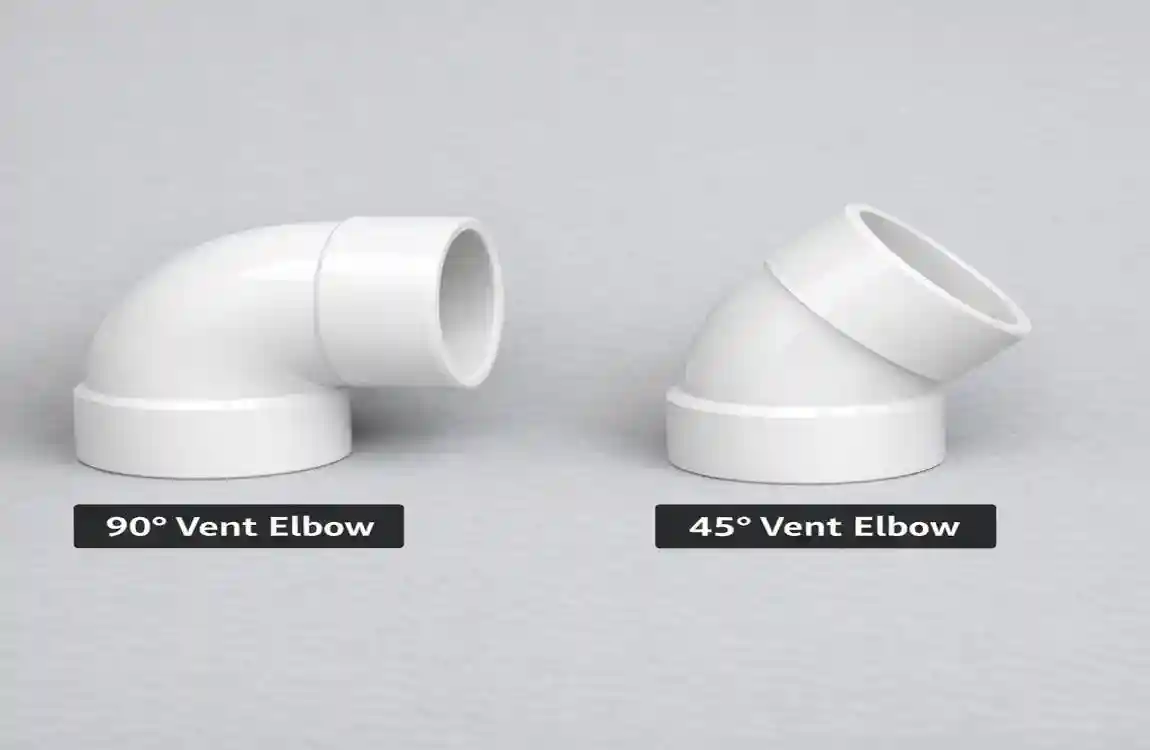
Before we dive into the specific types, let us define what a plumbing vent elbow actually is. In the simplest terms, a plumbing vent elbow is a specially designed pipe fitting that changes the direction of your vent lines.
Think of your vent pipes like a highway for air. Sometimes, that highway needs to take a turn to avoid a wall stud, navigate through an attic, or reach the roof. The elbow is the curved piece that allows that turn.
What role does this play in a house vent system? Vent elbows help maintain air-pressure equalization. When water rushes down a drain, it pushes air in front of it and pulls air behind it. The vent system provides the necessary air so the water flows smoothly. It also safely removes toxic sewer gas from your home and vents it outside. Most importantly, it protects your trap seals—the little pool of water in the curved pipe under your sink that blocks sewer odors from entering your rooms.
It is important to understand how a vent elbow differs from a standard drain elbow. While they might look similar to the untrained eye, their jobs are very different. Drain elbows are designed to handle the heavy, fast flow of water and solid waste. Vent elbows, on the other hand, are strictly designed to handle the flow of air and the occasional drop of condensation.
When you walk down the plumbing aisle at your local hardware store, you will see these elbows in a few common materials. Modern homes primarily use PVC (the white plastic) or ABS (the black plastic). Older homes might still have heavy cast-iron vent pipes. We will explore these materials in more detail later, but for now, know that the material you choose needs to match the rest of your system.
Why Are Vent Elbows Important in a House?
You might be thinking, “It’s just a curved piece of plastic. Does it really matter?” The short answer is a resounding yes. The performance of your entire plumbing system relies heavily on these seemingly insignificant fittings.
First and foremost, correctly installed vent elbows prevent clogs, eliminate gurgling noises, and fix slow-draining sinks. If your vent system cannot pull in enough air, your drains will struggle. Imagine putting your finger over the top of a straw filled with water; the water stays trapped inside. The moment you remove your finger—letting air in—the water drops. Your plumbing works the same way.
Proper elbows also protect your home from dangerous sewer gas entry and trap siphoning. If a vent is choked off because of a bad bend, rushing drain water will suck the water right out of your P-traps. Once that water barrier is gone, nothing stops raw sewer gases from drifting into your living space.
Many homeowners do not realize that poorly placed elbows can severely restrict airflow, even if the pipe technically remains “open.” Every time air is forced to turn a sharp corner, it creates friction and turbulence. Too many sharp turns, and the air cannot move fast enough to keep up with the draining water.
This is why code-compliant elbows are so vital. They keep the house safe, ensure optimal airflow, and keep your home up to standard. Understanding the correct types of plumbing vent elbows in house systems is key to avoiding these frustrating and potentially unhealthy issues.
Common Types of Plumbing Vent Elbows in House Systems
Not all pipe bends are created equal. Depending on where the pipe is located and how much air needs to flow through it, plumbers use different angles and shapes. Let’s break down each main elbow type used in residential vents.
90-Degree Vent Elbows (Standard Elbows)
The 90-degree vent elbow is exactly what it sounds like: a sharp, right-angle change in direction.
Where they are used in a house: You will typically find these standard elbows in vertical stacks, right at the point where a vent pipe exits the roof, or in tight attic spaces and wall offsets where a pipe needs to make an immediate, sharp turn to fit inside the wooden framing.
Code note: Building codes often allow 90-degree elbows in vent systems, but they are certainly not preferred for long-run vents where maintaining high air velocity is important.
45-Degree Vent Elbows (Smaller Bends)
When you want to be kinder to your airflow, you reach for a 45-degree vent elbow.
These fittings offer a much smoother transition than their sharp 90-degree cousins. Instead of forcing the air to slam into a wall and turn abruptly, a 45-degree elbow gently guides the air in a new direction.
Ideal locations: These are perfect for offsets around support beams, floor joists, or any area where you need to change the direction of the pipe without choking airflow. Plumbers often use two 45-degree elbows together to create a smooth, sweeping 90-degree turn.
Why guidebooks prefer them: If you read any plumbing guidebook or manual, you will see heavy praise for the 45-degree elbow. The gentle bend drastically reduces air turbulence and promotes much better gas flow.
If you look at International Plumbing Code (IPC) style guidance, you will find that local code expectations almost always prefer the use of 45-degree bends over sharper angles to ensure the system breathes easily.
Long-Radius (Sweep) Elbows
If you have the space for it, the long-radius elbow—often called a sweep elbow—is the gold standard for moving air and waste.
These fittings feature a significantly wider bend radius than a standard 90-degree elbow. The curve is stretched out, making the transition incredibly smooth.
How they reduce friction: Because the curve is so gradual, air glides through a long-radius elbow with almost zero resistance. Furthermore, this smooth design drastically reduces the risk of clogs or condensation buildup, which can occur when moisture gets trapped in a sharp corner.
Typical use: You will usually see sweep elbows used in horizontal wet-vent runs behind walls and deep in basements. A wet vent is a pipe that serves as a drain for one fixture and a vent for another, so it must handle both air and water flawlessly.
When you are researching the best types of plumbing vent elbows in house systems that carry both air and occasional condensate, the long-radius elbow is usually the top recommendation for ensuring long-term reliability.
Reducing Elbows (For Mixed Pipe Sizes)
Sometimes, your plumbing system needs to transition from a larger pipe to a smaller one while simultaneously turning a corner. That is where reducing elbows comes in.
These are special elbows that connect two pipes of different diameters—for example, reducing a larger 3-inch main vent to a smaller 2-inch branch vent.
Where they appear in a house: You will spot these transitions where the main, thick soil stack branches off to vent a smaller group of fixtures, like a single guest bathroom.
A quick warning: You should never use a reducing elbow to shrink a pipe size unnecessarily. Shrinking the pipe limits the amount of air that can flow through it, which can easily restrict airflow and cause your drains to choke. Only use reducing elbows when your plumbing plan specifically calls for a smaller branch line.
Sanitary-Style Elbows (Sanitary Tees Plus Elbows in Traps/Vents)
Finally, we need to talk about sanitary-style elbows and fittings.
Technically, things like sanitary Tees and sanitary elbows are heavily involved in drainage, but they work hand in hand with your vents. These fittings are specially designed with a sweeping curve to guide waste down while allowing air to flow up.
They are widely used in fixture trap arms—the horizontal pipe that connects your sink drain to the wall and then feeds directly into the vent stack.
While a purist might argue that not all of these are strictly “vent elbows,” they undeniably live in the same venting story. Their swooping design plays a massive role in residential drain-vent combos, ensuring that water flows away without sucking the air—and the trap seal—down with it.
Here is a quick reference guide to help you remember the different types:
Elbow Type: Typical Use in House Plumbing: Airflow Impact: Notes
90° standard Stack offsets, tight wall runs , Higher resistance, Limit the quantity you use
45° Gentle redirects around beams Lower resistance Very Code-friendly
Long-radius Main vent runs, horizontal wet vents. Very smooth. Takes up more physical space
Redupipe-size transitions depend on the size ratio. Use only when absolutely needed
Sanitary-style Trap arms feeding into vents. Moderate. Often paired with Sanitary Tees
Where Are Vent Elbows Placed in a Residential House?
Now that you know the different shapes and sizes, let’s explore where these elbows actually live inside your home. Placement is everything when it comes to effective venting.
Inside Walls and Attics
Most of your plumbing is invisible, hidden away inside your walls and attic spaces. Vertical vent runs travel up through the stud bays of your home. However, houses are full of obstacles, such as electrical wires, structural beams, and HVAC ducts.
To avoid this framing, plumbers use 90-degree or 45-degree elbows to jog the pipe to the left or right, bypassing the obstacle before continuing upward. These elbows route the vent lines safely toward the roof or connect smaller branch vents into a larger horizontal main vent hidden in the ceiling.
Roof Exits and Attic Transitions
Your vent system ultimately has to release gases into the open air outside. This requires breaching the roof.
Often, plumbers will use an elbow or a combination of 45-degree elbows to bring the vent up and straight through the roof deck. These roof exits must be placed properly. Plumbers use elbows to angle the pipes so they exit above the roofline and stay far away from operable windows. You certainly do not want an elbow routing sewer gas directly next to your bedroom window!
Basement and Crawl Space Vent Runs
If you look up while standing in an unfinished basement, you will likely see a network of horizontal pipes.
Many of these are horizontal wet vents. In these areas, plumbers strongly prefer using long-radius sweep elbows or 45-degree elbows. Because these pipes run horizontally, any condensation that forms inside the vent pipe needs a smooth path to drip back into the main sewer line. Sharp elbows in a basement run can trap debris and moisture, leading to clogs.
Fixture-Specific Venting (Toilets, Sinks, Showers)
Every water fixture in your home must be vented.
You will find small elbows very close to the P-traps under your sinks, branching off behind your walls. For example, you might have a tiny vent elbow sitting just above a sink’s Air Admittance Valve (AAV), hidden in a cabinet, or tucked tight behind a wall-mounted toilet to connect it to the main stack. These small, localized bends ensure that specific fixture drains perfectly every time you turn off the tap.
Materials and Compatibility for House Vent Elbows
You cannot just grab any random piece of curved pipe off the shelf. Vent elbows come in several materials, and matching them correctly is a matter of building code and safety.
Common Material Overview
The most common materials you will encounter are PVC (Polyvinyl Chloride), ABS (Acrylonitrile Butadiene Styrene), cast iron, and sometimes copper.
Older homes often feature thick, heavy cast-iron or even copper vent pipes. However, if your home was built or remodeled in the last few decades, your vent elbows are almost certainly plastic.
Why Plastic Dominates Modern Construction
PVC and ABS completely dominate modern residential construction for a simple reason: they are incredibly lightweight, very inexpensive, and highly corrosion-resistant. Sewer gases are highly acidic and can slowly corrode metal pipes over decades. Plastics like PVC and ABS shrug off these corrosive gases without a problem.
The Rule of Compatibility
One of the most important rules of plumbing is matching your elbows to your pipe type. You must never mix PVC (white) with ABS (black) using standard chemical glues. They require different types of solvent cements to melt and fuse the plastic. If you must connect an ABS elbow to a PVC pipe, you must use proper mechanical transition adapters, not just glue.
Temperature and UV Resistance
You also need to consider the elements. For vent pipes that exit your roof and are exposed to the sun, UV resistance is vital. ABS plastic can degrade and become brittle when exposed to direct sunlight for extended periods. Therefore, many codes require using PVC-only elbows and pipes for exposed roof exits, as PVC handles UV rays much better.
Finally, pay attention to the connections. Most residential plastic vent elbows use a solvent-weld (glue) system, which permanently fuses the plastic parts. However, you might occasionally find threaded elbows used in cleanout access points or specific fixture setups.
Code and Safety Considerations for Vent Elbows in Homes
Plumbing codes can seem like annoying red tape, but they exist strictly to keep your home safe, sanitary, and smelling fresh. Understanding these rules establishes good plumbing habits.
General Code Principles (IPC-style)
If you look at the International Plumbing Code (IPC), which many local codes are based on, you will find strict rules about elbows.
The primary rule is to limit the number of bends in a vent line. You want to avoid having “too many” elbows completely. Every bend reduces airflow efficiency. If a vent snakes around too much, it becomes useless.
This is why there is a strong code preference for using 45-degree and long-radius elbows over tight 90-degree bends in many situations. Furthermore, you are strictly prohibited from installing sharp elbows below the waterline in any system that acts as both a drain and a vent, as it will trap solid waste.
Slope and Airflow Guidance
Many people assume that because a vent only carries air, it can be installed perfectly flat. This is a massive misconception.
Even horizontal vent elbows must maintain a correct, slight slope back toward the main drain. Why? Warm, moist air from your sewer system creates condensation inside the vent pipes. If the pipe is perfectly flat, the water puddles. By sloping the elbows and horizontal runs, that moisture safely drips back down into the sewer.
Additionally, codes require that main vent stacks remain as vertical as possible, using elbows only when an offset is absolutely unavoidable.
Vent Termination and Roof Elbows
The elbows that bring your vent up through the roof are heavily regulated.
Codes dictate the minimum height the pipe must extend above the roofline (often to prevent snow from burying the vent in the winter). Codes also dictate how far these termination points must be from any openable window, door, or air intake. Elbows are widely used in attics to shift pipes left or right to meet these strict clearance requirements.
Local Code Variations
It is crucial to remember that plumbing codes vary wildly depending on where you live. A rule that applies in Florida might not apply in freezing North Dakota.
We highly encourage you to check your local plumbing code rather than relying entirely on a one-size-fits-all internet rule. If you are ever staring at a massive, complicated web of pipes and wondering how to vent it legally, that is the perfect time to involve a licensed local plumber.
How to Choose the Right Type of Vent Elbow for Your House
With all this information, how do you actually pick the right elbow at the hardware store? Let us break down a simple decision process.
Step 1: Look at the layout and space. Start by evaluating your system layout and the available physical space. If you are inside a cramped 2×4 wall, you might be forced to use a standard 90-degree elbow.
Step 2: Prioritize gentle bends. Whenever you have the room—especially in attics, basements, and for long-run vents—always prefer 45-degree or long-radius sweep elbows. Your airflow will thank you.
Step 3: Limit the sharp turns. Make a conscious effort to use 90-degree elbows sparingly. Reserve them only for spaces where you absolutely have no other option.
Step 4: Think about the future. Always consider future maintenance access. If leaves, a bird’s nest, or heavy condensation clog your roof vent, a plumber will need to run a drain snake down the pipe. Can a plumbing snake easily navigate the elbow you are installing? Sharp 90s make snaking very difficult; sweep elbows make it easy.
Step 5: Match materials. This is non-negotiable. Match your pipe size and material exactly. Do not slap a 2-inch elbow on a 3-inch pipe without a proper reducing fitting, and do not mix plastics without approved adapters.
When in doubt, the safest bet is always to use the manufacturer-recommended elbows for the specific vent system in your home.
DIY vs Hiring a Professional: Vent Elbows in House Systems
With the rise of DIY home improvement videos, many homeowners are eager to grab some PVC glue and tackle plumbing issues themselves. But is vent work a good DIY project?
When it is okay for a homeowner: If you are dealing with a simple, highly visible vent elbow in an unfinished basement or an easy-to-reach attic space, replacing it can be a manageable DIY task. Cutting out a cracked elbow and gluing in a new one is straightforward if you know how to prime and glue PVC correctly. Installing a small vent for a single new vanity sink is also well within the realm of an ambitious DIYer.
When you should absolutely call a plumber: You should step away and call a professional when you are dealing with:
- Complex stack configurations: If you are relocating a main 3-inch or 4-inch soil stack that vents multiple bathrooms, the code requirements for airflow and angles are extremely complex.
- Roof-line vent elbows: Anytime you are cutting holes in your roof to run a vent, you risk massive water damage to your home if the flashing and elbows are not installed perfectly.
- Failed inspections: If your DIY modifications cause your system to fail a building code inspection, call a pro to fix the layout.
You must emphasize to yourself that bad elbow choices can easily void home warranties or cause massive slow-drain issues down the road that will cost ten times as much to fix.
Common Mistakes with Vent Elbows in a House
To save you time and headaches, we have compiled a list of the most frequent mistakes we see homeowners and amateur handypersons make when installing vent elbows. Avoid these at all costs!
- Packing in too many 90-degree elbows: Snaking a vent pipe through a maze of 90-degree turns creates a massive air choke-point. The pipe might be connected, but the air will barely flow.
- Using drain-only elbows in vent lines: Drain fittings often have different internal profiles. Make sure you use fittings approved for venting to prevent airflow restriction.
- Installing elbows that trap condensate: Never install a vent elbow in a way that creates a dip or a “belly” in the pipe. Moisture will pool in the elbow, eventually blocking the air completely. Always maintain a slope back to the drain.
- Misplacing elbows around trap arms: Putting a vent elbow too close or too far from a P-trap can disrupt the pressure dynamics, causing the water in the trap to siphon out and letting sewer gas into your home.
- Changing vent pipe size randomly: Never use reducing elbows to neck down a vent pipe size just because you ran out of the larger pipe. This chokes the system and violates building codes.
Visualizing Vent Elbows: How They Fit in a Whole-House System
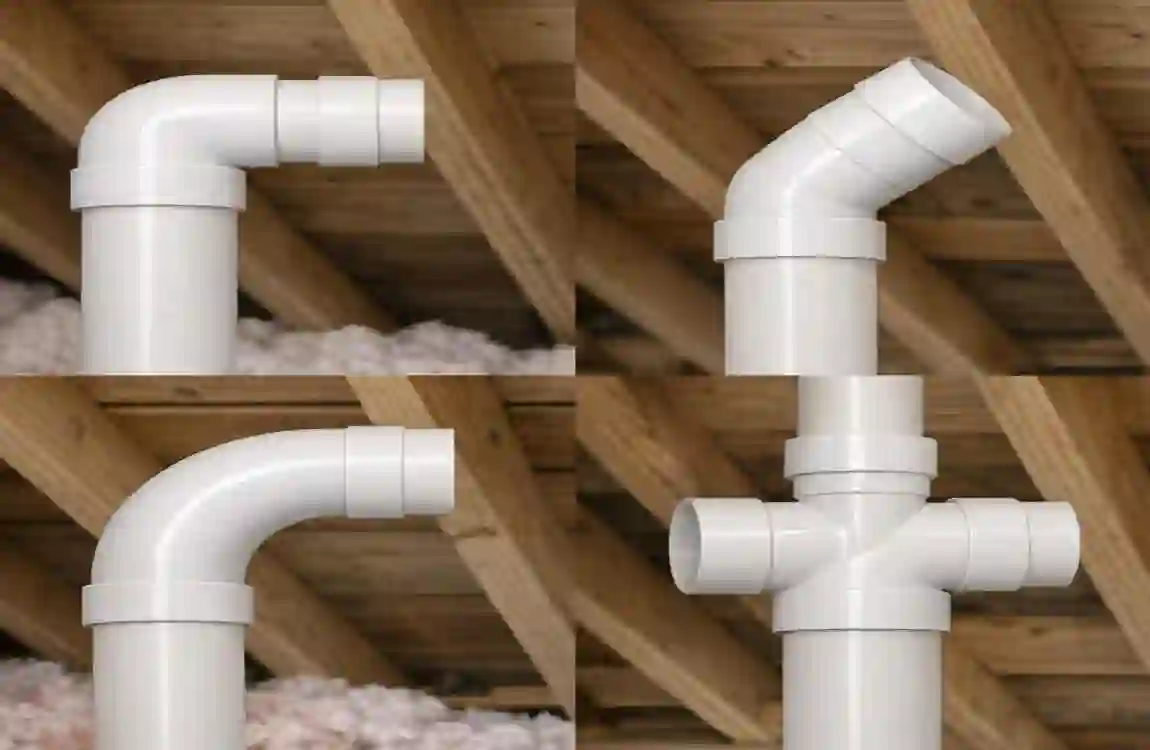
Sometimes, it helps to close your eyes and map out the system in your head.
Briefly picture a typical modern vent layout. At the center of your modern home, you have the main stack, a large vertical pipe running from your basement sewer line straight up through the roof.
Branching off from this main trunk, like branches on a tree, are your branch vents. These run to your individual bathrooms and kitchens. Finally, at specific sinks or islands where running a pipe to the roof is impossible, you might have localized AAVs (Air Admittance Valves).
Elbows sit at every single junction of this invisible tree. You have a sanitary elbow “behind the bathroom wall” guiding air up from the sink trap. You have a long-radius elbow in the basement guiding a wet vent into the main stack. You have a pair of 45-degree elbows “near the attic roof-penetration,” jogging the main stack out of the way of a roof valley.
Every single elbow is a crucial link in the chain that keeps your home breathing freely.
FAQ Section: Types of Plumbing Vent Elbows in the House
To wrap up our deep dive, let’s answer some of the most common questions homeowners ask about their venting systems.
Can plumbing vents have elbows in a house?
Yes, absolutely. It is virtually impossible to build a house without using elbows to route the pipes around framing and obstacles. However, they must follow local plumbing codes and be strategically placed so they do not restrict the vital airflow your drains need. As noted by experts at Evans Plumbing Inc, while elbows are allowed, the goal is always to use the minimum number required.
What is the best angle for vent elbows in a residential house?
45-degree and long-radius bends are generally preferred. According to resources like Plumbing List, these gentler angles create significantly less air friction and turbulence than sharp 90-degree turns, allowing the plumbing system to “breathe” much more easily.
How many elbows can a plumbing vent have in a house?
Codes strictly limit the total number of bends and sharp turns. While there isn’t always a single magic number for every house, building codes require you to keep directional changes to the absolute minimum required. As highlighted by Sunset Cliffs Plumbing, excessive bends create a cumulative restriction on airflow that will eventually cause your drains to fail.
Can I use 90-degree elbows on a house vent pipe?
Yes, but in limited places. You can use standard 90-degree elbows, especially when fitting pipes into tight wall framing. However, you should avoid clustering them together or using them heavily in long horizontal runs. Evans Plumbing Inc points out that 90-degree angles are sometimes necessary, but they should be a last resort compared to smoother angles.
Do vent elbows cause clogs or odors if installed incorrectly?
Yes, they absolutely do. If an elbow is installed flat (without a slope) or if too many elbows are installed too close together, improper elbows can trap condensation and severely restrict airflow. According to Sunset Cliffs Plumbing, this lack of air leads to trap siphoning, allowing foul sewer smells to enter the home and causing loud gurgling noises from the sink.
