

Imagine this scenario: You have just finished a beautiful, expensive renovation on your dream kitchen. The countertops gleam, the new cabinets are perfect, and you are ready to host your first family dinner. But suddenly, you notice a dark water stain spreading across your brand-new ceiling just beneath the upstairs bathroom. A leaky pipe has just turned your dream home into a complete nightmare.
Situations like this are incredibly common, but they are also entirely preventable. The secret lies behind your walls. Choosing the right plumbing pipes and fittings for house projects is the single most important decision you can make to protect your home from devastating water damage.
We often spend months picking out the perfect paint colours or hardwood floors, but we completely ignore the essential network of pipes that carry water in and out of our daily lives. As we move deeper into 2026, modern home renovations are focusing heavily on what is behind the drywall. Industry reports show that homeowners are prioritising water efficiency, sustainability, and leak-proof technology more than ever before.
Upgrading your setup is not just about avoiding disasters. It is also about saving money on your monthly water bills and ensuring your family has clean, safe drinking water. Modern materials perform better, last longer, and are surprisingly easy to work with.
Why Choose the Right Plumbing Pipes and Fittings for a House?
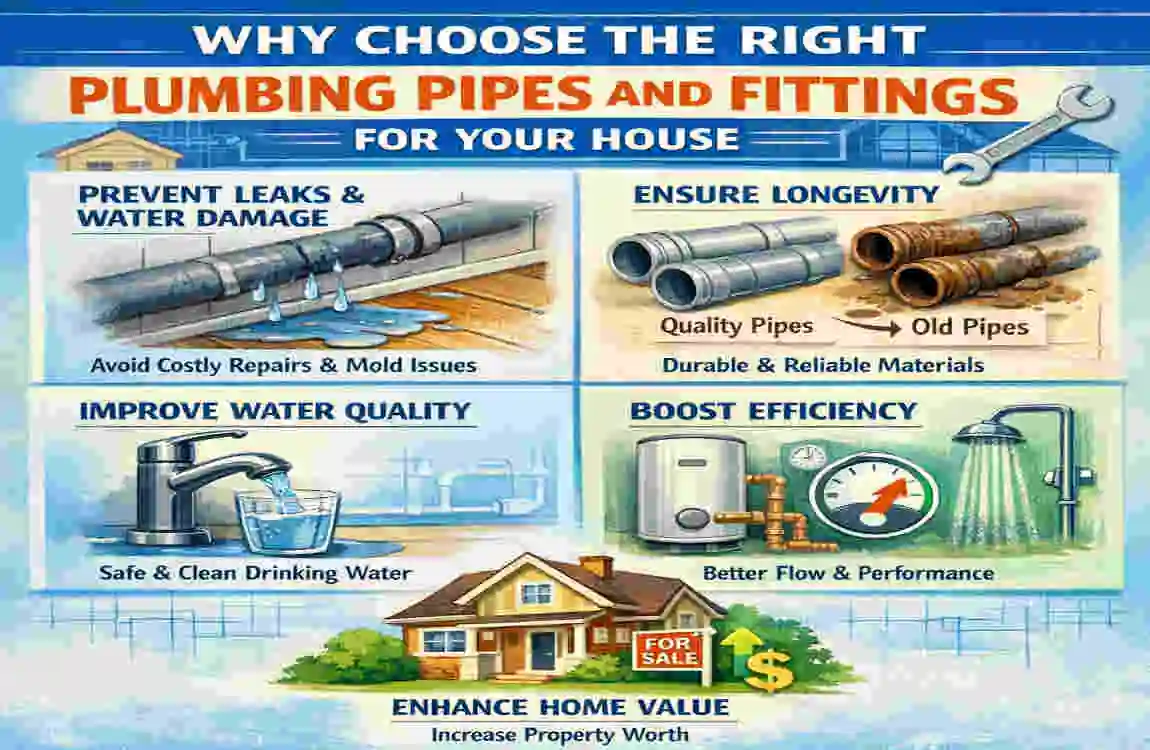
You might be wondering why you should care about the pipes hidden inside your walls. As long as the water turns on, everything is fine, right? Unfortunately, that is a risky way to view your home.
When you choose the right plumbing pipes and fittings for house construction or renovation, you are investing in the very lifeblood of your property. Let’s look at exactly why making an informed choice is so incredibly important for your peace of mind and your wallet.
The Hidden Benefits of Quality Materials
First and foremost, quality materials bring unmatched durability. When you use top-tier pipes, you are essentially building a system designed to outlive you. Modern materials resist rusting, do not break down easily, and can handle the daily pressure of running a busy household.
Furthermore, the right fittings provide a completely leak-proof seal. A tiny drip behind a wall might not seem like a big deal, but over time it can create hidden mould, rot your wood framing, and destroy your drywall. High-quality connections stop these slow leaks before they ever start.
Finally, do not underestimate the eco-friendliness and cost savings of a modern plumbing upgrade. Newer pipes have smoother insides, which means water flows through them with less friction. This allows your water heater to work less, saving you serious money on your monthly energy bills.
Common Issues with Poor Plumbing Choices
What happens if you ignore your plumbing or choose the absolute cheapest materials? You open your door to a world of expensive headaches.
Statistics show that roughly 40% of homes experience some form ofform of failure each year. These failures range from annoying slow drains to catastrophic burst pipes during the winter. When cheap metal pipes rust from the inside out, they flake off into your drinking water, causing massive clogs.
When poor-quality fittings crack under pressure, you end up paying for emergency plumbing services that can cost thousands of dollars. By investing in the essential plumbing pipes and fittings for house renovations now, you avoid these massive financial disasters later.
Exciting Home Plumbing Trends
The plumbing industry has changed dramatically in recent years. We are stepping away from heavy, rigid metals and moving toward highly flexible, intelligent materials.
For instance, flexible plastic tubing (known as PEX) has taken the home building world by storm because it bends around corners, requiring fewer cuts and connections. We are also seeing a massive rise in smart fittings. These high-tech connectors are equipped with tiny sensors that instantly alert your smartphone when they detect even a drop of moisture.
To help you navigate all these new options, we have put together a detailed buyer’s guide below. We will explore the absolute best materials available today.
Plumbing Pipes and Fittings for the House
Walking down the plumbing aisle at your local hardware store can feel totally overwhelming. You will see a rainbow of colored tubes, heavy metals, and confusing connectors.
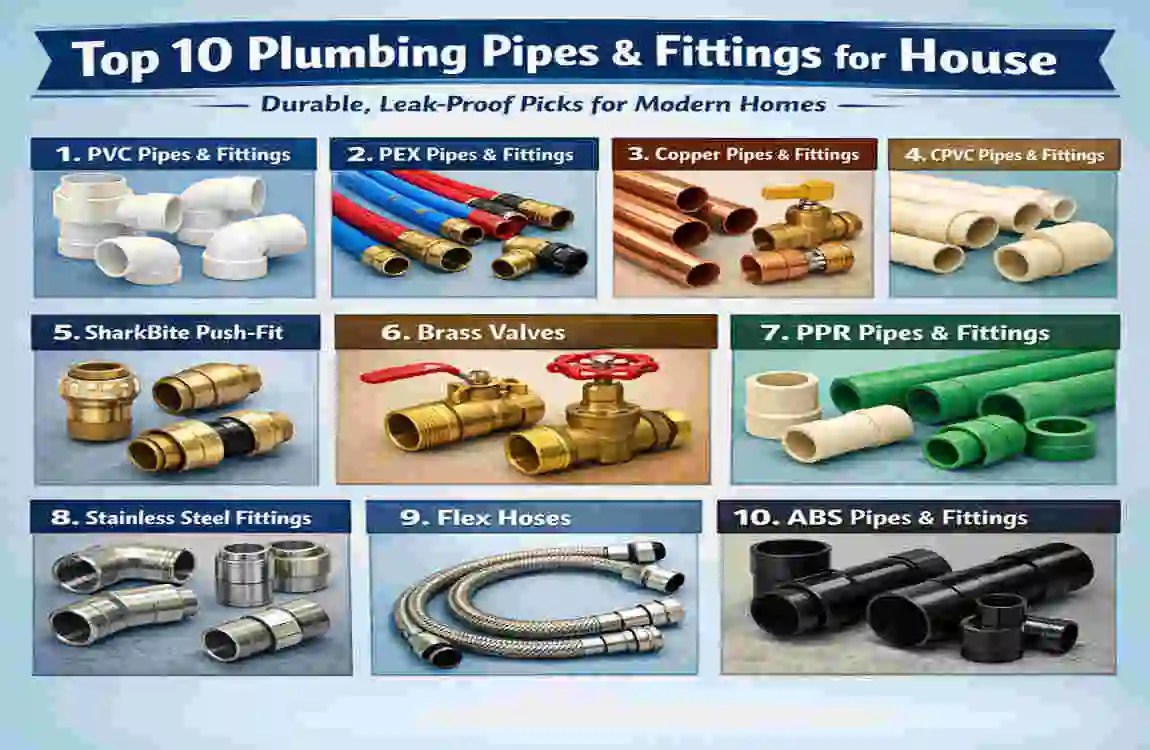
To make your life easier, we have ranked the top 10 plumbing pipes and fittings for household use. We will explain exactly what each item does, where it belongs in your home, and why it might be the perfect fit for your next project.
PEX Pipes – Flexible and Freeze-Resistant Leaders
If there is a modern superhero in the world of home plumbing, it is PEX. PEX stands for cross-linked polyethene, but you can think of it as incredibly strong, flexible plastic tubing.
PEX is currently the absolute best choice for running hot and cold drinking water lines throughout modern houses. Because it comes in long, flexible rolls, you can snake it through your walls almost like a heavy-duty extension cord. This flexibility means you do not have to cut the pipe and glue a joint every time you need to turn a corner. Fewer joints mean a much lower chance of future leaks.
If you live in a house in a cold climate, PEX is a lifesaver. Unlike rigid metals that snap when water freezes inside them, PEX can stretch and expand. While it is not completely freeze-proof, it resists bursting far better than older materials.
PVC Pipes – Budget-Friendly for Drainage
You have definitely seen PVC pipes before. They are the thick, rigid, bright white plastic tubes used in almost every home across the country. PVC stands for polyvinyl chloride, and it is the undisputed champion of draining water away from your house.
It is very important to note that standard PVC is ideal for non-potable house systems. This means you should not use it to carry your clean drinking water. Instead, PVC is designed to carry dirty wastewater away from your sinks, showers, and toilets. It is also used to vent sewer gases up and out through your roof.
PVC is incredibly lightweight, making it very easy for you to carry and install. It is also completely immune to rust. Because the inside of the pipe is perfectly smooth, hair and soap scum slide right through, which helps prevent nasty clogs.
CPVC Pipes – High-Temp Durability
Think of CPVC as the tougher, more heat-resistant sibling of regular PVC. The “C” in CPVC stands for chlorinated. Manufacturers add extra chlorine to the plastic during production, altering the material’s properties.
While standard white PVC softens and melts when you run boiling water through it, CPVC can withstand temperatures up to 200 degrees Fahrenheit. Because of its excellent hot-water performance, CPVC is widely used to carry clean, hot drinking water directly from your water heater to your bathroom and kitchen faucets.
CPVC usually comes in a yellowish or cream colour, making it easy to tell apart from standard white PVC. It offers the budget-friendly benefits of plastic while ensuring your hot water lines remain strong and secure.
Copper Pipes – Timeless Reliability
Before the invention of high-tech plastics, copper was the absolute gold standard for bringing drinking water into a home. Even today, it remains a Premium pick for homeowners who want timeless reliability and classic longevity.
When you see those shiny, penny-colored pipes in your basement, you are looking at a material that can easily last for 50 to 100 years. Copper is incredibly strong and naturally resists the growth of harmful bacteria, keeping your family’s drinking water exceptionally clean.
Unlike plastics, copper can safely be used outdoors because it does not break down under the sun’s UV rays. However, working with copper traditionally requires a blowtorch to melt metal solder around the joints, which requires a bit of skill.
ABS Pipes – Tough for Sewage Lines
ABS is very similar to PVC, but it is easily recognisable by its solid black colour. Like its white cousin, ABS is used exclusively for your home’s drainage, waste, and venting lines. You will never use this for drinking water.
Many builders prefer ABS for heavy-duty sewage lines, especially underground, because it is exceptionally tough. It handles extremely cold outdoor temperatures slightly better than PVC without becoming brittle or cracking.
Another great benefit for the DIY homeowner is how easy it is to install. While PVC requires a two-step glueing process (a purple primer, then the glue), ABS only requires a single swipe of special black cement to create a permanent, leak-proof bond.
Compression Fittings – Easy No-Solder Installs
Now that we have covered the pipes, let’s talk about how to connect them. Fittings are the critical pieces that hold your plumbing system together.
Compression fittings are brilliant little devices that focus on creating leak-proof house connections without any messy glues or dangerous blowtorches. You will usually find these under your kitchen sink or behind your toilet, connecting the water shut-off valves to the wall pipe.
They work through simple pressure. You slide a metal nut over your pipe, followed by a small brass ring. When you tighten the nut with a basic wrench, it literally squeezes (or compresses) the ring incredibly tight against the pipe. This squeezing action creates a perfect, watertight seal.
Push-Fit Fittings – DIY Homeowner Favourites
If you want the absolute easiest way to connect two pipes, push-fit fittings are your new best friend. These have completely revolutionised home repairs and are massive favourites among DIY homeowners.
With a push-fit connector, you literally push the end of your pipe into the fitting until it clicks. That is it! Inside the fitting, there is a ring of tiny metal teeth that bite down onto the pipe to hold it in place, along with a rubber O-ring that seals the water inside.
You do not need any tools, glue, or heat to use these. Even better, most push-fit fittings can connect two completely different types of pipes. For example, if you need to connect a new piece of PEX plastic to an old Copper pipe, a push-fit fitting does the job in 3 seconds.
Threaded Fittings – Versatile for Repairs
Threaded fittings are the rugged, heavy-duty connectors of the plumbing world. If you look closely at these metal or plastic fittings, you will see grooved spirals on the inside or outside—exactly like the grooves on the neck of a soda bottle.
You connect these by simply screwing the pipe into the fitting. These are commonly used for heavy iron gas lines, but they are also incredibly versatile for water repairs. For example, your outdoor garden hose spigot likely connects to your house using a threaded fitting.
To ensure a threaded fitting is totally leak-proof, you wrap a few layers of white Teflon plumbing tape around the threads before you screw them together. The tape fills in any microscopic gaps in the metal, keeping the water safely contained.
SharkBite Fittings – Quick, Tool-Free Solutions
You might hear plumbers talk about “SharkBites.” SharkBite is actually the most famous brand of push-fit fittings (which we talked about in number 7), and they are so popular that people use the name to describe the whole category!
SharkBite fittings deserve their own spot on this list because they are the ultimate emergency rescue tool. They are usually made of heavy, solid brass, making them incredibly durable.
If you accidentally drill a hole into a water pipe while hanging a picture frame, a SharkBite fitting is your quick, tool-free solution. You turn off the water, cut out the broken inch of pipe, and snap a SharkBite connector right into the gap. Your nightmare emergency is solved in less than five minutes without calling a costly repair service.
PPR Pipes and Fittings – Eco-Smart for Future Homes
Finally, let’s look at the future of plumbing pipes and fittings for house construction. PPR (Polypropylene Random Copolymer) is a highly trending, sustainable option that is taking the green building world by storm.
These are thick, rigid plastic pipes, usually green or white. What makes PPR so special is how the fittings connect. You do not use glue, threads, or metal teeth. Instead, you use a special heating tool that slightly melts the outside of the pipe and the inside of the fitting. You push them together, and as the plastic cools, they permanently fuse into a single, solid piece.
Because the pipe and fitting literally melt together, it is practically impossible for a PPR joint to leak. They are also incredibly eco-friendly, highly insulated to keep hot water hot, and completely safe for drinking.
Quick Material Comparison Table
To help you easily choose the best materials for your specific house project, here is a quick summary of everything we just covered.
Pipe/Fitting Type Best Used For Average Cost Durability Rating
PEX Pipe Flexible hot/cold water lines Low Excellent
PVC Pipe Drain and sewer lines Very Low Good
CPVC Pipe Rigid hot water lines Low Good
Copper Pipe Premium drinking water High Outstanding
ABS Pipe Heavy-duty drains Low Very Good
Compression Under-sink shut-off valves Medium Good
Push-Fit (General) Fast DIY connections High Very Good
Threaded Heavy metal connections Medium Excellent
SharkBite (Brass) Quick emergency repairs High Outstanding
PPR Pipe Eco-friendly home builds Medium Outstanding
How to install Plumbing Pipes and Fittings for a House: Step-by-Step Guide
So, you have picked out your materials. Now comes the fun part: putting it all together! Installing plumbing pipes and fittings for house projects might seem intimidating, but if you break it down into manageable steps, it is highly rewarding.
Let’s look at a basic, universal guide for cutting and connecting modern plastic pipes.
Your Basic Plumbing Tools Needed List
Before you start cutting into your walls, make sure you have these basic tools ready:
- A tape measure and a permanent marker.
- A ratcheting PVC/PEX pipe cutter (this looks like a pair of thick scissors and cuts plastic perfectly straight).
- A deburring tool (a small tool used to smooth out the rough edges of a cut pipe).
- Your chosen pipes and fittings.
- A dry towel to wipe away moisture.
Step-by-Step Installation
Measure and Mark Carefully. The old saying “measure twice, cut once” is the golden rule of plumbing. Measure the exact length of pipe you need to span the gap. Remember to account for the extra inch of pipe that will slide inside the fitting on both ends. Use your marker to draw a clear line on the pipe.
Make a Clean, Straight Cut. Place your ratcheting cutter over your mark. Squeeze the handle repeatedly until the blade slices cleanly through the plastic. Your cut must be perfectly straight (90 degrees). If you cut the pipe at an angle, it will not fully seat in the fitting, leading to a massive leak.
Clean and Deburr the Edges. After cutting, the inside of the pipe might have small plastic shavings hanging off it. Use your deburring tool (or light sandpaper) to smooth the inside and outside edges of the pipe. If you leave sharp plastic shavings on the pipe, they can slice the rubber seal inside your fittings!
Connect the Pieces. This step depends on your chosen fitting.
- If you are using Push-Fit, push the pipe firmly into the fitting until you feel it hit the back wall, then click it into place.
- If you are using PVC/ABS Glue, swab the primer and glue onto the outside of the pipe and the inside of the fitting, push them together, and hold them together firmly for 30 seconds while the chemical melts them.
Safety Tips and Common Mistakes to Avoid: Always turn off the main water valve at your home before starting any plumbing project! The most common mistake beginners make with threaded or compression fittings is over-tightening. You do not need the strength of a bodybuilder. Tighten the nut with a wrench until it feels snug, then give it one more quarter-turn. Over-tightening crushes the washers and actually causes the exact leak you are trying to prevent.
Maintenance Tips for Long-Lasting Plumbing Pipes and Fittings for the House
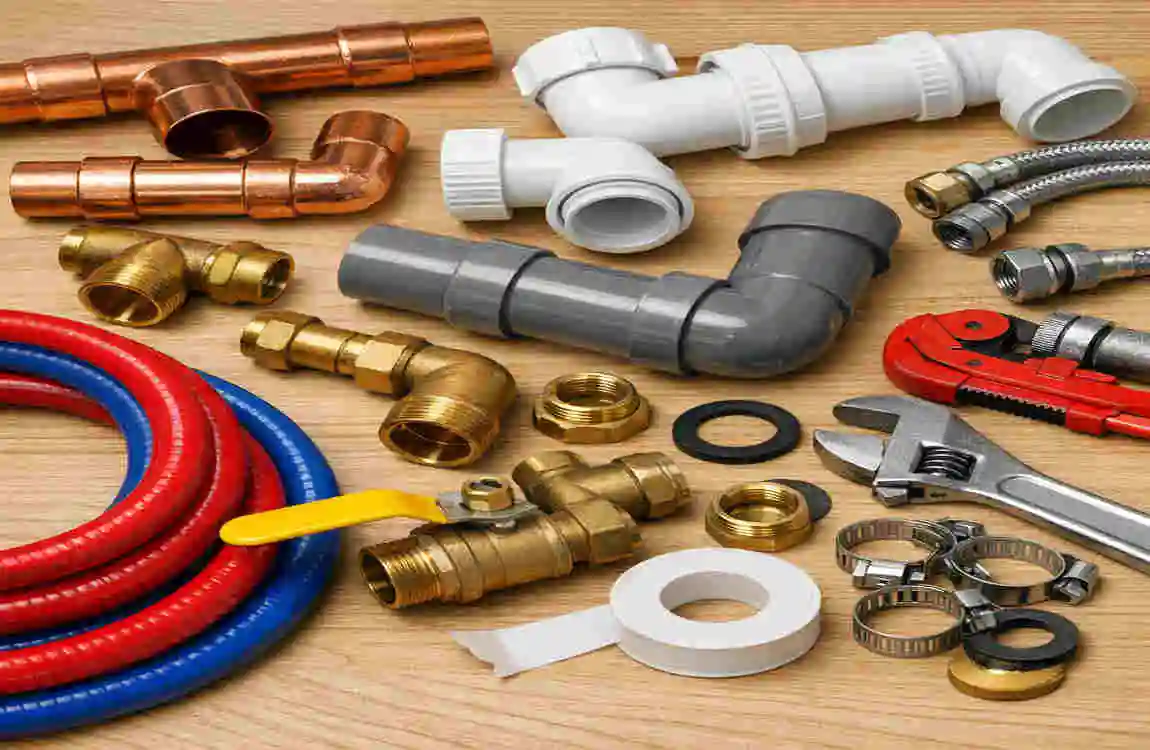
Installing great plumbing is only half the battle. To ensure your plumbing pipes and fittings for house use last for decades, you need to show them a little bit of ongoing love.
Taking care of your pipes is much easier than you think. By following a few simple habits, you can stop water damage in its tracks.
Essential Maintenance Habits
- Perform Annual Inspections: Pick one weekend each year as your plumbing checkup day. Grab a bright flashlight and look under every sink, behind your toilets, and around the base of your water heater. If you see any rust, water stains, or feel dampness, you have caught a tiny problem before it becomes a disaster.
- Take Winter Prep Seriously: When freezing weather approaches, disconnect all your outdoor garden hoses. Unhooking the hose allows the trapped water inside the pipe to drain out. If you leave the hose attached, the water freezes, expands, and splits the pipes inside your walls.
- Consider a Water Softener: If you live in an area with “hard water” (water rich in minerals like calcium), consider installing a water softener. Hard minerals build up in your pipes over time, reducing water pressure and eventually clogging the lines completely.
- Ditch the Harsh Chemicals: Never pour thick, toxic, liquid drain cleaners down your sinks to clear a clog. Those chemicals generate intense heat that can actually melt your PVC pipes and eat away at your metal fittings. Use a simple plastic drain snake or a plunger instead!
Signs of Failure and Quick Fixes
Pay attention to what your house is telling you. If your water pressure suddenly drops, or if you hear a loud “banging” noise inside the walls when you turn off a faucet (known as water hammer), your fittings might be failing.
If you spot a tiny pinhole leak on an exposed pipe in your basement, turn off the water and grab one of those SharkBite push-fit connectors we discussed earlier. Cut out the leaking inch, snap the fitting on, and your system is safely repaired until you can consult a professional for a larger checkup.
FAQs: Plumbing Pipes and Fittings for the House
To ensure you have all the information you need, we have gathered the most frequently asked questions from homeowners just like you regarding their home plumbing systems.
What are the best plumbing pipes and fittings for house use? For carrying clean drinking water, flexible PEX pipes combined with push-fit or crimp fittings are currently the top recommendation for modern homes. For draining dirty wastewater, a classic white PVC pipe is the best, most budget-friendly option.
PEX vs PVC for homes: Which is better? They actually serve completely different purposes! PEX is highly flexible and is used exclusively for pressurised drinking water (hot and cold). PVC is rigid, handles much larger volumes, and is used strictly for non-pressurised drainage and sewer lines. A healthy house uses both!
What is the average cost of upgrading house plumbing? The cost varies wildly depending on your home’s size. Small, localised repairs using push-fit fittings might cost only $50 in materials. However, completely repiping a standard 3-bedroom house with new PEX and modern fittings typically ranges between $2,000 and $5,000.
Are push-fit fittings truly leak-proof? Yes, when installed correctly! As long as the pipe is cut perfectly straight, deburred of sharp edges, and pushed all the way into the fitting, the internal O-ring creates a permanent, highly reliable, and leak-proof seal.
